
-
 Argentina
-
 Australia
-
 Austria
-
 Belgium
-
 Brazil
-
 Canada
-
 China
China
-
 Czech Republic
-
 Denmark
-
 Finland
-
 France
-
 Germany
-
 Greece
-
 Hong Kong
-
 Hungary
-
 Iceland
-
 India
India
-
 Ireland
-
 Israel
-
 Italy
Italy
-
 Japan
Japan
-
 Korea
Korea
-
 Luxembourg
-
 Malaysia
-
 Netherlands
-
 New Zealand
-
 Norway
-
 Poland
-
 Portugal
-
 Qatar
Qatar
-
 Romania
-
 Saudi Arabia
-
 Singapore
-
 Spain
Spain
-
 Sweden
-
 Switzerland
-
 Taiwan
-
 Turkey
-
 United Kingdom
-
 United States
research use only
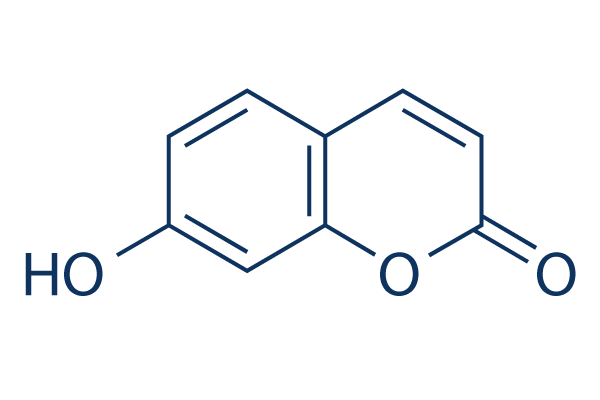
Umbelliferone Immunology & Inflammation related chemical
Cat.No.S3675
Quality Control
| Related Targets | PD-1/PD-L1 CXCR STING AhR CD markers Interleukins Anti-infection Antioxidant COX Histamine Receptor |
|---|---|
| Other Immunology & Inflammation related Inhibitors | Cl-amidine Bestatin (Ubenimex) Bindarit (AF 2838) Tempol Tranilast GI254023X (GI4023) Sinomenine Geniposidic acid CORM-3 Germacrone |
Solubility
|
In vitro |
DMSO
: 32 mg/mL
(197.36 mM)
Ethanol : 32 mg/mL Water : Insoluble |
Molarity Calculator
|
In vivo |
|||||
In vivo Formulation Calculator (Clear solution)
Step 1: Enter information below (Recommended: An additional animal making an allowance for loss during the experiment)
Step 2: Enter the in vivo formulation (This is only the calculator, not formulation. Please contact us first if there is no in vivo formulation at the solubility Section.)
Calculation results:
Working concentration: mg/ml;
Method for preparing DMSO master liquid: mg drug pre-dissolved in μL DMSO ( Master liquid concentration mg/mL, Please contact us first if the concentration exceeds the DMSO solubility of the batch of drug. )
Method for preparing in vivo formulation: Take μL DMSO master liquid, next addμL PEG300, mix and clarify, next addμL Tween 80, mix and clarify, next add μL ddH2O, mix and clarify.
Method for preparing in vivo formulation: Take μL DMSO master liquid, next add μL Corn oil, mix and clarify.
Note: 1. Please make sure the liquid is clear before adding the next solvent.
2. Be sure to add the solvent(s) in order. You must ensure that the solution obtained, in the previous addition, is a clear solution before proceeding to add the next solvent. Physical methods such
as vortex, ultrasound or hot water bath can be used to aid dissolving.
Chemical Information, Storage & Stability
| Molecular Weight | 162.14 | Formula | C9H6O3 |
Storage (From the date of receipt) | |
|---|---|---|---|---|---|
| CAS No. | 93-35-6 | Download SDF | Storage of Stock Solutions |
|
|
| Synonyms | 7-hydroxycoumarin, hydrangine, skimmetine, beta-umbelliferone | SMILES | C1=CC(=CC2=C1C=CC(=O)O2)O | ||
Read more about storage stability stock solution CAS number SMILES
Mechanism of Action
| In vitro |
Treatment of KB cells with Umbelliferone (UMB), prevents and reduces the cell proliferation with the IC50--200 μM as well as induces loss of cell viability, morphology change and internucleosomal DNA fragmentation in a concentration dependent manner. UMB induces apoptosis in KB cells in a dose dependent manner. UMB has the potential to increase oxidative DNA damage in KB cells through DNA tail formation significantly. UMB brings a dose-dependent elevation of reactive oxygen species (ROS), which is evidenced by the DCF fluorescence, alters the mitochondrial membrane potential in KB cells. UMB exhibits anticancer effect on KB cell line with the increased generation of intracellular ROS, triggers oxidative stress mediated depolarization of mitochondria, which contributes cell death via DNA damage as well as cell cycle arrest at G0/G1 phase. UMB protects alcoholic fatty liver, detoxify reactive aldehyde, radiation mediated cellular damage in human blood lymphocytes, immuno modulators and treat vascular lesions.
|
|---|---|
| In vivo |
Treatment with umbelliferone (60 and 90 mg/kg) causes a marked reduction of cellularity and eosinophil numbers in bronchoalveolar lavage fluids from asthmatic mice. In addition, a decrease in mucus production and lung inflammation are observed in mice treated with umbelliferone. A reduction of IL-4, IL-5, and IL-13, but not of IFN-γ, is found in bronchoalveolar lavage fluids of mice treated with umbelliferone. umbelliferone attenuates airway inflammation in a murine model of asthma. Dietary administration of umbelliferone and esculetin significantly attenuates MPTP-induced neurotoxicity in the substantia nigra pars compacta but not striatum, as measured by tyrosine hydroxylase staining. Umbelliferone also prevents MPTP-dependent caspase 3 activation, an indicator of apoptosis, but does not inhibit monoamine oxidase activity.
|
References |
|
Tech Support
Tel: +1-832-582-8158 Ext:3
If you have any other enquiries, please leave a message.

Products are for research use only. Not for human use. We do not sell to patients.
©Copyright 2013 Selleck Chemicals. All Rights Reserved.