
-
 Argentina
-
 Australia
-
 Austria
-
 Belgium
-
 Brazil
-
 Canada
-
 China
China
-
 Czech Republic
-
 Denmark
-
 Finland
-
 France
-
 Germany
-
 Greece
-
 Hong Kong
-
 Hungary
-
 Iceland
-
 India
India
-
 Ireland
-
 Israel
-
 Italy
Italy
-
 Japan
Japan
-
 Korea
Korea
-
 Luxembourg
-
 Malaysia
-
 Netherlands
-
 New Zealand
-
 Norway
-
 Poland
-
 Portugal
-
 Qatar
Qatar
-
 Romania
-
 Saudi Arabia
-
 Singapore
-
 Spain
Spain
-
 Sweden
-
 Switzerland
-
 Taiwan
-
 Turkey
-
 United Kingdom
-
 United States
research use only
PF-573228 FAK inhibitor
Cat.No.S2013
Quality Control
| Related Targets | EGFR VEGFR JAK FGFR PDGFR Src HIF FLT3 HER2 FLT |
|---|---|
| Other FAK Inhibitors | Defactinib (VS-6063) PF-562271 (VS-6062) VS-4718 (PND-1186) PF-562271 HCl PF-562271 Besylate TAE226 (NVP-TAE226) GSK2256098 PF-431396 Y15 Ifebemtinib (IN10018, BI-853520) |
Cell Culture, Treatment & Working Concentration
| Cell Lines | Assay Type | Concentration | Incubation Time | Formulation | Activity Description | PMID |
|---|---|---|---|---|---|---|
| A431 | Kinase assay | ~10 μM | DMSO | inhibits FAK phosphorylation with IC50 of 11 nM | 17395594 | |
| REF52 | Kinase assay | ~10 μM | DMSO | inhibits the phosphorylation of FAK Tyr397 with IC50 of ~100 nM | 17395594 | |
| PC3 | Kinase assay | ~10 μM | DMSO | inhibits the phosphorylation of FAK Tyr397 with IC50 of 100 nM | 17395594 | |
| SKOV-3 | Kinase assay | ~10 μM | DMSO | inhibits the phosphorylation of FAK Tyr397 with IC50 of 50 nM | 17395594 | |
| L3.6p1 | Kinase assay | ~10 μM | DMSO | inhibits the phosphorylation of FAK Tyr397 with IC50 of 300 nM | 17395594 | |
| F-G | Kinase assay | ~10 μM | DMSO | inhibits the phosphorylation of FAK Tyr397 with IC50 of 30 nM | 17395594 | |
| MDCK | Kinase assay | ~10 μM | DMSO | inhibits the phosphorylation of FAK Tyr397 with IC50 of 500 nM | 17395594 | |
| PC3 | Growth inhibitory assay | 10 μM | DMSO | significantly inhibits cell growth. | 17395594 | |
| REF52 | Growth inhibitory assay | 10 μM | DMSO | significantly inhibits cell growth. | 17395594 | |
| MDCK | Apoptosis assay | 10 μM | DMSO | induces apoptosis | 17395594 | |
| REF52 | Apoptosis assay | 10 μM | DMSO | induces apoptosis | 17395594 | |
| REF52 | Function assay | 10 μM | DMSO | blocks serum and FN-stimulated migration | 17395594 | |
| platelet | Function assay | 1 μM | DMSO | inhibits platelet aggregation and spreading | 19716803 | |
| platelet | Function assay | 1 μM | DMSO | leads to inhibition of PAK and AKT | 19716803 | |
| platelet | Function assay | 1 μM | DMSO | blocks calcium mobilization and dense granule secretion | 19716803 | |
| 4T1 | Function assay | DMSO | abolishes the interaction between β3 integrin and TβR-II | 19740433 | ||
| MCF7 | Kinase assay | ~10 μM | DMSO | inhibits the phosphorylation of FAK Tyr397 with IC50 of 430 nM | 20354780 | |
| TamR | Kinase assay | ~10 μM | DMSO | inhibits the phosphorylation of FAK Tyr397 with IC50 of 50 nM | 20354780 | |
| FasR | Kinase assay | ~10 μM | DMSO | inhibits the phosphorylation of FAK Tyr397 with IC50 of 130 nM | 20354780 | |
| TamR | Function assay | 1 μM | DMSO | inhibits cell migration | 20354780 | |
| FasR | Function assay | 1 μM | DMSO | inhibits cell migration | 20354780 | |
| endothelial cell | Kinase assay | 40 nM | DMSO | inhibits H2O2-induced phosphorylation of FAK | 21212402 | |
| endothelial cell | Function assay | 40 nM | DMSO | inhibits H2O2-induced stress fiber formation | 21212402 | |
| endothelial cell | Apoptosis assay | 40 nM | DMSO | inhibits apoptosis | 21212402 | |
| GH3 | Function assay | 3 μM | DMSO | increases IK(Ca) amplitude | 21925512 | |
| GH3 | Function assay | 3 μM | DMSO | enhances BKCa-channel activity | 21925512 | |
| HUVEC | cytotoxicity assay | ~10 μM | DMSO | impairs endothelial cell viability | 22075057 | |
| HUVEC | Kinase assay | 5 μM | DMSO | inhibits FAK kinase activity | 22075057 | |
| HUVEC | Function assay | 5 μM | DMSO | induces cell cycle arrest | 22075057 | |
| HUVEC | Apoptosis assay | 5 μM | DMSO | induces apoptosis | 22075057 | |
| HUVEC | Function assay | 5 μM | DMSO | impedes endothelial cell migration and alters the cellular actin cytoskeleton | 22075057 | |
| HUVEC | Function assay | 5 μM | DMSO | blocks HUVEC sprouting on collagen I gels | 22075057 | |
| human peripheral blood T cells | Kinase assay | ~10 μM | DMSO | inhibits site-specific phosphorylation of FAK | 23928188 | |
| human peripheral blood T cells | Function assay | ~10 μM | DMSO | impairs TCR-induced T cell morphological changes and alters activity of RhoA | 23928188 | |
| human peripheral blood T cells | Function assay | ~10 μM | DMSO | inhibits phosphorylation of ZAP-70 and LAT | 23928188 | |
| human peripheral blood T cells | Function assay | ~10 μM | DMSO | impairs Antigen-dependent T cell conjugation | 23928188 | |
| U-2 OS | qHTS assay | qHTS of pediatric cancer cell lines to identify multiple opportunities for drug repurposing: Primary screen for U-2 OS cells | 29435139 | |||
| A673 | qHTS assay | qHTS of pediatric cancer cell lines to identify multiple opportunities for drug repurposing: Primary screen for A673 cells | 29435139 | |||
| Saos-2 | qHTS assay | qHTS of pediatric cancer cell lines to identify multiple opportunities for drug repurposing: Primary screen for Saos-2 cells | 29435139 | |||
| BT-37 | qHTS assay | qHTS of pediatric cancer cell lines to identify multiple opportunities for drug repurposing: Primary screen for BT-37 cells | 29435139 | |||
| RD | qHTS assay | qHTS of pediatric cancer cell lines to identify multiple opportunities for drug repurposing: Primary screen for RD cells | 29435139 | |||
| SK-N-SH | qHTS assay | qHTS of pediatric cancer cell lines to identify multiple opportunities for drug repurposing: Primary screen for SK-N-SH cells | 29435139 | |||
| MG 63 (6-TG R) | qHTS assay | qHTS of pediatric cancer cell lines to identify multiple opportunities for drug repurposing: Primary screen for MG 63 (6-TG R) cells | 29435139 | |||
| NB1643 | qHTS assay | qHTS of pediatric cancer cell lines to identify multiple opportunities for drug repurposing: Primary screen for NB1643 cells | 29435139 | |||
| OHS-50 | qHTS assay | qHTS of pediatric cancer cell lines to identify multiple opportunities for drug repurposing: Primary screen for OHS-50 cells | 29435139 | |||
| SJ-GBM2 | qHTS assay | qHTS of pediatric cancer cell lines to identify multiple opportunities for drug repurposing: Primary screen for SJ-GBM2 cells | 29435139 | |||
| SK-N-MC | qHTS assay | qHTS of pediatric cancer cell lines to identify multiple opportunities for drug repurposing: Primary screen for SK-N-MC cells | 29435139 | |||
| NB-EBc1 | qHTS assay | qHTS of pediatric cancer cell lines to identify multiple opportunities for drug repurposing: Primary screen for NB-EBc1 cells | 29435139 | |||
| LAN-5 | qHTS assay | qHTS of pediatric cancer cell lines to identify multiple opportunities for drug repurposing: Primary screen for LAN-5 cells | 29435139 | |||
| Click to View More Cell Line Experimental Data | ||||||
Solubility
|
In vitro |
DMSO
: 26 mg/mL
(52.9 mM)
Water : Insoluble Ethanol : Insoluble |
Molarity Calculator
|
In vivo |
|||||
In vivo Formulation Calculator (Clear solution)
Step 1: Enter information below (Recommended: An additional animal making an allowance for loss during the experiment)
Step 2: Enter the in vivo formulation (This is only the calculator, not formulation. Please contact us first if there is no in vivo formulation at the solubility Section.)
Calculation results:
Working concentration: mg/ml;
Method for preparing DMSO master liquid: mg drug pre-dissolved in μL DMSO ( Master liquid concentration mg/mL, Please contact us first if the concentration exceeds the DMSO solubility of the batch of drug. )
Method for preparing in vivo formulation: Take μL DMSO master liquid, next addμL PEG300, mix and clarify, next addμL Tween 80, mix and clarify, next add μL ddH2O, mix and clarify.
Method for preparing in vivo formulation: Take μL DMSO master liquid, next add μL Corn oil, mix and clarify.
Note: 1. Please make sure the liquid is clear before adding the next solvent.
2. Be sure to add the solvent(s) in order. You must ensure that the solution obtained, in the previous addition, is a clear solution before proceeding to add the next solvent. Physical methods such
as vortex, ultrasound or hot water bath can be used to aid dissolving.
Chemical Information, Storage & Stability
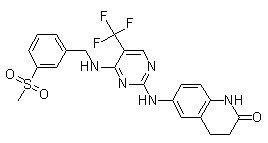
| Molecular Weight | 491.49 | Formula | C22H20F3N5O3S |
Storage (From the date of receipt) | |
|---|---|---|---|---|---|
| CAS No. | 869288-64-2 | Download SDF | Storage of Stock Solutions |
|
|
| Synonyms | N/A | SMILES | CS(=O)(=O)C1=CC=CC(=C1)CNC2=NC(=NC=C2C(F)(F)F)NC3=CC4=C(C=C3)NC(=O)CC4 | ||
Read more about storage stability stock solution CAS number SMILES
Mechanism of Action
| Targets/IC50/Ki |
FAK
(Cell-free assay) 4 nM
|
|---|---|
| In vitro |
PF 573228 blocks the phosphorylation of FAK Tyr397 in REF52 cells, PC3 cells, SKOV-3 cells, L3.6p1 and F-G, MDCK cells with IC50 of 30-500 nM. However, this compound (1 μM) with 80% inhibition of FAK phosphorylation fails to inhibit cell growth or apoptosis. Similar treatment of cells with this chemical resulted in inhibition of serum or FN-directed migration and decreased focal adhesion turnover.
|
| Kinase Assay |
Affinity determination
|
|
Purified activated FAK kinase domain (amino acids 410–689) is reacted with 50 μM ATP, and 10 μg/well of a random peptide polymer of Glu and Tyr (molar ratio of 4:1), poly(Glu/Tyr) in kinase buffer (50 mM HEPES, pH 7.5, 125 mM NaCl, 48 mM MgCl2) for 15 min. Phosphorylation of poly(Glu/Tyr) is challenged with serially diluted compounds at 1/2-Log concentrations starting at a top concentration of 1 μM. Each concentration is run in triplicate. Phosphorylation of poly(Glu/Tyr) is detected with a general anti-phospho-tyrosine (PY20) antibody, followed by horseradish peroxidase-conjugated goat anti-mouse IgG antibody. The standard horseradish peroxidase substrate 3, 3
|
|
| In vivo |
Inhibition of FAK by PF-573,228 in Ctrl-MT mice leads to a significant suppression of mammary tumorigenesis as well as lung metastasis. In contrast, treatment of MFCKO-MT mice with this compound did not affect the initiation of mammary tumors in these mice, as would be expected due to the absence of FAK in mammary epithelial cells of these mice .
|
References |
|
Applications
| Methods | Biomarkers | Images | PMID |
|---|---|---|---|
| Western blot | cyclin B1 p-FAK / FAK Lamin A / Lamin C |

|
30761269 |
| Immunofluorescence | FAK / F-actin Emerin |
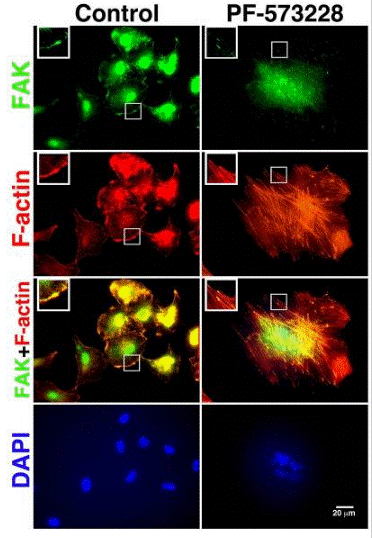
|
30761269 |
| Growth inhibition assay | Cell viability |
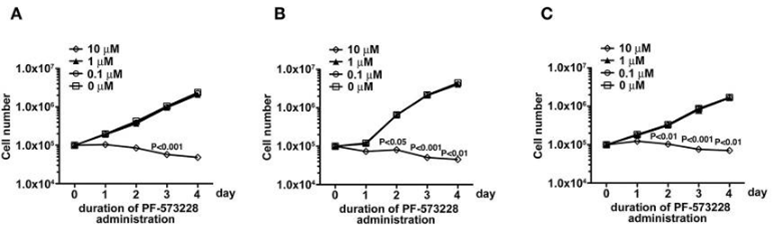
|
30761269 |
Tech Support
Tel: +1-832-582-8158 Ext:3
If you have any other enquiries, please leave a message.
Frequently Asked Questions
Question 1:
Would you please let me know the detail of how to dissolve it for in vivo study (oral administration)? This compound is referred to as Catalog No.S2013.
Answer:
A suspension of this compound in 30% PEG400+0.5% Tween80+ 5% Propylene glycol at 30mg/ml is fine for oral gavage.
Signaling Pathway Map

Products are for research use only. Not for human use. We do not sell to patients.
©Copyright 2013 Selleck Chemicals. All Rights Reserved.