
-
 Argentina
-
 Australia
-
 Austria
-
 Belgium
-
 Brazil
-
 Canada
-
 China
China
-
 Czech Republic
-
 Denmark
-
 Finland
-
 France
-
 Germany
-
 Greece
-
 Hong Kong
-
 Hungary
-
 Iceland
-
 India
India
-
 Ireland
-
 Israel
-
 Italy
Italy
-
 Japan
Japan
-
 Korea
Korea
-
 Luxembourg
-
 Malaysia
-
 Netherlands
-
 New Zealand
-
 Norway
-
 Poland
-
 Portugal
-
 Qatar
Qatar
-
 Romania
-
 Saudi Arabia
-
 Singapore
-
 Spain
Spain
-
 Sweden
-
 Switzerland
-
 Taiwan
-
 Turkey
-
 United Kingdom
-
 United States
research use only
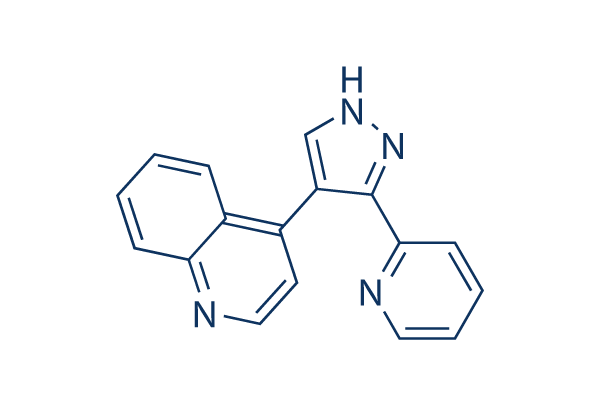
LY364947 TGF-beta/Smad inhibitor
Cat.No.S2805
Quality Control
| Related Targets | PKC ROCK Bcr-Abl |
|---|---|
| Other TGF-beta/Smad Inhibitors | SB431542 RepSox (E-616452) Vactosertib (TEW-7197) LDN-193189 A-83-01 LDN-193189 Dihydrochloride Galunisertib (LY2157299) SRI-011381 (C381) LY2109761 SIS3 Hydrochloride |
Cell Culture, Treatment & Working Concentration
| Cell Lines | Assay Type | Concentration | Incubation Time | Formulation | Activity Description | PMID |
|---|---|---|---|---|---|---|
| mink Mv1Lu lung cells | Function assay | Inhibition of TGFbeta R1 induced transcriptional activation of p3TP-Lux in mink Mv1Lu lung cells, IC50=0.04 μM | ||||
| Sf9 cells | Function assay | Inhibition of human Transforming growth factor (TGF) beta-1 receptor (T204D mutation) autophosphorylation in Sf9 cells, IC50=0.051 μM | ||||
| Sf9 cells | Function assay | Inhibition of recombinant human TGFbeta R1 expressed in Sf9 cells, IC50=0.059 μM | ||||
| HepG2 cells | Function assay | Inhibition of TGF-beta-induced expression of PAI-luciferase reporter in HepG2 cells, IC50=0.06 μM | ||||
| NIH3T3 cells | Function assay | Inhibitory activity against TGF-beta-stimulated proliferation in NIH3T3 cells, IC50=0.081 μM | ||||
| Sf9 cells | Function assay | Inhibition of recombinant human TGFbeta R2 expressed in Sf9 cells, IC50=0.4 μM | ||||
| Click to View More Cell Line Experimental Data | ||||||
Solubility
|
In vitro |
DMSO
: 4 mg/mL
(14.68 mM)
Water : Insoluble Ethanol : Insoluble |
Molarity Calculator
|
In vivo |
|||||
In vivo Formulation Calculator (Clear solution)
Step 1: Enter information below (Recommended: An additional animal making an allowance for loss during the experiment)
Step 2: Enter the in vivo formulation (This is only the calculator, not formulation. Please contact us first if there is no in vivo formulation at the solubility Section.)
Calculation results:
Working concentration: mg/ml;
Method for preparing DMSO master liquid: mg drug pre-dissolved in μL DMSO ( Master liquid concentration mg/mL, Please contact us first if the concentration exceeds the DMSO solubility of the batch of drug. )
Method for preparing in vivo formulation: Take μL DMSO master liquid, next addμL PEG300, mix and clarify, next addμL Tween 80, mix and clarify, next add μL ddH2O, mix and clarify.
Method for preparing in vivo formulation: Take μL DMSO master liquid, next add μL Corn oil, mix and clarify.
Note: 1. Please make sure the liquid is clear before adding the next solvent.
2. Be sure to add the solvent(s) in order. You must ensure that the solution obtained, in the previous addition, is a clear solution before proceeding to add the next solvent. Physical methods such
as vortex, ultrasound or hot water bath can be used to aid dissolving.
Chemical Information, Storage & Stability
| Molecular Weight | 272.3 | Formula | C17H12N4 |
Storage (From the date of receipt) | |
|---|---|---|---|---|---|
| CAS No. | 396129-53-6 | Download SDF | Storage of Stock Solutions |
|
|
| Synonyms | HTS 466284 | SMILES | C1=CC=C2C(=C1)C(=CC=N2)C3=C(NN=C3)C4=CC=CC=N4 | ||
Read more about storage stability stock solution CAS number SMILES
Mechanism of Action
| Targets/IC50/Ki |
TGFβRI
(Cell-free assay) 59 nM
RIPK2
(Cell-free assay) 0.11 μM
CK1δ
(Cell-free assay) 0.22 μM
TGFβRII
(Cell-free assay) 0.4 μM
MLK-7K
(Cell-free assay) 1.4 μM
|
|---|---|
| In vitro |
LY364947 is an ATP competitive and tight-binding inhibitor, inhibiting phosphorylation of P-Smad3 by TGFβR-I kinase with Ki of 28 nM. This compound inhibits in vivo Smad2 phosphorylation within the NMuMg cells with IC50 of 135 nM. It reverses TGF-β-mediated growth inhibition in NMuMg cells with IC50 of 0.218 μM. This chemical potentiates the xVent2-lux BMP4 response in NMuMg cells by 30% at concentrations as low as 0.25 μM. It (2 μM) prevents TGF-β-induced epithelial−mesenchymal transition in NMuMg cells. This compound (3 μM) induces expression of Prox1 and LYVE-1 in almost all HDLECs after 24 hours. It promotes nuclear export of Foxo3a, with low Smad2/3 and high Akt phosphorylation levels in leukaemia-initiating cells. This chemical (< 20 μM) suppresses leukaemia-initiating cells colony-forming ability after co-culture with OP-9 stromal cells.
|
| Kinase Assay |
Filter-binding assay
|
|
The IC50 of LY364947 at different enzyme concentrations are determined by the filter-binding assay. Typically, 40 μL reactions in 50 mM HEPES at pH 7.5, 1 mM NaF, 200 μM pKSmad3(−3), and 50 mM ATP containing a titration of each inhibitor with concentrations of 1600, 800, 400, 200, 100, 50, 25, and 0 nM are incubated at 30 °C for 30 min. The IC50 is calculated using a nonlinear regression method with GraphPad Prism software. The binding type is determined by plotting the correlation between enzyme concentrations and IC50 values.
|
|
| In vivo |
LY364947 (1 mg/kg i.p.) accelerates lymphangiogenesis, as evidence by significantly increased the LYVE-1-positive areas, in a mouse model of chronic peritonitis. This compound significantly increases the LYVE-1-positive areas in tumor tissues in tumor xenograft models using BxPC3 pancreatic adenocarcinoma cells. This chemical increases p-Akt and decreases nuclear Foxo3a in leukaemia-initiating cells in CML-affected mice.
|
References |
|
Applications
| Methods | Biomarkers | Images | PMID |
|---|---|---|---|
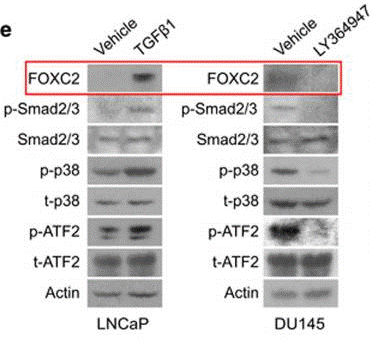
| Western blot | FOXC2 / p-Smad / Smad / p-p38 / p38 / p-ATF2 / ATF2 |
|
26804168 |
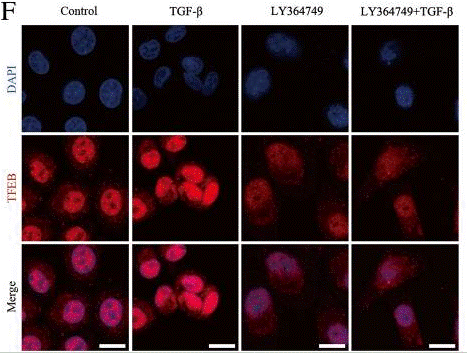
| Immunofluorescence | TEEB |
|
31387632 |
Tech Support
Tel: +1-832-582-8158 Ext:3
If you have any other enquiries, please leave a message.
Signaling Pathway Map

Products are for research use only. Not for human use. We do not sell to patients.
©Copyright 2013 Selleck Chemicals. All Rights Reserved.