
-
 Argentina
-
 Australia
-
 Austria
-
 Belgium
-
 Brazil
-
 Canada
-
 China
China
-
 Czech Republic
-
 Denmark
-
 Finland
-
 France
-
 Germany
-
 Greece
-
 Hong Kong
-
 Hungary
-
 Iceland
-
 India
India
-
 Ireland
-
 Israel
-
 Italy
Italy
-
 Japan
Japan
-
 Korea
Korea
-
 Luxembourg
-
 Malaysia
-
 Netherlands
-
 New Zealand
-
 Norway
-
 Poland
-
 Portugal
-
 Qatar
Qatar
-
 Romania
-
 Saudi Arabia
-
 Singapore
-
 Spain
Spain
-
 Sweden
-
 Switzerland
-
 Taiwan
-
 Turkey
-
 United Kingdom
-
 United States
research use only
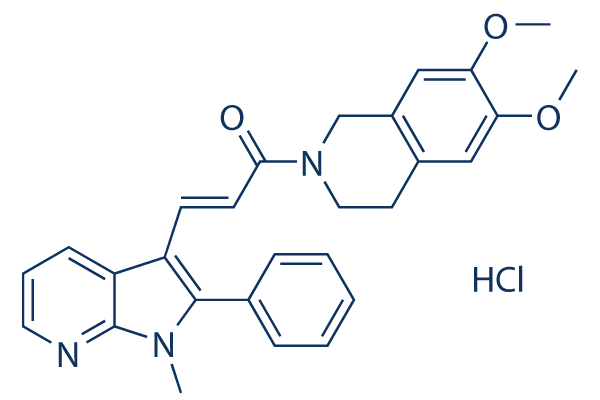
SIS3 Hydrochloride Smad3 Inhibitor
Cat.No.S7959
Quality Control
| Related Targets | PKC ROCK Bcr-Abl |
|---|---|
| Other TGF-beta/Smad Inhibitors | SB431542 RepSox (E-616452) Vactosertib (TEW-7197) LDN-193189 A-83-01 LDN-193189 Dihydrochloride Galunisertib (LY2157299) SRI-011381 (C381) LY2109761 SB-525334 |
Cell Culture, Treatment & Working Concentration
| Cell Lines | Assay Type | Concentration | Incubation Time | Formulation | Activity Description | PMID |
|---|---|---|---|---|---|---|
| HK-2 cell | Cell viability assay | 5 μM | 1 h | Treatment with SIS3 suppressed cadmium-induced HK-2 cell death. | 30804470 | |
| A549 cells | Function assay | 3 μM | The cells in the SIS3 group displayed a spindle-shaped elongated fibroblast-like morphology. | 29207055 | ||
| AML12 cell line | Function assay | 10 μM | 30 mins | SIS3 blocks TGF-β-mediated phosphorylation of SMAD3 and the total SMAD2/3 levels are unchanged. | 27462075 | |
| A549 cells | Function assay | 3 μM | 4 h | SIS3 significantly restored E-cadherin expression and impaired vimentin and Snail expression in the presence of TGF-β1. | 24573038 | |
| MCF-7 cells | Proliferation assay | 2.5 μM | concurrent treatment with SIS3 reduced the inhibitory effect of ellagic acid on the proliferation of MCF-7 breast cancer cells. | 24528038 | ||
| KB-8-5-11 cells | qHTS assay | P-glycoprotein substrates identified in KB-8-5-11 adenocarcinoma cell line, qHTS therapeutic library screen, Potency = 20.5962 μM. | 31515284 | |||
| Click to View More Cell Line Experimental Data | ||||||
Solubility
|
In vitro |
DMSO
: 98 mg/mL
(200.0 mM)
Water : Insoluble Ethanol : Insoluble |
Molarity Calculator
|
In vivo |
|||||
In vivo Formulation Calculator (Clear solution)
Step 1: Enter information below (Recommended: An additional animal making an allowance for loss during the experiment)
Step 2: Enter the in vivo formulation (This is only the calculator, not formulation. Please contact us first if there is no in vivo formulation at the solubility Section.)
Calculation results:
Working concentration: mg/ml;
Method for preparing DMSO master liquid: mg drug pre-dissolved in μL DMSO ( Master liquid concentration mg/mL, Please contact us first if the concentration exceeds the DMSO solubility of the batch of drug. )
Method for preparing in vivo formulation: Take μL DMSO master liquid, next addμL PEG300, mix and clarify, next addμL Tween 80, mix and clarify, next add μL ddH2O, mix and clarify.
Method for preparing in vivo formulation: Take μL DMSO master liquid, next add μL Corn oil, mix and clarify.
Note: 1. Please make sure the liquid is clear before adding the next solvent.
2. Be sure to add the solvent(s) in order. You must ensure that the solution obtained, in the previous addition, is a clear solution before proceeding to add the next solvent. Physical methods such
as vortex, ultrasound or hot water bath can be used to aid dissolving.
Chemical Information, Storage & Stability
| Molecular Weight | 489.99 | Formula | C28H27N3O3.HCl |
Storage (From the date of receipt) | |
|---|---|---|---|---|---|
| CAS No. | 521984-48-5 | Download SDF | Storage of Stock Solutions |
|
|
| Synonyms | N/A | SMILES | CN1C(=C(C2=C1N=CC=C2)C=CC(=O)N3CCC4=CC(=C(C=C4C3)OC)OC)C5=CC=CC=C5.Cl | ||
Read more about storage stability stock solution CAS number SMILES
Mechanism of Action
| Targets/IC50/Ki |
Smad3
|
|---|---|
| In vitro |
Addition of SIS3 attenuates the effects of TGF-β1 by reducing the transcriptional activity. SIS3 also inhibits the myofibroblast differentiation of fibroblasts by TGF-β1. SIS3 completely diminishes the constitutive phosphorylation of Smad3 as well as the up-regulated type I collagen expression in scleroderma fibroblasts, thus abolishes the ECM overexpression in the TGF-β1-treated normal dermal fibroblasts and scleroderma fibroblasts in vitro.
|
| In vivo |
SIS3 inhibits Smad3 activation in streptozotocin(STZ)-induced diabetic nephropathy in Tie2-Cre;Loxp-EGFP mice. It also reduces AGE-induced EndoMT and decreases EndoMT in STZ-induced diabetic nephropathy in Tie2-Cre;Loxp-EGFP mice. SIS3 significantly reduces collagen IV and fibronectin expression in the glomeruli and tubulointerstitium of STZ-injected Tie2-Cre;Loxp-EGFP mice, suggesting that SIS3 retards the early development of STZ-induced diabetic glomerulosclerosis and tubulointerstitial fibrosis. However, SIS3 administration does not reduce proteinuria.
|
References |
|
Applications
| Methods | Biomarkers | Images | PMID |
|---|---|---|---|
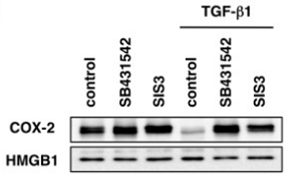
| Western blot | COX-2 / HMGB1 p-Smad3 / Smad3 / E-cadherin / Ck18 / Fibronectin / MMP9 |
|
24098479 |
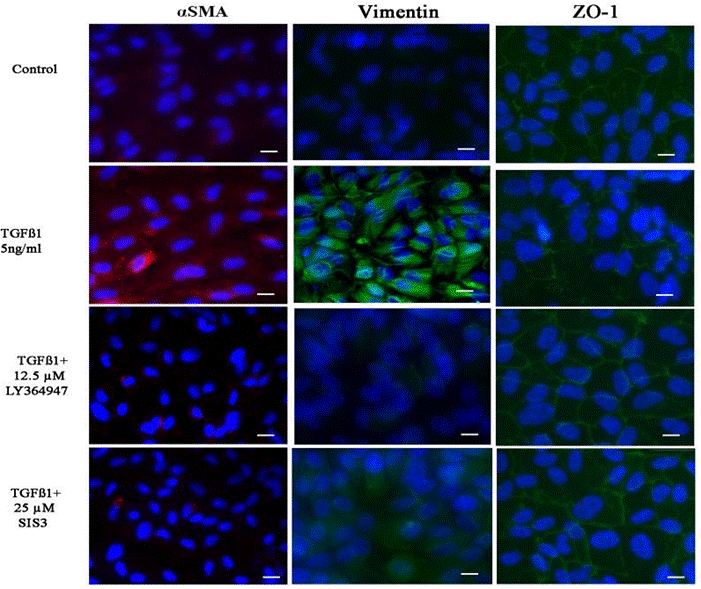
| Immunofluorescence | α-SMA / Vimentin KDEL / Fibronectin E-cadherin / α-SMA p-Smad3 |
|
25793924 |
Clinical Trial Information
(data from https://clinicaltrials.gov, updated on 2024-05-22)
| NCT Number | Recruitment | Conditions | Sponsor/Collaborators | Start Date | Phases |
|---|---|---|---|---|---|
| NCT06096831 | Not yet recruiting | Stroke|Cerebrovascular Disorders|Cerebrovascular Accident|Healthcare Utilization |
University of Haifa|Ben-Gurion University of the Negev|Clalit Health Services|Carmel Medical Center |
2023-11-15 | -- |
| NCT05816811 | Recruiting | Stroke |
McMaster University |
2023-08-01 | Not Applicable |
Read more about Clinical Trials
Tech Support
Tel: +1-832-582-8158 Ext:3
If you have any other enquiries, please leave a message.
Signaling Pathway Map

Products are for research use only. Not for human use. We do not sell to patients.
©Copyright 2013 Selleck Chemicals. All Rights Reserved.