
-
 Argentina
-
 Australia
-
 Austria
-
 Belgium
-
 Brazil
-
 Canada
-
 China
China
-
 Czech Republic
-
 Denmark
-
 Finland
-
 France
-
 Germany
-
 Greece
-
 Hong Kong
-
 Hungary
-
 Iceland
-
 India
India
-
 Ireland
-
 Israel
-
 Italy
Italy
-
 Japan
Japan
-
 Korea
Korea
-
 Luxembourg
-
 Malaysia
-
 Netherlands
-
 New Zealand
-
 Norway
-
 Poland
-
 Portugal
-
 Qatar
Qatar
-
 Romania
-
 Saudi Arabia
-
 Singapore
-
 Spain
Spain
-
 Sweden
-
 Switzerland
-
 Taiwan
-
 Turkey
-
 United Kingdom
-
 United States
research use only
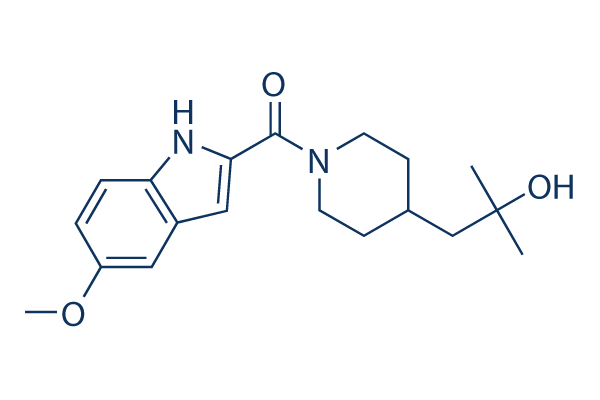
ASP-9521 Dehydrogenase inhibitor
Cat.No.S6749
Quality Control
Solubility
|
In vitro |
DMSO
: 66 mg/mL
(199.74 mM)
Ethanol : 66 mg/mL Water : Insoluble |
Molarity Calculator
|
In vivo |
|||||
In vivo Formulation Calculator (Clear solution)
Step 1: Enter information below (Recommended: An additional animal making an allowance for loss during the experiment)
Step 2: Enter the in vivo formulation (This is only the calculator, not formulation. Please contact us first if there is no in vivo formulation at the solubility Section.)
Calculation results:
Working concentration: mg/ml;
Method for preparing DMSO master liquid: mg drug pre-dissolved in μL DMSO ( Master liquid concentration mg/mL, Please contact us first if the concentration exceeds the DMSO solubility of the batch of drug. )
Method for preparing in vivo formulation: Take μL DMSO master liquid, next addμL PEG300, mix and clarify, next addμL Tween 80, mix and clarify, next add μL ddH2O, mix and clarify.
Method for preparing in vivo formulation: Take μL DMSO master liquid, next add μL Corn oil, mix and clarify.
Note: 1. Please make sure the liquid is clear before adding the next solvent.
2. Be sure to add the solvent(s) in order. You must ensure that the solution obtained, in the previous addition, is a clear solution before proceeding to add the next solvent. Physical methods such
as vortex, ultrasound or hot water bath can be used to aid dissolving.
Chemical Information, Storage & Stability
| Molecular Weight | 330.42 | Formula | C19H26N2O3 |
Storage (From the date of receipt) | 3 years -20°C powder |
|---|---|---|---|---|---|
| CAS No. | 1126084-37-4 | -- | Storage of Stock Solutions |
|
|
| Synonyms | N/A | SMILES | CC(C)(CC1CCN(CC1)C(=O)C2=CC3=C(N2)C=CC(=C3)OC)O | ||
Read more about storage stability stock solution CAS number SMILES
Mechanism of Action
| Targets/IC50/Ki |
17β-HSD5
|
|---|---|
| In vitro |
In vitro, ASP9521 inhibited the conversion of androstenedione into testosterone by recombinant human and cynomolgus monkey AKR1C3 in a concentration-dependent manner, with IC50 values of 11 and 49 nmol/L, respectively. In contrast, ASP9521 did not inhibit the conversion by rat and mouse homologues (AKR1C1 and AKR1C6, respectively) up to a concentration of 10 μmol/L. ASP9521 showed moderately high selectivity (>100-fold) for human AKR1C3 (IC50: 120 nmol/L) over the human isoform AKR1C2 (IC50: >20,000 nmol/L). |
| In vivo |
In murine models harbouring CWR22R xenograft tumours, single oral administration of ASP9521 suppressed AD-induced intratumoural testosterone production in a dose-dependent manner. This inhibitory effect was maintained for 24 h after single oral administration of ASP9521. Over this 24 h period, ASP9521 concentration rapidly decreased in plasma from 771.8 ng/mL (mean) to undetectable levels, while its intratumoural concentration reached its maximal level within 15 min after administration of ASP9521 and remained stable for 24 h. In nude mice bearing HEK293 tumours with or without AKR1C3 expression, after single oral administration of ASP9521, plasma concentrations of ASP9521 reached maximum values within 0.25 h (mean: 767.3 ng/mL and 648.2 ng/mL for HEK293 and HEK293-AKR1C3 cells, respectively), but decreased rapidly thereafter. Accumulation of ASP9521 in tumour tissue may depend on AKR1C3 expression. After single oral administration of 1 mg/kg ASP9521 to rats, dogs and monkeys, the drug was rapidly absorbed. The bioavailability values were 35 %, 78 %, and 58 %, respectively. After iv administration of ASP9521 to rats, dogs and monkeys, plasma concentrations of the drug declined with t1/2 values of 0.2, 1.7 and 5.8 h, respectively. |
References |
Clinical Trial Information
(data from https://clinicaltrials.gov, updated on 2014-03-24)
| NCT Number | Recruitment | Conditions | Sponsor/Collaborators | Start Date | Phases |
|---|---|---|---|---|---|
| NCT01352208 | TERMINATED | Castrate Resistant Prostate Cancer |
Astellas Pharma Inc |
2011-03 | PHASE1; PHASE2 |
Read more about Clinical Trials
Tech Support
Tel: +1-832-582-8158 Ext:3
If you have any other enquiries, please leave a message.
Signaling Pathway Map

Products are for research use only. Not for human use. We do not sell to patients.
©Copyright 2013 Selleck Chemicals. All Rights Reserved.