
-
 Argentina
-
 Australia
-
 Austria
-
 Belgium
-
 Brazil
-
 Canada
-
 China
China
-
 Czech Republic
-
 Denmark
-
 Finland
-
 France
-
 Germany
-
 Greece
-
 Hong Kong
-
 Hungary
-
 Iceland
-
 India
India
-
 Ireland
-
 Israel
-
 Italy
Italy
-
 Japan
Japan
-
 Korea
Korea
-
 Luxembourg
-
 Malaysia
-
 Netherlands
-
 New Zealand
-
 Norway
-
 Poland
-
 Portugal
-
 Qatar
Qatar
-
 Romania
-
 Saudi Arabia
-
 Singapore
-
 Spain
Spain
-
 Sweden
-
 Switzerland
-
 Taiwan
-
 Turkey
-
 United Kingdom
-
 United States
research use only
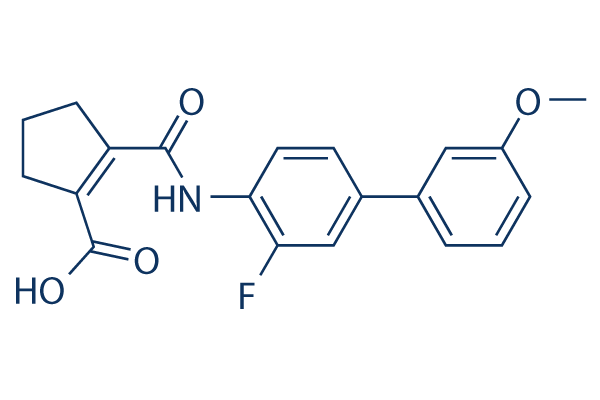
Vidofludimus Dehydrogenase inhibitor
Cat.No.S7262
Quality Control
Solubility
|
In vitro |
DMSO
: 100 mg/mL
(281.4 mM)
Ethanol : 1 mg/mL Water : Insoluble |
Molarity Calculator
|
In vivo |
|||||
In vivo Formulation Calculator (Clear solution)
Step 1: Enter information below (Recommended: An additional animal making an allowance for loss during the experiment)
Step 2: Enter the in vivo formulation (This is only the calculator, not formulation. Please contact us first if there is no in vivo formulation at the solubility Section.)
Calculation results:
Working concentration: mg/ml;
Method for preparing DMSO master liquid: mg drug pre-dissolved in μL DMSO ( Master liquid concentration mg/mL, Please contact us first if the concentration exceeds the DMSO solubility of the batch of drug. )
Method for preparing in vivo formulation: Take μL DMSO master liquid, next addμL PEG300, mix and clarify, next addμL Tween 80, mix and clarify, next add μL ddH2O, mix and clarify.
Method for preparing in vivo formulation: Take μL DMSO master liquid, next add μL Corn oil, mix and clarify.
Note: 1. Please make sure the liquid is clear before adding the next solvent.
2. Be sure to add the solvent(s) in order. You must ensure that the solution obtained, in the previous addition, is a clear solution before proceeding to add the next solvent. Physical methods such
as vortex, ultrasound or hot water bath can be used to aid dissolving.
Chemical Information, Storage & Stability
| Molecular Weight | 355.36 | Formula | C20H18FNO4 |
Storage (From the date of receipt) | |
|---|---|---|---|---|---|
| CAS No. | 717824-30-1 | Download SDF | Storage of Stock Solutions |
|
|
| Synonyms | SC12267, 4SC-101 | SMILES | COC1=CC=CC(=C1)C2=CC(=C(C=C2)NC(=O)C3=C(CCC3)C(=O)O)F | ||
Read more about storage stability stock solution CAS number SMILES
Mechanism of Action
| Targets/IC50/Ki |
Human DHODH
134 nM
|
|---|---|
| In vitro |
Vidofludimus causes a concentration dependent inhibition of phytohemagglutinin-stimulated PBMC proliferation via the inhibition of pyrimidine de novo synthesis. This compound attenuates IL-17 secretion from colonic strips by inhibition of STAT3 and NF-κB activation.
|
| Kinase Assay |
DHODH inhibition assay
|
|
In vitro DHODH inhibition assay mixture contains 50 μM decycloubiquinone, 100 μM dihydroorotate, and 60 μM 2,6-dichloroindophenol. The amount of enzyme is adjusted such that an average slope of approximately 0.2 AU/min will be achieved in the assay for the positive control (eg, without inhibitor). Measurements are conducted in 50 mM TrisHCl, 150 mM KCl, 0.1% Triton X-100, and pH 8.0 at 30°C in a final volume of 1 ml. The components are mixed, and the reaction is started by adding dihydroorotate. The reaction is followed spectrophotometrically by measuring the decrease in absorption at 600 nm for 2 minutes. The assay is linear in time and enzyme concentration. Inhibitory studies are conducted in a standard assay with additional variable amounts of this compound. For the determination of the IC50 values (concentration of inhibitor required for 50% inhibition), eight different inhibitor concentrations are applied. Each data point is recorded in triplicates on a single measurement day.
|
|
| In vivo |
In MRLlpr/lpr mice, Vidofludimus (300 mg/kg, p.o.) reduces systemic autoimmunity and improves Lupus Nephritis. In Rats, this compound (60 mg/kg, p.o.) effectively reduces macroscopic and histological pathology and the numbers of CD3+ T cells. In a rat model of renal transplantation, this chemical (20 mg/kg, p.o.) prolongs survival, paralleled by amelioration of histologic signs of acute rejection.
|
References |
|
Clinical Trial Information
(data from https://clinicaltrials.gov, updated on 2022-10-17)
| NCT Number | Recruitment | Conditions | Sponsor/Collaborators | Start Date | Phases |
|---|---|---|---|---|---|
| NCT03722576 | COMPLETED | Primary Sclerosing Cholangitis |
Elizabeth Carey |
2019-06-17 | PHASE2 |
| NCT00820365 | Completed | Inflammatory Bowel Disease (IBD) |
4SC AG |
2009-03 | Phase 2 |
Read more about Clinical Trials
Tech Support
Tel: +1-832-582-8158 Ext:3
If you have any other enquiries, please leave a message.
Signaling Pathway Map

Products are for research use only. Not for human use. We do not sell to patients.
©Copyright 2013 Selleck Chemicals. All Rights Reserved.