
-
 Argentina
-
 Australia
-
 Austria
-
 Belgium
-
 Brazil
-
 Canada
-
 China
China
-
 Czech Republic
-
 Denmark
-
 Finland
-
 France
-
 Germany
-
 Greece
-
 Hong Kong
-
 Hungary
-
 Iceland
-
 India
India
-
 Ireland
-
 Israel
-
 Italy
Italy
-
 Japan
Japan
-
 Korea
Korea
-
 Luxembourg
-
 Malaysia
-
 Netherlands
-
 New Zealand
-
 Norway
-
 Poland
-
 Portugal
-
 Qatar
Qatar
-
 Romania
-
 Saudi Arabia
-
 Singapore
-
 Spain
Spain
-
 Sweden
-
 Switzerland
-
 Taiwan
-
 Turkey
-
 United Kingdom
-
 United States
research use only
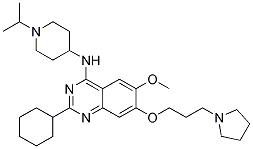
UNC0638 Histone Methyltransferase inhibitor
Cat.No.S8071
Quality Control
| Related Targets | HDAC JAK BET PKC PARP HIF PRMT EZH2 AMPK Histone Acetyltransferase |
|---|---|
| Other Histone Methyltransferase Inhibitors | Pinometostat (EPZ5676) 3-Deazaneplanocin A (DZNep) Hydrochloride BIX-01294 Trihydrochloride EPZ015666 (GSK3235025) UNC1999 EPZ004777 MM-102 (HMTase Inhibitor IX) Chaetocin SGC 0946 EPZ005687 |
Cell Culture, Treatment & Working Concentration
| Cell Lines | Assay Type | Concentration | Incubation Time | Formulation | Activity Description | PMID |
|---|---|---|---|---|---|---|
| 22Rv1 cells | Function assay | Inhibition of G9a in human 22Rv1 cells assessed as reduction of H3K9me2 after 48 hrs by In-Cell Western assay, IC50=0.048 μM | ||||
| PC3 cells | Function assay | Inhibition of G9a in human PC3 cells assessed as reduction of H3K9me2 after 48 hrs by In-Cell Western assay, IC50=0.059 μM | ||||
| MCF7 cells | Function assay | Inhibition of G9a in human MCF7 cells assessed as reduction of H3K9me2 after 48 hrs by In-Cell Western assay, IC50=0.07 μM | ||||
| MDA-MB-231 cells | Function assay | 48 h | Inhibition of G9a in human MDA-MB-231 cells after 48 hrs by clonogenic assay, IC50=0.081 μM | |||
| IMR90 cells | Function assay | Inhibition of G9a in human IMR90 cells assessed as reduction of H3K9me2 after 48 hrs by In-Cell Western assay, IC50=0.12 μM | ||||
| HCT116 cells | Function assay | Inhibition of G9a in human HCT116 cells assessed as reduction of H3K9me2 after 48 hrs by In-Cell Western assay, IC50=0.21 μM | ||||
| H1299 cells | Function assay | 0.25 uM | 24 h | Inhibition of G9a expressed in H1299 cells assessed as inhibition of dimethylation of p53 at lys 373 at 0.25 uM after 24 hrs by Western blot analysis | ||
| Click to View More Cell Line Experimental Data | ||||||
Solubility
|
In vitro |
DMSO
: 100 mg/mL
(196.18 mM)
Water : Insoluble Ethanol : Insoluble |
Molarity Calculator
|
In vivo |
|||||
In vivo Formulation Calculator (Clear solution)
Step 1: Enter information below (Recommended: An additional animal making an allowance for loss during the experiment)
Step 2: Enter the in vivo formulation (This is only the calculator, not formulation. Please contact us first if there is no in vivo formulation at the solubility Section.)
Calculation results:
Working concentration: mg/ml;
Method for preparing DMSO master liquid: mg drug pre-dissolved in μL DMSO ( Master liquid concentration mg/mL, Please contact us first if the concentration exceeds the DMSO solubility of the batch of drug. )
Method for preparing in vivo formulation: Take μL DMSO master liquid, next addμL PEG300, mix and clarify, next addμL Tween 80, mix and clarify, next add μL ddH2O, mix and clarify.
Method for preparing in vivo formulation: Take μL DMSO master liquid, next add μL Corn oil, mix and clarify.
Note: 1. Please make sure the liquid is clear before adding the next solvent.
2. Be sure to add the solvent(s) in order. You must ensure that the solution obtained, in the previous addition, is a clear solution before proceeding to add the next solvent. Physical methods such
as vortex, ultrasound or hot water bath can be used to aid dissolving.
Chemical Information, Storage & Stability
| Molecular Weight | 509.73 | Formula | C30H47N5O2 |
Storage (From the date of receipt) | |
|---|---|---|---|---|---|
| CAS No. | 1255580-76-7 | Download SDF | Storage of Stock Solutions |
|
|
Read more about storage stability stock solution CAS number SMILES
Mechanism of Action
| Targets/IC50/Ki |
G9a
(Cell-free assay) <15 nM
GLP
(Cell-free assay) 19 nM
|
|---|---|
| In vitro |
UNC0638 is a potent, selective and cell-penetrant chemical probe for G9a and GLP, with a toxicity/function ratio of >100, compared to <6 for BIX01294. This compound is a selectivite inhibitor of G9a and GLP over a wide range of epigenetic and non-epigenetic targets. It is more than 10,000-fold selective against SET7/9 (a H3K4 HMTase), SET8 (a H4K20 HMTase), PRMT3, and SUV39H2. In MDA-MB-231 cells, this chemical (48 h exposure) reduces H3K9me2 levels in a concentration-dependent manner with an IC50 of 81 nM. Its treatment of a variety of cell lines results in lower global H3K9me2 levels, equivalent to levels observed for small hairpin RNA knockdown of G9a and GLP with the functional potency of this compound being well separated from its toxicity. It markedly reduces the clonogenicity of MCF7 cells, reduces the abundance of H3K9me2 marks at promoters of known G9a-regulated endogenous genes and disproportionately affected several genomic loci encoding microRNAs. In mouse embryonic stem cells, this probe reactivates G9a-silenced genes and a retroviral reporter gene in a concentration-dependent manner without promoting differentiation.
|
| Kinase Assay |
SAHH-coupled assays
|
|
This assay utilizes SAHH to hydrolyze the methyltransfer product S-adenosylhomocysteine to homocysteine and adenosine in the presence of adenosine deaminase which converts adenosine to inosine. The homocysteine concentration is then determined through conjugation of its free sulfhydryl moiety to a thiol-sensitive fluorophore, ThioGlo. For IC50 determinations, assay mixtures are prepared in 25 mM Potassium Phosphate buffer pH 7.5, 1 mM EDTA, 2 mM MgCl2, 0.01% Triton X 100 with 5 μM SAHH , 0.3 U/mL of adenosine deaminase, 25 μM SAM, and 15 μM ThioGlo. G9a, EHMT1, SETD7, SETD8, PRMT3 and SUV39H2 are assayed at 25 nM, 100 nM, 200 nM, 250 nM, 1 μM and 100 nM, respectively. UNC0638 is added at concentrations ranging from 4 nM to 16 μM. After 2 min incubation, reactions are initiated by addition of the histone peptides: 10 μM H3(1-25) for G9a, 20 μM H3(1-25) for EHMT1, 100 μM H3(1-25) for SETD7, 500 μM H4(1-24) for SETD8, 10 μM H4(1-24) for PRMT3 and 200 μM H3K9Me1 (1-15) for SUV39H2. The methylation reaction is followed by monitoring the increase in fluorescence using Biotek Synergy2 plate reader with 360/40 nm excitation filter and 528/20 nm emission filter for 20 min in 384 well-plate format. Activity values are corrected by subtracting background caused by the peptide or the protein. IC50 values are calculated using Sigmaplot. Standard deviations are calculated from two independent experiments.
|
|
| In vivo |
In mouse drug metabolism and pharmacokinetic studies, UNC0638 had high clearance, short half-life, high volume distribution and low exposure after intravenous, oral or intraperitoneal administration. Thus, although this compound is probably not suitable for in vivo animal studies owing to low exposure levels, its high stability under cellular assay conditions, in combination with high potency and selectivity, makes it an ideal chemical tool for cell-based studies.
|
References |
Tech Support
Tel: +1-832-582-8158 Ext:3
If you have any other enquiries, please leave a message.
Signaling Pathway Map

Products are for research use only. Not for human use. We do not sell to patients.
©Copyright 2013 Selleck Chemicals. All Rights Reserved.