
-
 Argentina
-
 Australia
-
 Austria
-
 Belgium
-
 Brazil
-
 Canada
-
 China
China
-
 Czech Republic
-
 Denmark
-
 Finland
-
 France
-
 Germany
-
 Greece
-
 Hong Kong
-
 Hungary
-
 Iceland
-
 India
India
-
 Ireland
-
 Israel
-
 Italy
Italy
-
 Japan
Japan
-
 Korea
Korea
-
 Luxembourg
-
 Malaysia
-
 Netherlands
-
 New Zealand
-
 Norway
-
 Poland
-
 Portugal
-
 Qatar
Qatar
-
 Romania
-
 Saudi Arabia
-
 Singapore
-
 Spain
Spain
-
 Sweden
-
 Switzerland
-
 Taiwan
-
 Turkey
-
 United Kingdom
-
 United States
research use only
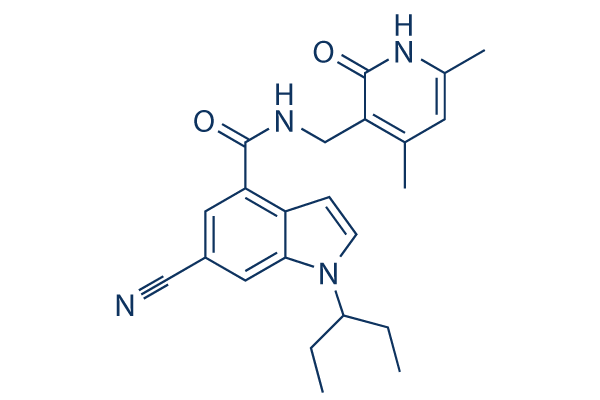
EI1 Histone Methyltransferase inhibitor
Cat.No.S7611
Quality Control
| Related Targets | HDAC JAK BET PKC PARP HIF PRMT EZH2 AMPK Histone Acetyltransferase |
|---|---|
| Other Histone Methyltransferase Inhibitors | Pinometostat (EPZ5676) 3-Deazaneplanocin A (DZNep) Hydrochloride BIX-01294 Trihydrochloride EPZ015666 (GSK3235025) UNC1999 EPZ004777 MM-102 (HMTase Inhibitor IX) Chaetocin SGC 0946 EPZ005687 |
Solubility
|
In vitro |
DMSO
: 42 mg/mL
(107.55 mM)
Water : Insoluble Ethanol : Insoluble |
Molarity Calculator
|
In vivo |
|||||
In vivo Formulation Calculator (Clear solution)
Step 1: Enter information below (Recommended: An additional animal making an allowance for loss during the experiment)
Step 2: Enter the in vivo formulation (This is only the calculator, not formulation. Please contact us first if there is no in vivo formulation at the solubility Section.)
Calculation results:
Working concentration: mg/ml;
Method for preparing DMSO master liquid: mg drug pre-dissolved in μL DMSO ( Master liquid concentration mg/mL, Please contact us first if the concentration exceeds the DMSO solubility of the batch of drug. )
Method for preparing in vivo formulation: Take μL DMSO master liquid, next addμL PEG300, mix and clarify, next addμL Tween 80, mix and clarify, next add μL ddH2O, mix and clarify.
Method for preparing in vivo formulation: Take μL DMSO master liquid, next add μL Corn oil, mix and clarify.
Note: 1. Please make sure the liquid is clear before adding the next solvent.
2. Be sure to add the solvent(s) in order. You must ensure that the solution obtained, in the previous addition, is a clear solution before proceeding to add the next solvent. Physical methods such
as vortex, ultrasound or hot water bath can be used to aid dissolving.
Chemical Information, Storage & Stability
| Molecular Weight | 390.48 | Formula | C23H26N4O2 |
Storage (From the date of receipt) | |
|---|---|---|---|---|---|
| CAS No. | 1418308-27-6 | Download SDF | Storage of Stock Solutions |
|
|
| Synonyms | KB-145943 | SMILES | CCC(CC)N1C=CC2=C(C=C(C=C21)C#N)C(=O)NCC3=C(C=C(NC3=O)C)C | ||
Read more about storage stability stock solution CAS number SMILES
Mechanism of Action
| Targets/IC50/Ki |
EZH2 (Y641F)
(Cell-free assay) 13 nM
Ezh2 (wild-type)
(Cell-free assay) 15 nM
|
|---|---|
| In vitro |
In DLBCL cells, EI1 inhibits cellular H3K27 methylation and activates Ezh2 target gene p16 expression. In mouse embryonic fibroblasts, this compound also inhibits H3K27me3 and cell proliferation. In addition, it selectively inhibits the growth of DLBCL cells carrying Ezh2 mutation, and causes cell cycle arrest and apoptosis.
|
| Kinase Assay |
Biochemical Assay
|
|
For IC50 determination, EI1 is serial diluted threefold in DMSO for a total of 12 concentrations, with the starting concentration at 1 μM. The reaction is incubated at room temperature for 120 min, and stopped by adding quench solution (2.5% TFA with 320 nM d4-SAH). SAH production is quantitated using an API 4000 triple quadrupole mass spectrometry with Turbulon Spray coupled with Prominence UFLC. The percentage of inhibition is normalized using positive (no inhibitor) and negative (no enzyme) controls, and IC50 calculated using PRISM. Enzymology studies of S-Adenosyl methionine (SAM) competition are performed with slight modification of reaction condition: 10 μM of this compound is used as the starting dose for serial dilution. SAM is titrated over a range between 1 μM and 50 μM (corresponding to 1 × Km and 50 × Km), and substrate peptide is present in the final reaction mixture at its saturated condition (10 μM). For histone methyltransferase (HMT) profiling in Table 1, all HMTs are purified recombinant proteins from either Escherichia coli or Baculovirus system. The catalytic domain of G9a, SuV39H2, Set7/9, CARM1, SETD8, NSD3, SETD2, and Dot1L, and the full-length SmyD2 protein were used in the biochemical assays. HMT biochemical reactions are carefully characterized with enzymology studies and the SAM and substrate Km determined. The SAM and substrate concentrations are kept at their respective Km for most of the HMTs, except the ones (SmyD2 and Set7/9) with low SAM-Km value, for which 0.5 μM SAM is used. All HMT reactions are performed using the same assay format where the production of SAH from the biochemical reaction is quantitated by LC-MS.
|
References |
Tech Support
Tel: +1-832-582-8158 Ext:3
If you have any other enquiries, please leave a message.
Signaling Pathway Map

Products are for research use only. Not for human use. We do not sell to patients.
©Copyright 2013 Selleck Chemicals. All Rights Reserved.