
-
 Argentina
-
 Australia
-
 Austria
-
 Belgium
-
 Brazil
-
 Canada
-
 China
China
-
 Czech Republic
-
 Denmark
-
 Finland
-
 France
-
 Germany
-
 Greece
-
 Hong Kong
-
 Hungary
-
 Iceland
-
 India
India
-
 Ireland
-
 Israel
-
 Italy
Italy
-
 Japan
Japan
-
 Korea
Korea
-
 Luxembourg
-
 Malaysia
-
 Netherlands
-
 New Zealand
-
 Norway
-
 Poland
-
 Portugal
-
 Qatar
Qatar
-
 Romania
-
 Saudi Arabia
-
 Singapore
-
 Spain
Spain
-
 Sweden
-
 Switzerland
-
 Taiwan
-
 Turkey
-
 United Kingdom
-
 United States
research use only
HSP990 (NVP-HSP990) HSP inhibitor
Cat.No.S7097
-chemical-structure-s7097.gif)
Quality Control
Cell Culture, Treatment & Working Concentration
| Cell Lines | Assay Type | Concentration | Incubation Time | Formulation | Activity Description | PMID |
|---|---|---|---|---|---|---|
| human A2058 cells | Cytotoxicity assay | Cytotoxicity against human A2058 cells in presence of HSF1 knock down treatment, IC50=0.0052 μM | ||||
| human A375 cells | Cytotoxicity assay | Cytotoxicity against human A375 cells in presence of HSF1 knock down treatment, IC50=0.006 μM | ||||
| human GTL16 cells | Cytotoxicity assay | 72 h | Cytotoxicity against human GTL16 cells after 72 hrs by CellTitre-Glo assay, IC50=0.014 μM | |||
| Click to View More Cell Line Experimental Data | ||||||
Solubility
|
In vitro |
DMSO
: 76 mg/mL
(200.32 mM)
Water : Insoluble Ethanol : Insoluble |
Molarity Calculator
|
In vivo |
|||||
In vivo Formulation Calculator (Clear solution)
Step 1: Enter information below (Recommended: An additional animal making an allowance for loss during the experiment)
Step 2: Enter the in vivo formulation (This is only the calculator, not formulation. Please contact us first if there is no in vivo formulation at the solubility Section.)
Calculation results:
Working concentration: mg/ml;
Method for preparing DMSO master liquid: mg drug pre-dissolved in μL DMSO ( Master liquid concentration mg/mL, Please contact us first if the concentration exceeds the DMSO solubility of the batch of drug. )
Method for preparing in vivo formulation: Take μL DMSO master liquid, next addμL PEG300, mix and clarify, next addμL Tween 80, mix and clarify, next add μL ddH2O, mix and clarify.
Method for preparing in vivo formulation: Take μL DMSO master liquid, next add μL Corn oil, mix and clarify.
Note: 1. Please make sure the liquid is clear before adding the next solvent.
2. Be sure to add the solvent(s) in order. You must ensure that the solution obtained, in the previous addition, is a clear solution before proceeding to add the next solvent. Physical methods such
as vortex, ultrasound or hot water bath can be used to aid dissolving.
Chemical Information, Storage & Stability
| Molecular Weight | 379.39 | Formula | C20H18FN5O2 |
Storage (From the date of receipt) | |
|---|---|---|---|---|---|
| CAS No. | 934343-74-5 | Download SDF | Storage of Stock Solutions |
|
|
| Synonyms | N/A | SMILES | CC1=C2C(=NC(=N1)N)CC(NC2=O)C3=C(C=C(C=C3)F)C4=NC(=CC=C4)OC | ||
Read more about storage stability stock solution CAS number SMILES
Mechanism of Action
| Features |
NVP-HSP990 is an orally available HSP90 inhibitor and is structurally distinct from other clinical HSP90 inhibitors.
|
|---|---|
| Targets/IC50/Ki |
HSP90α
(Cell-free assay) 0.6 nM
HSP90β
(Cell-free assay) 0.8 nM
|
| In vitro |
HSP990 (NVP-HSP990) is based on a 2-amino-4-methyl-7,8-dihydropyrido[4,3-d]pyrimidin-5(6H)-one scaffold, which is structurally distinct from other known HSP90 inhibitors. It binds to the N-terminal ATP-binding domain of HSP90 and exhibits single digit nanomolar IC50 values on three of the HSP90 isoforms (HSP90α, HSP90β, and GRP94) and 320 nM IC50 value on the fourth (TRAP-1), with selectivity against unrelated enzymes, receptors, and kinases. This compound dissociates the HSP90-p23 complex, depleted client protein c-Met, and induced Hsp70 in c-Met amplified GTL-16 gastric tumor cells. It potently inhibites the growth of human cell lines and primary patient samples from a variety of tumor types. It displays dose- and time-dependent effects on HSP90 client proteins and inhibits Glioma tumor-initiating cells (GIC) proliferation in all GIC lines, with IC50 values ranging approximately between 10 and 500 nM. Olig2 is a functional marker associated with cell proliferation and response to NVP-HSP990, as the compound attenuated cell proliferation in Olig2-high GIC lines. In addition, it disrupted cell-cycle control mechanism by decreasing CDK2 and CDK4 and elevating apoptosis-related molecules.
|
| Kinase Assay |
HSP90 binding, ATPase, and selectivity profiling assays
|
|
The potency of HSP990 (NVP-HSP990) for HSP90α, HSP90β, and Grp94 is determined by AlphaScreen competition binding assays, and its activity against TRAP-1 is assessed by an ATPase assay.
|
|
| In vivo |
HSP990 (NVP-HSP990) exhibits drug-like pharmaceutical and pharmacologic properties with high oral bioavailability. In the GTL-16 xenograft model, a single oral administration of 15 mg/kg of this compound induced sustained downregulation of c-Met and upregulation of Hsp70. In repeat dosing studies, it resulted in tumor growth inhibition of GTL-16 and other human tumor xenograft models driven by well-defined oncogenic HSP90 client proteins.
|
References |
|
Applications
| Methods | Biomarkers | Images | PMID |
|---|---|---|---|
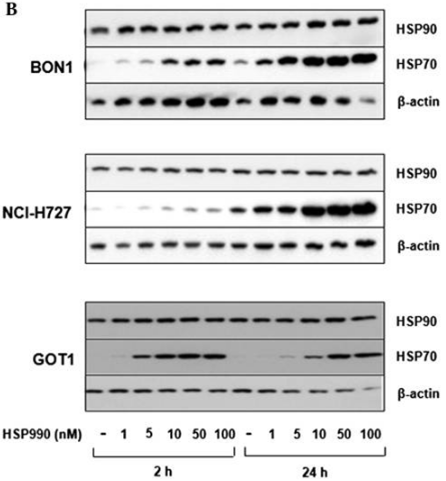
| Western blot | HSP90 / HSP70 EGFR / ErbB2 / ErbB3 / IGF-1R p-Akt / Akt / p-ERK / ERK / pp70S6K / p70S6K / p4EBP1 / 4EBP1 |
|
24100469 |
Clinical Trial Information
(data from https://clinicaltrials.gov, updated on 2026-02-02)
| NCT Number | Recruitment | Conditions | Sponsor/Collaborators | Start Date | Phases |
|---|---|---|---|---|---|
| NCT07380204 | RECRUITING | Parkinson's Disease (PD); Alzheimer's Disease (AD); Amyotrophic Lateral Sclerosis (ALS) |
Universitaire Ziekenhuizen KU Leuven |
2024-09-04 | |
| NCT00879905 | COMPLETED | Advanced Solid Malignancies |
Novartis Pharmaceuticals |
2009-05 | PHASE1 |
| NCT01064089 | TERMINATED | Advanced Solid Tumors |
Novartis Pharmaceuticals |
2010-02 | PHASE1 |
| NCT00879905 | Completed | Advanced Solid Malignancies |
Novartis Pharmaceuticals|Novartis |
2009-05 | Phase 1 |
Read more about Clinical Trials
Tech Support
Tel: +1-832-582-8158 Ext:3
If you have any other enquiries, please leave a message.
Signaling Pathway Map

Products are for research use only. Not for human use. We do not sell to patients.
©Copyright 2013 Selleck Chemicals. All Rights Reserved.