
-
 Argentina
-
 Australia
-
 Austria
-
 Belgium
-
 Brazil
-
 Canada
-
 China
China
-
 Czech Republic
-
 Denmark
-
 Finland
-
 France
-
 Germany
-
 Greece
-
 Hong Kong
-
 Hungary
-
 Iceland
-
 India
India
-
 Ireland
-
 Israel
-
 Italy
Italy
-
 Japan
Japan
-
 Korea
Korea
-
 Luxembourg
-
 Malaysia
-
 Netherlands
-
 New Zealand
-
 Norway
-
 Poland
-
 Portugal
-
 Qatar
Qatar
-
 Romania
-
 Saudi Arabia
-
 Singapore
-
 Spain
Spain
-
 Sweden
-
 Switzerland
-
 Taiwan
-
 Turkey
-
 United Kingdom
-
 United States
research use only
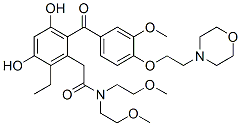
KW-2478 HSP inhibitor
Cat.No.S2685
Quality Control
Cell Culture, Treatment & Working Concentration
| Cell Lines | Assay Type | Concentration | Incubation Time | Formulation | Activity Description | PMID |
|---|---|---|---|---|---|---|
| TC32 | qHTS assay | qHTS of pediatric cancer cell lines to identify multiple opportunities for drug repurposing: Primary screen for TC32 cells | 29435139 | |||
| DAOY | qHTS assay | qHTS of pediatric cancer cell lines to identify multiple opportunities for drug repurposing: Primary screen for DAOY cells | 29435139 | |||
| SJ-GBM2 | qHTS assay | qHTS of pediatric cancer cell lines to identify multiple opportunities for drug repurposing: Primary screen for SJ-GBM2 cells | 29435139 | |||
| A673 | qHTS assay | qHTS of pediatric cancer cell lines to identify multiple opportunities for drug repurposing: Primary screen for A673 cells | 29435139 | |||
| SK-N-MC | qHTS assay | qHTS of pediatric cancer cell lines to identify multiple opportunities for drug repurposing: Primary screen for SK-N-MC cells | 29435139 | |||
| BT-37 | qHTS assay | qHTS of pediatric cancer cell lines to identify multiple opportunities for drug repurposing: Primary screen for BT-37 cells | 29435139 | |||
| NB-EBc1 | qHTS assay | qHTS of pediatric cancer cell lines to identify multiple opportunities for drug repurposing: Primary screen for NB-EBc1 cells | 29435139 | |||
| SK-N-SH | qHTS assay | qHTS of pediatric cancer cell lines to identify multiple opportunities for drug repurposing: Primary screen for SK-N-SH cells | 29435139 | |||
| NB1643 | qHTS assay | qHTS of pediatric cancer cell lines to identify multiple opportunities for drug repurposing: Primary screen for NB1643 cells | 29435139 | |||
| LAN-5 | qHTS assay | qHTS of pediatric cancer cell lines to identify multiple opportunities for drug repurposing: Primary screen for LAN-5 cells | 29435139 | |||
| Rh18 | qHTS assay | qHTS of pediatric cancer cell lines to identify multiple opportunities for drug repurposing: Primary screen for Rh18 cells | 29435139 | |||
| RD | qHTS assay | qHTS of pediatric cancer cell lines to identify multiple opportunities for drug repurposing: Primary screen for RD cells | 29435139 | |||
| Rh41 | qHTS assay | qHTS of pediatric cancer cell lines to identify multiple opportunities for drug repurposing: Primary screen for Rh41 cells | 29435139 | |||
| Click to View More Cell Line Experimental Data | ||||||
Solubility
|
In vitro |
DMSO
: 115 mg/mL
(200.11 mM)
Ethanol : 3 mg/mL Water : Insoluble |
Molarity Calculator
|
In vivo |
|||||
In vivo Formulation Calculator (Clear solution)
Step 1: Enter information below (Recommended: An additional animal making an allowance for loss during the experiment)
Step 2: Enter the in vivo formulation (This is only the calculator, not formulation. Please contact us first if there is no in vivo formulation at the solubility Section.)
Calculation results:
Working concentration: mg/ml;
Method for preparing DMSO master liquid: mg drug pre-dissolved in μL DMSO ( Master liquid concentration mg/mL, Please contact us first if the concentration exceeds the DMSO solubility of the batch of drug. )
Method for preparing in vivo formulation: Take μL DMSO master liquid, next addμL PEG300, mix and clarify, next addμL Tween 80, mix and clarify, next add μL ddH2O, mix and clarify.
Method for preparing in vivo formulation: Take μL DMSO master liquid, next add μL Corn oil, mix and clarify.
Note: 1. Please make sure the liquid is clear before adding the next solvent.
2. Be sure to add the solvent(s) in order. You must ensure that the solution obtained, in the previous addition, is a clear solution before proceeding to add the next solvent. Physical methods such
as vortex, ultrasound or hot water bath can be used to aid dissolving.
Chemical Information, Storage & Stability
| Molecular Weight | 574.66 | Formula | C30H42N2O9 |
Storage (From the date of receipt) | |
|---|---|---|---|---|---|
| CAS No. | 819812-04-9 | Download SDF | Storage of Stock Solutions |
|
|
| Synonyms | N/A | SMILES | CCC1=C(C(=C(C=C1O)O)C(=O)C2=CC(=C(C=C2)OCCN3CCOCC3)OC)CC(=O)N(CCOC)CCOC | ||
Read more about storage stability stock solution CAS number SMILES
Mechanism of Action
| Targets/IC50/Ki |
HSP90
3.8 nM
|
|---|---|
| In vitro |
KW-2478 inhibits the binding of bRD to Hsp90α with IC50 of 3.8 nM. This compound degradates the Hsp90 client proteins, including FGFR3 and IGF-1Rβand c-Raf-1. It reduces the level of phosphorylated Erk1/2. This chemical induces apoptosis by cleavage of PARP, a substrate of caspase-3 In U266 cells,. It has Time dependency of antiproliferative activity, consecutive drug exposure for at least 12 hours is necessary to to exert potent antitumor activity. This agent downregulates the translocation products of IgH locus. It inhibits the transcription of c-Maf and cyclin D1 genes by mainly suppressing the function of Cdk9. This compound has potent and broad growth inhibitory activities against various cell lines, it inhibites cancer cell growth in all cell lines, with EC50 of 101-252 nM, 81.4-91.4 nM and 120-622 nM for B-cell lymphoma, mantle cell lymphoma and multiple myeloma, respectively. It also shows potent growth inhibitory activity in primary CLL and NHL cells with EC50 of 40-170 nM and 200-400 nM, respectively. .
|
| Kinase Assay |
Hsp90 Binding Assay
|
|
Human Hsp90α solution (0.5 μg/mL) is fixed on 96-well plates, followed by blocking with TBS containing 1% bovine serum albumin. KW-2478 solutions is added to the wells, and bRD is added to a concentration of 0.1 μmol/L. After removal of solution, poly-HRP streptavidin solution dilutes with poly-HRP dilution buffer is added to the wells. After removal of solution, equal volumes of TMB peroxidase substrate and peroxidase solution B are added to the wells. To stop the HRP reaction, 2 mol/L H2SO4 are added, followed by measurement of absorbance at 450 nm using a microplate spectrophotometer.
|
|
| In vivo |
KW-2478 suppresses tumor growth and induces the degradation of client proteins in tumors in NCI-H929 s.c. inoculated model at doses of 100 mg/kg or more. This compound reduces both serum M protein and MM tumor burden in the bone marrow in OPM-2/GFP i.v. inoculated mouse model at doses of 100 mg/kg.
|
References |
|
Clinical Trial Information
(data from https://clinicaltrials.gov, updated on 2024-04-25)
| NCT Number | Recruitment | Conditions | Sponsor/Collaborators | Start Date | Phases |
|---|---|---|---|---|---|
| NCT01063907 | COMPLETED | Multiple Myeloma |
Kyowa Kirin Co., Ltd. |
2010-03 | PHASE1; PHASE2 |
| NCT00457782 | COMPLETED | Multiple Myeloma; Chronic Lymphocytic Leukaemia; B-cell Non-Hodgkin's Lymphoma |
Kyowa Kirin Co., Ltd. |
2007-04 | PHASE1 |
Read more about Clinical Trials
Tech Support
Tel: +1-832-582-8158 Ext:3
If you have any other enquiries, please leave a message.
Signaling Pathway Map

Products are for research use only. Not for human use. We do not sell to patients.
©Copyright 2013 Selleck Chemicals. All Rights Reserved.