
-
 Argentina
-
 Australia
-
 Austria
-
 Belgium
-
 Brazil
-
 Canada
-
 China
China
-
 Czech Republic
-
 Denmark
-
 Finland
-
 France
-
 Germany
-
 Greece
-
 Hong Kong
-
 Hungary
-
 Iceland
-
 India
India
-
 Ireland
-
 Israel
-
 Italy
Italy
-
 Japan
Japan
-
 Korea
Korea
-
 Luxembourg
-
 Malaysia
-
 Netherlands
-
 New Zealand
-
 Norway
-
 Poland
-
 Portugal
-
 Qatar
Qatar
-
 Romania
-
 Saudi Arabia
-
 Singapore
-
 Spain
Spain
-
 Sweden
-
 Switzerland
-
 Taiwan
-
 Turkey
-
 United Kingdom
-
 United States
research use only
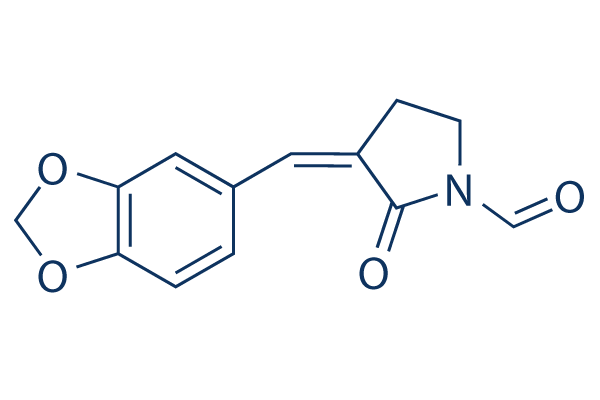
KNK437 HSP inhibitor
Cat.No.S7750
Quality Control
Solubility
|
In vitro |
DMSO
: 17 mg/mL
(69.32 mM)
Water : Insoluble Ethanol : Insoluble |
Molarity Calculator
|
In vivo |
|||||
In vivo Formulation Calculator (Clear solution)
Step 1: Enter information below (Recommended: An additional animal making an allowance for loss during the experiment)
Step 2: Enter the in vivo formulation (This is only the calculator, not formulation. Please contact us first if there is no in vivo formulation at the solubility Section.)
Calculation results:
Working concentration: mg/ml;
Method for preparing DMSO master liquid: mg drug pre-dissolved in μL DMSO ( Master liquid concentration mg/mL, Please contact us first if the concentration exceeds the DMSO solubility of the batch of drug. )
Method for preparing in vivo formulation: Take μL DMSO master liquid, next addμL PEG300, mix and clarify, next addμL Tween 80, mix and clarify, next add μL ddH2O, mix and clarify.
Method for preparing in vivo formulation: Take μL DMSO master liquid, next add μL Corn oil, mix and clarify.
Note: 1. Please make sure the liquid is clear before adding the next solvent.
2. Be sure to add the solvent(s) in order. You must ensure that the solution obtained, in the previous addition, is a clear solution before proceeding to add the next solvent. Physical methods such
as vortex, ultrasound or hot water bath can be used to aid dissolving.
Chemical Information, Storage & Stability
| Molecular Weight | 245.23 | Formula | C13H11NO4 |
Storage (From the date of receipt) | |
|---|---|---|---|---|---|
| CAS No. | 218924-25-5 | Download SDF | Storage of Stock Solutions |
|
|
| Synonyms | N/A | SMILES | C1CN(C(=O)C1=CC2=CC3=C(C=C2)OCO3)C=O | ||
Read more about storage stability stock solution CAS number SMILES
Mechanism of Action
| Targets/IC50/Ki |
HSP105
HSP72
HSP40
|
|---|---|
| In vitro |
KNK437 dose-dependently inhibits the acquisition of thermotolerance and the induction of various HSPs including HSP105, HSP70, and HSP40 in COLO 320DM (human colon carcinoma) cells. This compound and quercetin inhibits thermotolerance in a dose-dependent manner in PC-3 cells. It decreases heat-induced accumulation of Hsp70 mRNA and protein in PC-3 and LNCaP cells.
|
| Kinase Assay |
Metabolic Labeling and Gel Electrophoresis
|
|
COLO 320DM cells (200,000) are injected into each well of 12-well plastic plates 2 days before incubation in the presence of KNK437 for 1 h before heat shock. The cells are then heat-shocked at 42°C for 90 min or kept at 37°C for the same length of time and incubated at 37°C for 2 h. For metabolic labeling, cells are washed with PBS without Ca2+ or Mg2+ and incubated for 1 h with 1.22 MBq of [35S]methionine in 250 μL of methionine-free DMEM supplemented with 10% dialyzed fetal bovine serum. After metabolic labeling, cells are washed twice with PBS and lysed in a buffer containing 1% NP40, 0.15 M NaCl, 50 mM Tris-HCl (pH 8.0), 5 mM EDTA, and protease inhibitors [0.2 mM 4-(2-aminoethyl)benzenesulfonyl fluoride hydrochloride, 2 mM N-ethylmaleimide, 1 μg/mL pepstatin, and 1 μg/mL leupeptin]. After centrifugation at 12,000×g for 20 min, cell extracts containing equal amounts of trichloroacetic acid-insoluble radioactivity are analyzed by two-dimensional gel electrophoresis (the one-dimensional gel electrophoresis is a nonequilibrium pH gradient gel electrophoresis, and the two-dimensional gel electrophoresis is 10% SDS-PAGE).
|
|
| In vivo |
KNK437 (200 mg/kg, i.p.) shows no antitumor effects and does not increase the thermosensitivity of nontolerant tumors. The same dose of this compound enhances the antitumor effects of fractionated heat treatment in a synergistic manner.
|
References |
|
Tech Support
Tel: +1-832-582-8158 Ext:3
If you have any other enquiries, please leave a message.
Signaling Pathway Map

Products are for research use only. Not for human use. We do not sell to patients.
©Copyright 2013 Selleck Chemicals. All Rights Reserved.