
-
 Argentina
-
 Australia
-
 Austria
-
 Belgium
-
 Brazil
-
 Canada
-
 China
China
-
 Czech Republic
-
 Denmark
-
 Finland
-
 France
-
 Germany
-
 Greece
-
 Hong Kong
-
 Hungary
-
 Iceland
-
 India
India
-
 Ireland
-
 Israel
-
 Italy
Italy
-
 Japan
Japan
-
 Korea
Korea
-
 Luxembourg
-
 Malaysia
-
 Netherlands
-
 New Zealand
-
 Norway
-
 Poland
-
 Portugal
-
 Qatar
Qatar
-
 Romania
-
 Saudi Arabia
-
 Singapore
-
 Spain
Spain
-
 Sweden
-
 Switzerland
-
 Taiwan
-
 Turkey
-
 United Kingdom
-
 United States
research use only
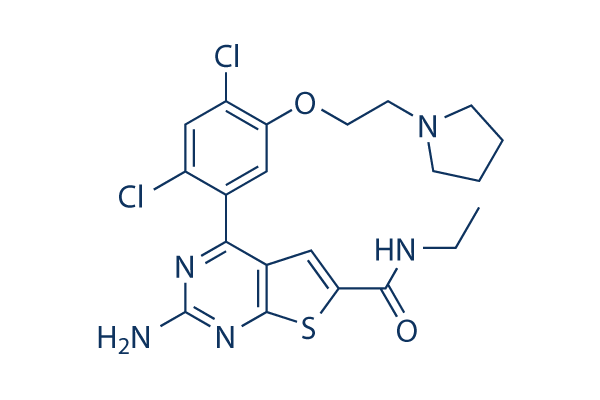
NVP-BEP800 HSP inhibitor
Cat.No.S1498
Quality Control
Solubility
|
In vitro |
Ethanol : 15 mg/mL
DMSO
: Insoluble
Water : Insoluble |
Molarity Calculator
|
In vivo |
|||||
In vivo Formulation Calculator (Clear solution)
Step 1: Enter information below (Recommended: An additional animal making an allowance for loss during the experiment)
Step 2: Enter the in vivo formulation (This is only the calculator, not formulation. Please contact us first if there is no in vivo formulation at the solubility Section.)
Calculation results:
Working concentration: mg/ml;
Method for preparing DMSO master liquid: mg drug pre-dissolved in μL DMSO ( Master liquid concentration mg/mL, Please contact us first if the concentration exceeds the DMSO solubility of the batch of drug. )
Method for preparing in vivo formulation: Take μL DMSO master liquid, next addμL PEG300, mix and clarify, next addμL Tween 80, mix and clarify, next add μL ddH2O, mix and clarify.
Method for preparing in vivo formulation: Take μL DMSO master liquid, next add μL Corn oil, mix and clarify.
Note: 1. Please make sure the liquid is clear before adding the next solvent.
2. Be sure to add the solvent(s) in order. You must ensure that the solution obtained, in the previous addition, is a clear solution before proceeding to add the next solvent. Physical methods such
as vortex, ultrasound or hot water bath can be used to aid dissolving.
Chemical Information, Storage & Stability
| Molecular Weight | 480.41 | Formula | C21H23Cl2N5O2S |
Storage (From the date of receipt) | |
|---|---|---|---|---|---|
| CAS No. | 847559-80-2 | Download SDF | Storage of Stock Solutions |
|
|
| Synonyms | VER82576 | SMILES | CCNC(=O)C1=CC2=C(N=C(N=C2S1)N)C3=CC(=C(C=C3Cl)Cl)OCCN4CCCC4 | ||
Read more about storage stability stock solution CAS number SMILES
Mechanism of Action
| Targets/IC50/Ki |
HSP90β
58 nM
|
|---|---|
| In vitro |
NVP-BEP800 is an ATP-competitive inhibitor of Hsp90β with an IC50 of 58 nM, exhibiting >70-fold selectivity against Hsp90 family members Grp94 and Trap-1 with IC50 values of 4.1 μM and 5.5 μM, respectively. This compound displays no inhibitory activity against the closely related GHKL ATPase, topoisomerase II, and the structurally unrelated ATPase, Hsp70 at the concentration of 10 μM. It potently inhibits the proliferation of various tumor cell lines with GI50 values ranging from 38 nM in A375 to 1.05 μM in PC3, and primary human tumors with the mean IC50 of 0.75 μM and IC70 of 1.8 μM. This chemical treatment at the concentration of five times the GI50 increases the percentage of G2-M phase in A2058 and A549 cells and sub-G1 phase in BT-474, HCT116, A2058 and A549 cells by 29.5%, 33.6%, 42.7%, 12.1%, 5.9% and 7.1%, respectively. It causes Akt and ErbB2 dephosphorylation, ErbB2 degradation, and Hsp70 induction in a concentration-dependent manner in BT-474 cells with IC50 values of 218 nM, 39.5 nM, 137 nM and 207 nM, respectively.
|
| Kinase Assay |
Competitive binding fluorescent polarization assay
|
|
Recombinant Hsp90β, TAMRA-radicicol, or various concentrations of NVP-BEP800 is added in assay buffer (50 mM TRIS pH 7.4, 5 mM MgCl2, 150 mM KCl, and 0.1% CHAPS), mixed, and incubated at room temperature for 30 to 45 minutes prior to reading. The 2D-FIDA-based HTS assay based on confocal technologies monitors the decreased fluorescence polarization on displacement of the high affinity ligand TAMRA-radicicol from Hsp90β by this compound. The concentration of this chemical which inhibits Hsp90β by 50% is determined from the competition curve.
|
|
| In vivo |
Oral administration of NVP-BEP800 at 15 or 30 mg/kg/day for 15 days causes a dose-dependent reduction in B-Raf and Akt phosphorylation levels, and displays significant dose-dependent antitumor efficacy in the A375 melanoma xenograft model with the T/C values of 53% and 6% at the dose of 15 and 30 mg/kg/day, respectively, suggesting almost complete tumor inhibition at 30 mg/kg/day. Administration of this compound induces dose-dependent increase of Hsp90-p23 complex dissociation and reductions in the levels of steady-state ErbB2, phospho-Akt and phospho-S6, in BT-474 breast cancer xenografts, and exhibits significant antitumor activity with 38% tumor regression at dose of 30 mg/kg/day and a T/C of 36% at dose of 15 mg/kg/day.
|
References |
Tech Support
Tel: +1-832-582-8158 Ext:3
If you have any other enquiries, please leave a message.
Signaling Pathway Map

Products are for research use only. Not for human use. We do not sell to patients.
©Copyright 2013 Selleck Chemicals. All Rights Reserved.