
-
 Argentina
-
 Australia
-
 Austria
-
 Belgium
-
 Brazil
-
 Canada
-
 China
China
-
 Czech Republic
-
 Denmark
-
 Finland
-
 France
-
 Germany
-
 Greece
-
 Hong Kong
-
 Hungary
-
 Iceland
-
 India
India
-
 Ireland
-
 Israel
-
 Italy
Italy
-
 Japan
Japan
-
 Korea
Korea
-
 Luxembourg
-
 Malaysia
-
 Netherlands
-
 New Zealand
-
 Norway
-
 Poland
-
 Portugal
-
 Qatar
Qatar
-
 Romania
-
 Saudi Arabia
-
 Singapore
-
 Spain
Spain
-
 Sweden
-
 Switzerland
-
 Taiwan
-
 Turkey
-
 United Kingdom
-
 United States
research use only
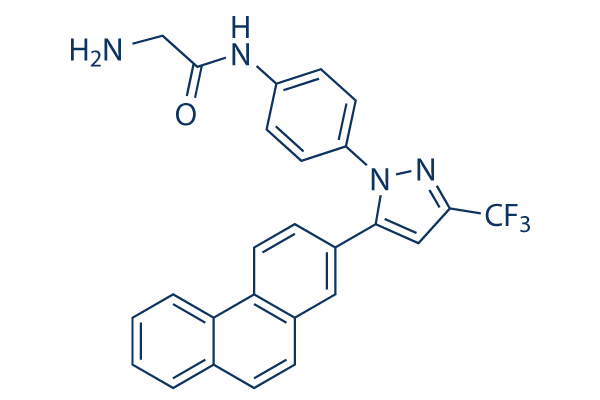
OSU-03012 (AR-12) PDPK1 inhibitor
Cat.No.S1106
Quality Control
Cell Culture, Treatment & Working Concentration
| Cell Lines | Assay Type | Concentration | Incubation Time | Formulation | Activity Description | PMID |
|---|---|---|---|---|---|---|
| mouse RAW264.7 cells | Function assay | 8 h | Antimicrobial activity against Salmonella enterica serovar Typhimurium ATCC 14028 infected in mouse RAW264.7 cells assessed as inhibition of intracellular bacterial growth after 8 hrs, IC50=0.2 μM | |||
| mouse RAW264.7 cells | Cytotoxic assay | 24 h | Cytotoxicity against mouse RAW264.7 cells assessed as cell viability after 24 hrs by MTT assay, IC50=10 μM | |||
| Click to View More Cell Line Experimental Data | ||||||
Solubility
|
In vitro |
DMSO
: 92 mg/mL
(199.8 mM)
Ethanol : 6 mg/mL Water : Insoluble |
Molarity Calculator
|
In vivo |
|||||
In vivo Formulation Calculator (Clear solution)
Step 1: Enter information below (Recommended: An additional animal making an allowance for loss during the experiment)
Step 2: Enter the in vivo formulation (This is only the calculator, not formulation. Please contact us first if there is no in vivo formulation at the solubility Section.)
Calculation results:
Working concentration: mg/ml;
Method for preparing DMSO master liquid: mg drug pre-dissolved in μL DMSO ( Master liquid concentration mg/mL, Please contact us first if the concentration exceeds the DMSO solubility of the batch of drug. )
Method for preparing in vivo formulation: Take μL DMSO master liquid, next addμL PEG300, mix and clarify, next addμL Tween 80, mix and clarify, next add μL ddH2O, mix and clarify.
Method for preparing in vivo formulation: Take μL DMSO master liquid, next add μL Corn oil, mix and clarify.
Note: 1. Please make sure the liquid is clear before adding the next solvent.
2. Be sure to add the solvent(s) in order. You must ensure that the solution obtained, in the previous addition, is a clear solution before proceeding to add the next solvent. Physical methods such
as vortex, ultrasound or hot water bath can be used to aid dissolving.
Chemical Information, Storage & Stability
| Molecular Weight | 460.45 | Formula | C26H19F3N4O |
Storage (From the date of receipt) | |
|---|---|---|---|---|---|
| CAS No. | 742112-33-0 | Download SDF | Storage of Stock Solutions |
|
|
| Synonyms | N/A | SMILES | C1=CC=C2C(=C1)C=CC3=C2C=CC(=C3)C4=CC(=NN4C5=CC=C(C=C5)NC(=O)CN)C(F)(F)F | ||
Read more about storage stability stock solution CAS number SMILES
Mechanism of Action
| Targets/IC50/Ki |
PDPK1
(Cell-free assay) 5 μM
|
|---|---|
| In vitro |
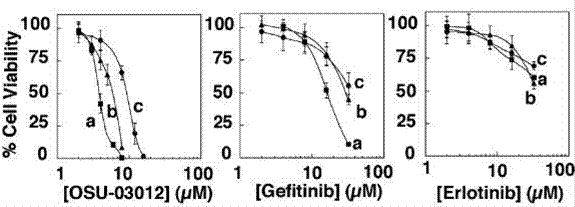
OSU-03012 (AR-12) induces apoptotic death in PC-3 cells with IC50 of 5 µM and reduces the activity of immunoprecipitated p70S6K. It completely suppresses cell growth in a diverse range of tumor cell lines at concentrations of 3–5 μm, as compared with the concentration of at least 50 μm. This compound promotes cell killing to a greater extent in glioma cells than in nontransformed astrocytes. It causes a dose-dependent induction of cell death that is not altered by p53 mutation, expression of ERBB1 VIII, or loss of phosphatase and tensin function due to a homolog deletion on chromosome 10. OSU-03012 and ionizing radiation cause an additive, caspase-independent elevation in cell killing. Its lethality as a single agent or when combined with signaling modulators is not modified in cells lacking expression of BIM or of BAX/BAK. It promotes the release of cathepsin B from the lysosomal compartment and that of AIF from mitochondria. The lethality of this compound is attenuated in protein kinase R-like endoplasmic reticulum kinase-/- cells, which correlated with the reduced cleavage of BID and suppression of cathepsin B and AIF release into the cytosol. It inhibits thyroid cancer cell (NPA, WRO, and ARO cells) proliferation, migration and induces apoptosis, which results in an increase of cells in the S phase without an increase of cells in G2. OSU-03012 is an ATP-competitive inhibitor of PAK activity and suppresses the phosphorylation of AKT in thyroid cancer cells. It inhibits cell growth of hepatocellular carcinoma cell lines including Huh7, Hep3B and HepG2 cells with IC50 values below 1 μM. This compound does not suppress PDK1 or AKT activity or induce cellular apoptosis but induces autophagy in Huh7 cells. Moreover, accumulation of reactive oxygen species (ROS) is detected after its treatment. A recent study shows that it could enhance the susceptibility of (Bcr)-Abl mutant cell lines to -induced apoptosis. |
| Kinase Assay |
PDK-1 Kinase Assay
|
|
This in vitro assay is performed using a PDK-1 kinase assay kit. This cell-free assay is based on the ability of recombinant PDK-1, in the presence of DMSO vehicle or OSU-03012 (AR-12), to activate its downstream serum- and glucocorticoid-regulated kinase which, in turn, phosphorylates the Akt/serum- and glucocorticoid-regulated kinase-specific peptide substrate RPRAATF with [γ-32P]ATP. The 32P-phosphorylated peptide substrate is then separated from the residual [γ-32P]-ATP by using P81 phosphocellulose paper and quantitated in a scintillation counter after three washes with 0.75% phosphoric acid.
|
|
| In vivo |
OSU-03012 (AR-12) suppresses tumor growth by 57.59% and increases cleaved LC3 in Huh7 tumor xenografts at 200 mg/kg. This compound remarkably decreases expression of EGFR protein in the tumors by 48% compared with vehicle controls and also prevents YB-1 from binding to the EGFR promoter in MDA-MB-435/LCC6 xenografts. It is well tolerated and inhibits the growth of HMS-97 schwannoma xenografts by 55% after oral administration. |
References |
|
Applications
| Methods | Biomarkers | Images | PMID |
|---|---|---|---|
| Western blot | p-Akt / Akt |

|
18413750 |
| Growth inhibition assay | Cell viability |
|
18413750 |
Clinical Trial Information
(data from https://clinicaltrials.gov, updated on 2014-01-29)
| NCT Number | Recruitment | Conditions | Sponsor/Collaborators | Start Date | Phases |
|---|---|---|---|---|---|
| NCT00978523 | COMPLETED | Solid Tumors; Lymphoma |
Arno Therapeutics |
2009-08 | PHASE1 |
Read more about Clinical Trials
Tech Support
Tel: +1-832-582-8158 Ext:3
If you have any other enquiries, please leave a message.

Products are for research use only. Not for human use. We do not sell to patients.
©Copyright 2013 Selleck Chemicals. All Rights Reserved.