
-
 Australia
-
 Austria
-
 Belgium
-
 Brazil
-
 Canada
-
 China
China
-
 Czech Republic
-
 Denmark
-
 Finland
-
 France
-
 Germany
-
 Greece
-
 Hong Kong
-
 Hungary
-
 Iceland
-
 India
India
-
 Ireland
-
 Israel
-
 Italy
Italy
-
 Japan
Japan
-
 Korea
Korea
-
 Luxembourg
-
 Malaysia
-
 Netherlands
-
 New Zealand
-
 Norway
-
 Poland
-
 Qatar
Qatar
-
 Romania
-
 Saudi Arabia
-
 Singapore
-
 Spain
Spain
-
 Sweden
-
 Switzerland
-
 Taiwan
-
 Turkey
-
 United Kingdom
-
 United States
research use only
Linifanib (ABT-869) VEGFR/PDGFR Inhibitor
Cat.No.S1003
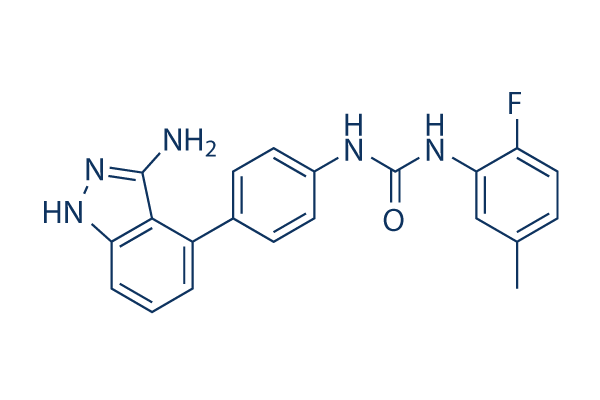
Chemical Structure
Molecular Weight: 375.41
Quality Control
| Related Targets | EGFR PDGFR FGFR c-Met Src MEK CSF-1R FLT3 HER2 c-Kit |
|---|---|
| Other VEGFR Inhibitors | SAR131675 SU 5402 Cediranib (AZD2171) Vatalanib (PTK787) 2HCl Anlotinib (AL3818) Dihydrochloride Apatinib (YN968D1) Apatinib (YN968D1) mesylate Ki8751 Semaxanib (SU5416) ZM 323881 HCl |
Cell Culture, Treatment & Working Concentration
| Cell Lines | Assay Type | Concentration | Incubation Time | Formulation | Activity Description | PMID |
|---|---|---|---|---|---|---|
| mouse 3T3 cells | Function assay | Inhibition of VEGF-induced human KDR phosphorylation in mouse 3T3 cells by ELISA, IC50=0.004 μM | ||||
| Sf9 insect cells | Function assay | 120 mins | Inhibition of recombinant GST-tagged VEGFR2 expressed in Sf9 insect cells after 120 mins by Kinase-Glo assay, IC50=5 nM | |||
| human MOLM13 cells | Cytotoxicity assay | 72 h | Cytotoxicity against human MOLM13 cells harboring mutant FLT3 after 72 hrs by MTS assay, GI50=0.037 μM | |||
| human MV4-11 cells | Proliferation assay | 72 h | Antiproliferation activity against FLT3/ITD harboring human MV4-11 cells after 72 hrs by MTS method, GI50=0.04 μM | |||
| human MOLT4 cells | Proliferation assay | 72 h | Antiproliferation activity against human MOLT4 after 72 hrs by MTS method, GI50=6.7 μM | |||
| RS4:11 cells | Proliferation assay | 72 h | Antiproliferation activity against human RS4:11 cells expressing wild type FLT3 after 72 hrs by MTS method, GI50=9.2 Μm | |||
| U937 cells | Proliferation assay | 72 h | Antiproliferation activity against human FLT3 gene-deficient U937 cells after 72 hrs by MTS method, GI50=19 μM | |||
| Click to View More Cell Line Experimental Data | ||||||
Solubility
|
In vitro |
DMSO
: 75 mg/mL
(199.78 mM)
Water : Insoluble Ethanol : Insoluble |
Molarity Calculator
|
In vivo |
|||||
In vivo Formulation Calculator (Clear solution)
Step 1: Enter information below (Recommended: An additional animal making an allowance for loss during the experiment)
Step 2: Enter the in vivo formulation (This is only the calculator, not formulation. Please contact us first if there is no in vivo formulation at the solubility Section.)
Calculation results:
Working concentration: mg/ml;
Method for preparing DMSO master liquid: mg drug pre-dissolved in μL DMSO ( Master liquid concentration mg/mL, Please contact us first if the concentration exceeds the DMSO solubility of the batch of drug. )
Method for preparing in vivo formulation: Take μL DMSO master liquid, next addμL PEG300, mix and clarify, next addμL Tween 80, mix and clarify, next add μL ddH2O, mix and clarify.
Method for preparing in vivo formulation: Take μL DMSO master liquid, next add μL Corn oil, mix and clarify.
Note: 1. Please make sure the liquid is clear before adding the next solvent.
2. Be sure to add the solvent(s) in order. You must ensure that the solution obtained, in the previous addition, is a clear solution before proceeding to add the next solvent. Physical methods such
as vortex, ultrasound or hot water bath can be used to aid dissolving.
Chemical Information, Storage & Stability
| Molecular Weight | 375.41 | Formula | C21H18FN5O |
Storage (From the date of receipt) | |
|---|---|---|---|---|---|
| CAS No. | 796967-16-3 | Download SDF | Storage of Stock Solutions |
|
|
| Synonyms | AL39324,RG3635 | Smiles | CC1=CC(=C(C=C1)F)NC(=O)NC2=CC=C(C=C2)C3=C4C(=CC=C3)NN=C4N | ||
Mechanism of Action
| Targets/IC50/Ki |
VEGFR1/FLT1
(Cell-free assay) 3 nM
CSF-1R
(Cell-free assay) 3 nM
VEGFR2/KDR
(Cell-free assay) 4 nM
FLT3
(Cell-free assay) 4 nM
Kit
(Cell-free assay) 14 nM
PDGFRβ
(Cell-free assay) 66 nM
Tie-2
(Cell-free assay) 170 nM
VEGFR3/FLT4
(Cell-free assay) 190 nM
|
|---|---|
| In vitro |
Linifanib (ABT-869) shows inhibitory activity to Kit, PDGFRβ and Flt4 with IC50 values of 14 nM, 66 nM and 190 nM in kinase assays. It also inhibits ligand-induced KDR, PDGFRβ, Kit, and CSF-1R phosphorylation with IC50 values of 2 nM, 2 nM, 31 nM and 10 nM at the cellular level, though this cellular potency could be affected by serum protein. The compound suppresses VEGF-stimulated HUAEC proliferation with an IC50 of 0.2 nM. While it has weak activity against tumor cells not induced by VEGF or PDGF, it is effective against MV4-11 leukemia cells (with constitutively active form of Flt3) with an IC50 of 4 nM. It causes a decrease in S and G2-M phases with a corresponding increase in the sub-G0-G1 apoptotic population in MV4-11 cells. This compound binds to the ATP-binding site of CSF-1R with a Ki of 3 nM. At 10 nM, it exhibits reduced phosphorylation of Akt at Ser473 and decreased phosphorylation of GSK3β at Ser9 in Ba/F3 FLT3 ITD cell lines.
|
| Kinase Assay |
Kinase assays
|
|
Potencies (IC50 values) are determined by assays of active kinase domains cloned and expressed in baculovirus using the FastBacbaculovirus expression system or obtained commercially. For tyrosine kinase assays, a biotinylated peptide substrate containing a single tyrosine is used with 1 mM ATP, anEu-cryptate–labeled anti-phosphotyrosine antibody (PT66), and Strepavidin-APC in a homogeneous time-resolved fluorescence assay. Serine/threonine kinases are assayed using 5 μM ATP, [33P]ATP, and a biotinylated peptide substrate with peptide capture and incorporation of 33P determined using a SA-Flashplate. This compound is assayed at multiple concentrations prepared by serial dilution of a DMSO stock solution of Linifanib (ABT-869). The concentration resulting in 50% inhibition of activity is calculated using nonlinear regression analysis of the concentration response data.
|
|
| In vivo |
Linifanib (ABT-869) (0.3 mg/kg) results in complete inhibition of KDR phosphorylation in lung tissue. It also inhibits the edema response with ED50 of 0.5 mg/kg. This compound (7.5 and 15 mg/kg, bid) significantly inhibits both bFGF- and VEGF-induced angiogenesis in the cornea. It inhibits tumor growth in flank xenograft models including HT1080, H526, MX-1 and DLD-1 with ED75 from 4.5-12 mg/kg. Linifanib also shows efficacy in A431 and MV4-11 xenografts at low dose levels. It (12.5 mg/kg bid) reveals a decrease of microvasculure density in MDA-231 xenograft. This compound shows a Cmax and AUC24 hours with 0.4 μg/mL and 2.7 μg•hour/mL in HT1080 fibrosarcoma model.
|
References |
|
Applications
| Methods | Biomarkers | Images | PMID |
|---|---|---|---|
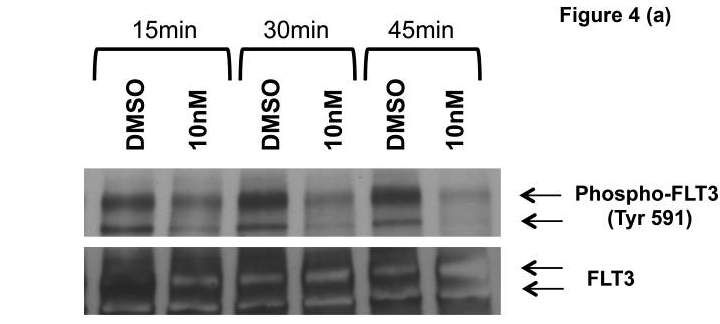
| Western blot | phospho-FLT3 / FLT3 Beclin-1 / ATG5 / ATG7 / p62 p-PDGFRβ / PDGFRβ/ p-AKT / AKT / p-mTOR / mTOR / p-S6K |
|
21471285 |
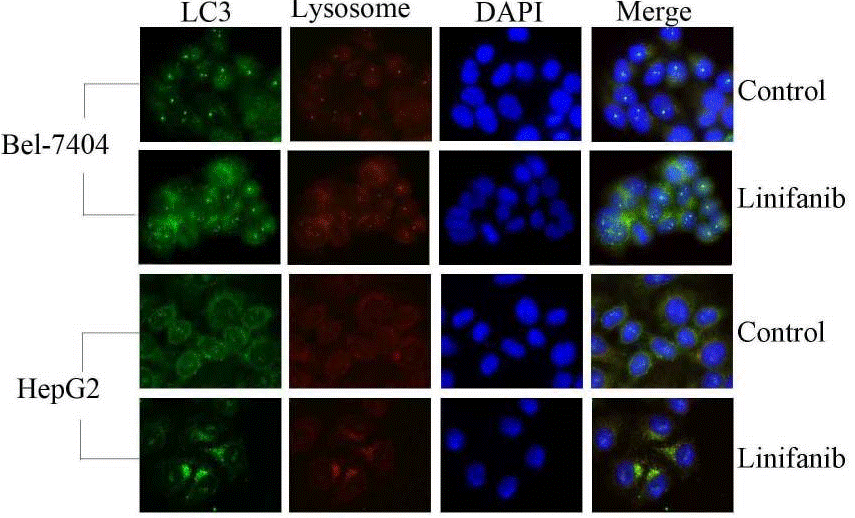
| Immunofluorescence | LC3 |
|
25327881 |
Clinical Trial Information
(data from https://clinicaltrials.gov, updated on 2024-05-22)
| NCT Number | Recruitment | Conditions | Sponsor/Collaborators | Start Date | Phases |
|---|---|---|---|---|---|
| NCT01401933 | Completed | Advanced Solid Tumors |
Abbott |
May 2011 | Phase 1 |
| NCT01381341 | Completed | Advanced Solid Tumors |
Abbott |
May 2011 | Phase 1 |
| NCT01114191 | Completed | Solid Tumors |
Abbott |
May 2010 | Phase 1 |
Tech Support
Tel: +1-832-582-8158 Ext:3
If you have any other enquiries, please leave a message.
Signaling Pathway Map

Products are for research use only. Not for human use. We do not sell to patients.
©Copyright 2013 Selleck Chemicals. All Rights Reserved.