
-
 Australia
-
 Austria
-
 Belgium
-
 Brazil
-
 Canada
-
 China
China
-
 Czech Republic
-
 Denmark
-
 Finland
-
 France
-
 Germany
-
 Greece
-
 Hong Kong
-
 Hungary
-
 Iceland
-
 India
India
-
 Ireland
-
 Israel
-
 Italy
Italy
-
 Japan
Japan
-
 Korea
Korea
-
 Luxembourg
-
 Malaysia
-
 Netherlands
-
 New Zealand
-
 Norway
-
 Poland
-
 Qatar
Qatar
-
 Romania
-
 Saudi Arabia
-
 Singapore
-
 Spain
Spain
-
 Sweden
-
 Switzerland
-
 Taiwan
-
 Turkey
-
 United Kingdom
-
 United States
research use only
Motesanib Diphosphate (AMG-706) VEGFR inhibitor
Cat.No.S1032
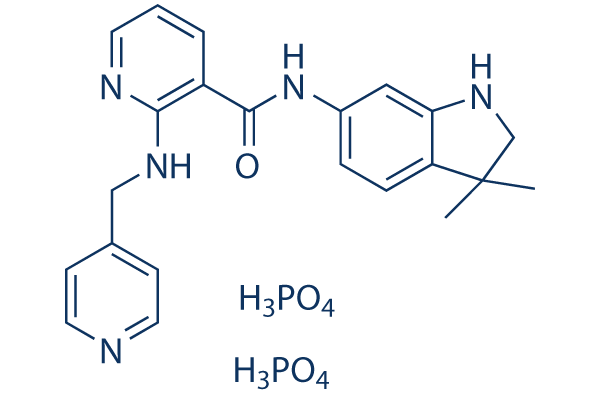
Chemical Structure
Molecular Weight: 569.44
Quality Control
| Related Targets | EGFR FGFR PDGFR c-Met Src MEK CSF-1R HER2 FLT3 c-Kit |
|---|---|
| Other VEGFR Inhibitors | SAR131675 SU 5402 Cediranib (AZD2171) Vatalanib (PTK787) 2HCl Anlotinib (AL3818) Dihydrochloride Linifanib (ABT-869) Apatinib (YN968D1) Apatinib (YN968D1) mesylate Ki8751 Semaxanib (SU5416) |
Solubility
|
In vitro |
DMSO
: 100 mg/mL
(175.61 mM)
Water : 19 mg/mL Ethanol : Insoluble |
Molarity Calculator
|
In vivo |
|||||
In vivo Formulation Calculator (Clear solution)
Step 1: Enter information below (Recommended: An additional animal making an allowance for loss during the experiment)
Step 2: Enter the in vivo formulation (This is only the calculator, not formulation. Please contact us first if there is no in vivo formulation at the solubility Section.)
Calculation results:
Working concentration: mg/ml;
Method for preparing DMSO master liquid: mg drug pre-dissolved in μL DMSO ( Master liquid concentration mg/mL, Please contact us first if the concentration exceeds the DMSO solubility of the batch of drug. )
Method for preparing in vivo formulation: Take μL DMSO master liquid, next addμL PEG300, mix and clarify, next addμL Tween 80, mix and clarify, next add μL ddH2O, mix and clarify.
Method for preparing in vivo formulation: Take μL DMSO master liquid, next add μL Corn oil, mix and clarify.
Note: 1. Please make sure the liquid is clear before adding the next solvent.
2. Be sure to add the solvent(s) in order. You must ensure that the solution obtained, in the previous addition, is a clear solution before proceeding to add the next solvent. Physical methods such
as vortex, ultrasound or hot water bath can be used to aid dissolving.
Chemical Information, Storage & Stability
| Molecular Weight | 569.44 | Formula | C22H23N5O.2H3PO4 |
Storage (From the date of receipt) | |
|---|---|---|---|---|---|
| CAS No. | 857876-30-3 | Download SDF | Storage of Stock Solutions |
|
|
| Synonyms | N/A | Smiles | CC1(CNC2=C1C=CC(=C2)NC(=O)C3=C(N=CC=C3)NCC4=CC=NC=C4)C.OP(=O)(O)O.OP(=O)(O)O | ||
Mechanism of Action
| Targets/IC50/Ki |
VEGFR1
(Cell-free assay) 2 nM
VEGFR2
(Cell-free assay) 3 nM
VEGFR2/Flk1
(Cell-free assay) 6 nM
VEGFR3
(Cell-free assay) 6 nM
Kit
(Cell-free assay) 8 nM
RET
(Cell-free assay) 59 nM
PDGFR
(Cell-free assay) 84 nM
|
|---|---|
| In vitro |
Motesanib Diphosphate (AMG-706) has broad activity against the human VEGFR family, and displays >1000 selectivity against EGFR, Src, and p38 kinase. It significantly inhibits VEGF-induced cellular proliferation of HUVECs with an IC50 of 10 nM, while displaying little effect at bFGF-induced proliferation with an IC50 of >3,000 nM. This compound also potently inhibits PDGF-induced proliferation and SCF-induced c-kit phosphorylation with IC50 of 207 nM and 37 nM, respectively, but is not effective against the EGF-induced EGFR phosphorylation and cell viability of A431 cells. Althouth displaying little antiproliferative activity on cell growth of HUVECs alone, it significantly sensitizes the cells to fractionated radiation. |
| Kinase Assay |
In vitro kinase assays
|
|
Optimal enzyme, ATP, and substrate (gastrin peptide) concentrations are established for each enzyme using homogeneous time-resolved fluorescence (HTRF) assays. For Motesanib Diphosphate (AMG-706), a 10-point dose-response curve is tested for each enzyme using an ATP concentration of two-thirds Km for each. Most assays consist of enzyme mixed with kinase reaction buffer [20 mM Tris-HCl (pH 7.5), 10 mM MgCl2, 5 mM MnCl2, 100 mM NaCl, 1.5 mM EGTA]. A final concentration of 1 mM DTT, 0.2 mM NaVO4, and 20 μg/mL BSA is added before each assay. For all assays, 5.75 mg/mL streptavidin-allophycocyanin and 0.1125 nM Eu-PT66 are added immediately before the HTRF reaction. Plates are incubated for 30 minutes at room temperature and read on a Discovery instrument. IC50 values are calculated using the Levenberg-Marquardt algorithm into a four-parameter logistic equation.
|
|
| In vivo |
Motesanib Diphosphate (AMG-706) administration at 100 mg/kg significantly inhibits VEGF-induced vascular permeability in a time-dependent manner. Oral administration of this compound twice daily or once daily potently inhibits, in a dose-dependent manner, VEGF-induced angiogenesis using the rat corneal model with ED50 of 2.1 mg/kg and 4.9 mg/kg, respectively. It induces a dose-dependent tumor regression of established A431 xenografts by selectively targeting neovascularization in tumor cells. When administered in combination with radiation, it displays significant anti-tumor activity in head and neck squamous cell carcinoma (HNSCC) xenograft models. Treatment with this compound also induces significant dose-dependent reductions in tumor growth and blood vessel density of MCF-7, MDA-MB-231, or Cal-51 xenografts. |
References |
|
Clinical Trial Information
(data from https://clinicaltrials.gov, updated on 2024-05-22)
| NCT Number | Recruitment | Conditions | Sponsor/Collaborators | Start Date | Phases |
|---|---|---|---|---|---|
| NCT01386866 | Completed | Advanced Solid Tumors |
Amgen |
May 2009 | Phase 1 |
| NCT00448786 | Completed | Solid Tumors |
Amgen |
February 2007 | Phase 1 |
| NCT00322400 | Completed | Locally Recurrent and Metastatic Breast Cancer |
Amgen |
March 2006 | Phase 1 |
| NCT01235416 | Completed | Histologically or Cytologically Documented Solid Tumors |
Amgen |
September 2005 | Phase 1 |
Tech Support
Tel: +1-832-582-8158 Ext:3
If you have any other enquiries, please leave a message.
Signaling Pathway Map

Products are for research use only. Not for human use. We do not sell to patients.
©Copyright 2013 Selleck Chemicals. All Rights Reserved.