
-
 Argentina
-
 Australia
-
 Austria
-
 Belgium
-
 Brazil
-
 Canada
-
 China
China
-
 Czech Republic
-
 Denmark
-
 Finland
-
 France
-
 Germany
-
 Greece
-
 Hong Kong
-
 Hungary
-
 Iceland
-
 India
India
-
 Ireland
-
 Israel
-
 Italy
Italy
-
 Japan
Japan
-
 Korea
Korea
-
 Luxembourg
-
 Malaysia
-
 Netherlands
-
 New Zealand
-
 Norway
-
 Poland
-
 Portugal
-
 Qatar
Qatar
-
 Romania
-
 Saudi Arabia
-
 Singapore
-
 Spain
Spain
-
 Sweden
-
 Switzerland
-
 Taiwan
-
 Turkey
-
 United Kingdom
-
 United States
research use only
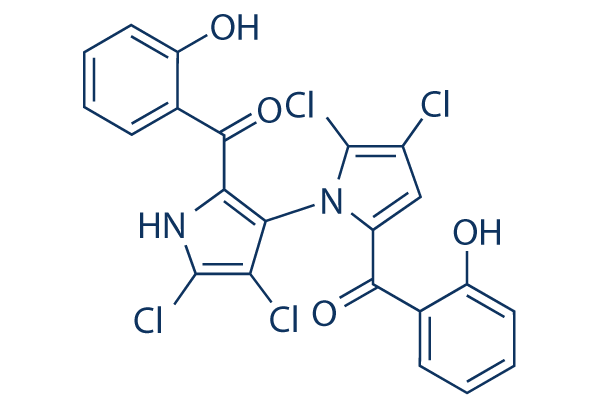
Marinopyrrole A (Maritoclax) Bcl-2 antagonist
Cat.No.S7126
Quality Control
| Related Targets | Caspase PD-1/PD-L1 Ferroptosis p53 Apoptosis related Synthetic Lethality STAT TNF-alpha Ras KRas |
|---|---|
| Other Bcl-2 Inhibitors | Navitoclax (ABT-263) S63845 ABT-737 Obatoclax Mesylate (GX15-070) A-1331852 A-1210477 TW-37 A-1155463 Dihydrochloride AZD5991 UMI-77 |
Solubility
|
In vitro |
DMSO
: 100 mg/mL
(196.02 mM)
Ethanol : 59 mg/mL Water : Insoluble |
Molarity Calculator
|
In vivo |
|||||
In vivo Formulation Calculator (Clear solution)
Step 1: Enter information below (Recommended: An additional animal making an allowance for loss during the experiment)
Step 2: Enter the in vivo formulation (This is only the calculator, not formulation. Please contact us first if there is no in vivo formulation at the solubility Section.)
Calculation results:
Working concentration: mg/ml;
Method for preparing DMSO master liquid: mg drug pre-dissolved in μL DMSO ( Master liquid concentration mg/mL, Please contact us first if the concentration exceeds the DMSO solubility of the batch of drug. )
Method for preparing in vivo formulation: Take μL DMSO master liquid, next addμL PEG300, mix and clarify, next addμL Tween 80, mix and clarify, next add μL ddH2O, mix and clarify.
Method for preparing in vivo formulation: Take μL DMSO master liquid, next add μL Corn oil, mix and clarify.
Note: 1. Please make sure the liquid is clear before adding the next solvent.
2. Be sure to add the solvent(s) in order. You must ensure that the solution obtained, in the previous addition, is a clear solution before proceeding to add the next solvent. Physical methods such
as vortex, ultrasound or hot water bath can be used to aid dissolving.
Chemical Information, Storage & Stability
| Molecular Weight | 510.15 | Formula | C22H12Cl4N2O4 |
Storage (From the date of receipt) | |
|---|---|---|---|---|---|
| CAS No. | 1227962-62-0 | Download SDF | Storage of Stock Solutions |
|
|
| Synonyms | N/A | SMILES | C1=CC=C(C(=C1)C(=O)C2=CC(=C(N2C3=C(NC(=C3Cl)Cl)C(=O)C4=CC=CC=C4O)Cl)Cl)O | ||
Read more about storage stability stock solution CAS number SMILES
Mechanism of Action
| Targets/IC50/Ki |
Mcl-1
|
|---|---|
| In vitro |
Maritoclax induces Mcl-1 degradation via the proteasome system, which is associated with its pro-apoptotic activity. It selectively kills Mcl-1-dependent, but not Bcl-2- or Bcl-XL-dependent, leukemia cells and markedly enhances the efficacy of ABT-737 against hematologic malignancies, including K562, Raji, and multidrug-resistant HL60/VCR, by ∼60- to 2000-fold at 1-2 μM. This compound blocks the interaction between a biotin-labeled Bim-BH3 peptide and GST-Mcl-1 in a dose-dependent manner with an IC50 value of 10.1 μM, while it does not inhibit the binding of Bim-BH3 peptide to GST-Bcl-XL at concentrations up to 80 μM. Maritoclax induces caspase-3 activation by degradation of Mcl-1 protein. Treatment with it markedly reduces the half-life of Mcl-1 to ∼0.5 h as compared with nearly 3 h in control cells. It has no apparent effect on Mcl-1 (Ser159/Thr163) phosphorylation, suggesting that it induces phosphorylation-independent Mcl-1 degradation. Marinopyrrole A has potent concentration-dependent bactericidal activity against clinically relevant hospital- and community-acquired MRSA strains. It shows limited toxicity to mammalian cell lines (at >20× MIC). Its sensitivity is cell type specific. It is not effective in HeLa, HEK293, or MEF cells. This compound is not a substrate for p-gp mediated drug efflux.
|
| In vivo |
Marinopyrrole A (Maritoclax) administration at 20 mg/kg/d intraperitoneally causes significant U937 tumor shrinkage, as well as a 36% tumor remission rate in athymic nude mice, without apparent toxicity to healthy tissue or circulating blood cells.
|
References |
|
Tech Support
Tel: +1-832-582-8158 Ext:3
If you have any other enquiries, please leave a message.
Signaling Pathway Map

Products are for research use only. Not for human use. We do not sell to patients.
©Copyright 2013 Selleck Chemicals. All Rights Reserved.