
-
 Argentina
-
 Australia
-
 Austria
-
 Belgium
-
 Brazil
-
 Canada
-
 China
China
-
 Czech Republic
-
 Denmark
-
 Finland
-
 France
-
 Germany
-
 Greece
-
 Hong Kong
-
 Hungary
-
 Iceland
-
 India
India
-
 Ireland
-
 Israel
-
 Italy
Italy
-
 Japan
Japan
-
 Korea
Korea
-
 Luxembourg
-
 Malaysia
-
 Netherlands
-
 New Zealand
-
 Norway
-
 Poland
-
 Portugal
-
 Qatar
Qatar
-
 Romania
-
 Saudi Arabia
-
 Singapore
-
 Spain
Spain
-
 Sweden
-
 Switzerland
-
 Taiwan
-
 Turkey
-
 United Kingdom
-
 United States
research use only
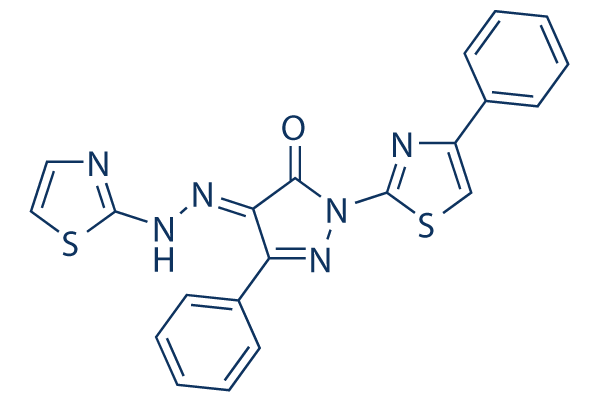
BTSA1 Bcl-2 activator
Cat.No.S8650
Quality Control
| Related Targets | Caspase PD-1/PD-L1 Ferroptosis p53 Apoptosis related Synthetic Lethality STAT TNF-alpha Ras KRas |
|---|---|
| Other Bcl-2 Inhibitors | Navitoclax (ABT-263) S63845 ABT-737 Obatoclax Mesylate (GX15-070) A-1331852 A-1210477 TW-37 A-1155463 Dihydrochloride AZD5991 UMI-77 |
Solubility
|
In vitro |
DMSO
: 81 mg/mL
(188.14 mM)
Water : Insoluble Ethanol : Insoluble |
Molarity Calculator
|
In vivo |
|||||
In vivo Formulation Calculator (Clear solution)
Step 1: Enter information below (Recommended: An additional animal making an allowance for loss during the experiment)
Step 2: Enter the in vivo formulation (This is only the calculator, not formulation. Please contact us first if there is no in vivo formulation at the solubility Section.)
Calculation results:
Working concentration: mg/ml;
Method for preparing DMSO master liquid: mg drug pre-dissolved in μL DMSO ( Master liquid concentration mg/mL, Please contact us first if the concentration exceeds the DMSO solubility of the batch of drug. )
Method for preparing in vivo formulation: Take μL DMSO master liquid, next addμL PEG300, mix and clarify, next addμL Tween 80, mix and clarify, next add μL ddH2O, mix and clarify.
Method for preparing in vivo formulation: Take μL DMSO master liquid, next add μL Corn oil, mix and clarify.
Note: 1. Please make sure the liquid is clear before adding the next solvent.
2. Be sure to add the solvent(s) in order. You must ensure that the solution obtained, in the previous addition, is a clear solution before proceeding to add the next solvent. Physical methods such
as vortex, ultrasound or hot water bath can be used to aid dissolving.
Chemical Information, Storage & Stability
| Molecular Weight | 430.51 | Formula | C21H14N6OS2 |
Storage (From the date of receipt) | |
|---|---|---|---|---|---|
| CAS No. | 314761-14-3 | Download SDF | Storage of Stock Solutions |
|
|
| Synonyms | N/A | SMILES | C1=CC=C(C=C1)C2=CSC(=N2)N3C(=O)C(=C(N3)C4=CC=CC=C4)N=NC5=NC=CS5 | ||
Read more about storage stability stock solution CAS number SMILES
Mechanism of Action
| Targets/IC50/Ki |
Bax
|
|---|---|
| In vitro |
BTSA1 has no capacity to directly activate the pro-apoptotic homolog BAK. This compound treatment potently and dose-responsively induces membrane translocation of recombinant soluble BAX to mitochondrial membrane, which is followed by induction of BAX oligomerization. This chemical-induced BAX activation promotes apoptosis in cancer cells. It reduces viability of all AML cell lines in a dose-dependent manner with IC50 values ranged between 1 and 4 μM, which leads to complete effect within 24 hr treatment. It induces dose-dependent caspase-3/7 activation in all five AML cell lines.
|
| In vivo |
BTSA1 potently suppresses human acute myeloid leukemia (AML) xenografts and increases host survival without toxicity. It is well-tolerated in mice with no toxic effects on healthy hematopoiesis, including healthy stem cellenriched (LSK) cells, common myeloid progenitors, granulocyte-monocyte progenitors, and megakaryocyte-erythrocyte progenitors. This compound has substantial half-life in mouse plasma (T1/2 = 15 hr) and oral bioavailability (%F = 51), while a 10 mg/kg dose reaches sufficient levels (~15 μM) of the compound to induce BAX activation and apoptosis in leukemia cells. Thus, it is orally bioavailable with excellent pharmacokinetics, has significant anti-tumor activity in leukemia xenografts by promoting apoptosis, and at therapeutically effective doses it does not show any detectable toxicity in the hematopoietic system or other tissues.
|
References |
Tech Support
Tel: +1-832-582-8158 Ext:3
If you have any other enquiries, please leave a message.
Signaling Pathway Map

Products are for research use only. Not for human use. We do not sell to patients.
©Copyright 2013 Selleck Chemicals. All Rights Reserved.