
-
 Argentina
-
 Australia
-
 Austria
-
 Belgium
-
 Brazil
-
 Canada
-
 China
China
-
 Czech Republic
-
 Denmark
-
 Finland
-
 France
-
 Germany
-
 Greece
-
 Hong Kong
-
 Hungary
-
 Iceland
-
 India
India
-
 Ireland
-
 Israel
-
 Italy
Italy
-
 Japan
Japan
-
 Korea
Korea
-
 Luxembourg
-
 Malaysia
-
 Netherlands
-
 New Zealand
-
 Norway
-
 Poland
-
 Portugal
-
 Qatar
Qatar
-
 Romania
-
 Saudi Arabia
-
 Singapore
-
 Spain
Spain
-
 Sweden
-
 Switzerland
-
 Taiwan
-
 Turkey
-
 United Kingdom
-
 United States
research use only
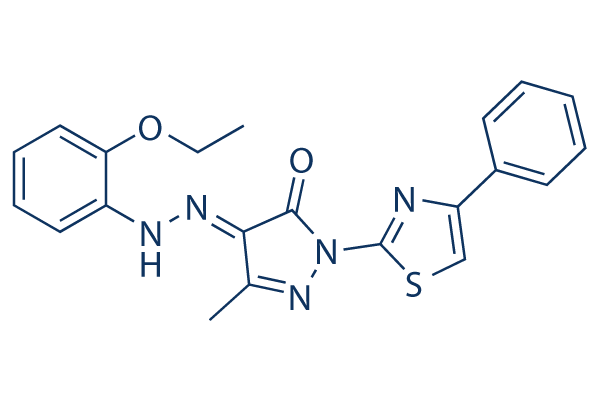
BAM7 Bcl-2 activator
Cat.No.S7105
Quality Control
| Related Targets | Caspase PD-1/PD-L1 Ferroptosis p53 Apoptosis related Synthetic Lethality STAT TNF-alpha Ras KRas |
|---|---|
| Other Bcl-2 Inhibitors | Navitoclax (ABT-263) S63845 ABT-737 Obatoclax Mesylate (GX15-070) A-1331852 A-1210477 TW-37 A-1155463 Dihydrochloride AZD5991 UMI-77 |
Solubility
|
In vitro |
DMSO
: 2 mg/mL
(4.93 mM)
Water : Insoluble Ethanol : Insoluble |
Molarity Calculator
|
In vivo |
|||||
In vivo Formulation Calculator (Clear solution)
Step 1: Enter information below (Recommended: An additional animal making an allowance for loss during the experiment)
Step 2: Enter the in vivo formulation (This is only the calculator, not formulation. Please contact us first if there is no in vivo formulation at the solubility Section.)
Calculation results:
Working concentration: mg/ml;
Method for preparing DMSO master liquid: mg drug pre-dissolved in μL DMSO ( Master liquid concentration mg/mL, Please contact us first if the concentration exceeds the DMSO solubility of the batch of drug. )
Method for preparing in vivo formulation: Take μL DMSO master liquid, next addμL PEG300, mix and clarify, next addμL Tween 80, mix and clarify, next add μL ddH2O, mix and clarify.
Method for preparing in vivo formulation: Take μL DMSO master liquid, next add μL Corn oil, mix and clarify.
Note: 1. Please make sure the liquid is clear before adding the next solvent.
2. Be sure to add the solvent(s) in order. You must ensure that the solution obtained, in the previous addition, is a clear solution before proceeding to add the next solvent. Physical methods such
as vortex, ultrasound or hot water bath can be used to aid dissolving.
Chemical Information, Storage & Stability
| Molecular Weight | 405.47 | Formula | C21H19N5O2S |
Storage (From the date of receipt) | |
|---|---|---|---|---|---|
| CAS No. | 331244-89-4 | Download SDF | Storage of Stock Solutions |
|
|
| Synonyms | N/A | SMILES | CCOC1=CC=CC=C1N=NC2=C(NN(C2=O)C3=NC(=CS3)C4=CC=CC=C4)C | ||
Read more about storage stability stock solution CAS number SMILES
Mechanism of Action
| Features |
Does not interact with the BH3-binding pocket of antiapoptotic proteins or proapoptotic BAK and induces cell death in a BAX-dependent fashion.
|
|---|---|
| Targets/IC50/Ki |
Bax
3.3 μM
|
| In vitro |
BAM7 directly binds the previously uncharacterized BH3-binding groove at the N-terminal face of BAX. This compound is selective for the BH3-binding groove at the N-terminal face of BAX. It directly interacts with BAX at the very surface used by the BIM BH3 helix to trigger BAX activation. This chemical results in functional BAX activation. It triggers the conversion of BAX from monomer to oligomer in a dose- and time-responsive manner, the kinetics of which approach saturation at a 1:8 dose ratio of BAX:BAM7. This compound triggers in vitro BAX oligomerization, BAX-mediated pore formation and BAX-dependent cell death. It selectively induces BAX-mediated apoptosis by triggering the hallmark features of intracellular BAX activation. This chemical only kills the cell line that contains BAX, eliciting the biochemical and morphologic features of BAX-mediated apoptosis.
|
| Kinase Assay |
Fluorescence polarization binding assays
|
|
Direct binding curves are first generated by incubating FITC-BIM SAHB (50 nM) with serial dilutions of fulllength BAX, BCL-XLΔC, MCL-1ΔNΔC, BFL-1/A1ΔC or BAKΔC and fluorescence
polarization measured at 20 minutes on a SpectraMax M5 microplate reader. For competition assays, a serial dilution of this compound
or acetylated BIM SAHB (Ac-BIM SAHB) is combined with FITC-BIM SAHB (50 nM), followed by the addition of recombinant protein at ~EC75 concentration, as determined by the direct binding assay (BAX, BAKΔC: 500 nM; BCL-XLΔC, MCL-1ΔNΔC, BFL-1/A1ΔC: 200 nM). Fluorescence polarization is measured
at 20 minutes and IC50 values calculated by nonlinear regression analysis of competitive binding curves using Prism software.
|
References |
Tech Support
Tel: +1-832-582-8158 Ext:3
If you have any other enquiries, please leave a message.
Signaling Pathway Map

Products are for research use only. Not for human use. We do not sell to patients.
©Copyright 2013 Selleck Chemicals. All Rights Reserved.