
-
 Argentina
-
 Australia
-
 Austria
-
 Belgium
-
 Brazil
-
 Canada
-
 China
China
-
 Czech Republic
-
 Denmark
-
 Finland
-
 France
-
 Germany
-
 Greece
-
 Hong Kong
-
 Hungary
-
 Iceland
-
 India
India
-
 Ireland
-
 Israel
-
 Italy
Italy
-
 Japan
Japan
-
 Korea
Korea
-
 Luxembourg
-
 Malaysia
-
 Netherlands
-
 New Zealand
-
 Norway
-
 Poland
-
 Portugal
-
 Qatar
Qatar
-
 Romania
-
 Saudi Arabia
-
 Singapore
-
 Spain
Spain
-
 Sweden
-
 Switzerland
-
 Taiwan
-
 Turkey
-
 United Kingdom
-
 United States
research use only
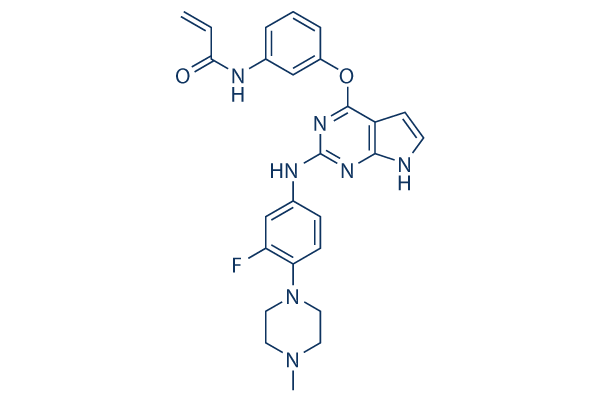
Avitinib (Abivertinib) EGFR inhibitor
Cat.No.S8741
Quality Control
| Related Targets | VEGFR FGFR PDGFR c-Met Src MEK CSF-1R FLT3 HER2 c-Kit |
|---|---|
| Other EGFR Inhibitors | Lazertinib (YH25448) Icotinib Hydrochloride Sunvozertinib AG-490 AG-1478 Canertinib (CI-1033) Genistein Poziotinib (NOV120101, HM781-36B) Rociletinib (CO-1686) WZ4002 |
Solubility
|
In vitro |
DMSO
: 97 mg/mL
(198.96 mM)
Ethanol : 97 mg/mL Water : Insoluble |
Molarity Calculator
|
In vivo |
|||||
In vivo Formulation Calculator (Clear solution)
Step 1: Enter information below (Recommended: An additional animal making an allowance for loss during the experiment)
Step 2: Enter the in vivo formulation (This is only the calculator, not formulation. Please contact us first if there is no in vivo formulation at the solubility Section.)
Calculation results:
Working concentration: mg/ml;
Method for preparing DMSO master liquid: mg drug pre-dissolved in μL DMSO ( Master liquid concentration mg/mL, Please contact us first if the concentration exceeds the DMSO solubility of the batch of drug. )
Method for preparing in vivo formulation: Take μL DMSO master liquid, next addμL PEG300, mix and clarify, next addμL Tween 80, mix and clarify, next add μL ddH2O, mix and clarify.
Method for preparing in vivo formulation: Take μL DMSO master liquid, next add μL Corn oil, mix and clarify.
Note: 1. Please make sure the liquid is clear before adding the next solvent.
2. Be sure to add the solvent(s) in order. You must ensure that the solution obtained, in the previous addition, is a clear solution before proceeding to add the next solvent. Physical methods such
as vortex, ultrasound or hot water bath can be used to aid dissolving.
Chemical Information, Storage & Stability
| Molecular Weight | 487.53 | Formula | C26H26FN7O2 |
Storage (From the date of receipt) | 3 years -20°C powder |
|---|---|---|---|---|---|
| CAS No. | 1557267-42-1 | -- | Storage of Stock Solutions |
|
|
| Synonyms | AC0010 | SMILES | CN1CCN(CC1)C2=C(C=C(C=C2)NC3=NC4=C(C=CN4)C(=N3)OC5=CC=CC(=C5)NC(=O)C=C)F | ||
Read more about storage stability stock solution CAS number SMILES
Mechanism of Action
| Targets/IC50/Ki |
JAK3
(Cell-free assay) 0.09 nM
EGFR L858R/T790M
(Cell-free assay) 0.18 nM
BTK
(Cell-free assay) 0.4 nM
|
|---|---|
| In vitro |
AC0010 selectively inhibits EGFR active and T790M mutations with up to 298-fold increase in potency compared to wild-type EGFR. AC0010 selectively inhibited mutant EGFR phosphorylation with IC50 values of 7.3 nM and 2.8 nM in NCI-H1975 and NIH/3T3_TC32T8 cells, about 115- and 298-fold more sensitive than that of the inhibition of wild type EGFR in A431. Immunoblotting analysis confirmed that AC0010 potently inhibited EGFR-Tyr1068 phosphorylation in NCI-H1975 cells, and the selectivity ratio is at 65-fold for NCI-H1975 cells versus A431 cells. In addition to inhibition of EGFR-Tyr1068 phosphorylation, AC0010 inhibited phosphorylation of the downstream targets Akt and ERK1/2, two important kinases involved in cancer cell proliferation and survival, in NCI-H1975 and HCC827 cells. The selectivity of AC0010 was also assessed by testing its activity against a panel of 349 kinases. At a concentration of 1 μM, AC0010 exhibited greater than 80% inhibition in 33 out of 349 unique kinase assays (9.5%). Kinase targets with greater than 80% inhibition include JAK3, BTK and 5 TEC family members. However, at the cellular level, the kinase inhibitory potency is much less than with the enzymatic assay. Much weaker inhibition was seen in BTK and JAK3 cellular assays with IC50 values of 59 nM and 360 nM. When tested against a selected panel of 55 key molecular targets including receptors, ion channels and transporters, AC0010 (1 μM) inhibits 5 out of 55 targets over 50% inhibition of radioligand binding, including Adenosine A3, L-type calcium (Cav1.2) channel, dopamine transporter, 5-HT2A and 5-HT2B. However, in cell-based functional assays, no inhibition was detected for above 5 targets, implying that the risk of off-target binding of AC0010 is minimal at pharmacologically relevant concentrations. |
| Kinase Assay |
In vitro kinase activity assay
|
|
Kinase activity assay was performed by service provider, Reaction Biology Corp (Malvern, PA, USA). For the single dose screening assay, AC0010 concentration at either 1 µM or 10 µM was used. For IC50 value determinations, a 10-concentration gradient from 5.1x10⁻¹¹-1.0x10⁻⁶ mol/L was set for the tested compounds. Staurosporine served as a control compound to monitor assay quality for IC50 value determinations and one-dose kinase activity assay.
|
|
| In vivo |
In a xenografte model, oral administration of AC0010 at daily dose of 500 mg/kg resulted in complete remission of tumors with EGFR active and T790M mutations for over 143 days with no weight loss. For PK analysis, following intravenous administration of 10 mg/kg of AC0010 in NCI-H1975 xenograft models, total body clearance and volume of distribution of AC0010 were estimated to be 5.91 L/h/kg and 14.76 L/kg, respectively. The elimination half-life (t1/2) of AC0010 was about 1.73 hour, indicating AC0010 is rapidly distributed into tissues including tumor tissues. Following oral administration of 12.5 mg/kg, 50 mg/kg and 200 mg/kg of AC0010 for 1 day or 8 consecutive days, AC0010 was absorbed with the Tmax of 1 to 2 hours, and bioavailability of 15.9-41.4%. AC0010 and its metabolites show no off-target effects and no skin lesion in animal models. Avitinib is well tolerated and efficacious in EGFR T790m(+) NSCLC patients. Its concentration in cerebrospinal fluid is low, and the penetrability of BBB is weak. But it still showed a good control of brain metastases (BM). |
References |
|
Clinical Trial Information
(data from https://clinicaltrials.gov, updated on 2024-03-18)
| NCT Number | Recruitment | Conditions | Sponsor/Collaborators | Start Date | Phases |
|---|---|---|---|---|---|
| NCT05361915 | SUSPENDED | Prostate Cancer; Prostate Cancer Metastatic |
Sorrento Therapeutics, Inc. |
2025-09 | PHASE2 |
| NCT03574402 | UNKNOWN | Carcinoma, Non-Small-Cell Lung |
Guangdong Association of Clinical Trials |
2018-07-09 | PHASE2 |
| NCT03856697 | UNKNOWN | Advanced Non-small Cell Lung Cancer |
Hangzhou ACEA Pharmaceutical Research Co., Ltd. |
2019-03 | PHASE3 |
| NCT04528667 | COMPLETED | Covid19 |
Sorrento Therapeutics, Inc. |
2021-01-06 | PHASE2 |
| NCT04440007 | COMPLETED | Covid-19 |
Sorrento Therapeutics, Inc. |
2020-10-09 | PHASE2 |
| NCT03060850 | Unknown status | B-cell Lymphoma |
Hangzhou ACEA Pharmaceutical Research Co. Ltd. |
2017-03-17 | Phase 1 |
Read more about Clinical Trials
Tech Support
Tel: +1-832-582-8158 Ext:3
If you have any other enquiries, please leave a message.
Signaling Pathway Map

Products are for research use only. Not for human use. We do not sell to patients.
©Copyright 2013 Selleck Chemicals. All Rights Reserved.