
-
 Argentina
-
 Australia
-
 Austria
-
 Belgium
-
 Brazil
-
 Canada
-
 China
China
-
 Czech Republic
-
 Denmark
-
 Finland
-
 France
-
 Germany
-
 Greece
-
 Hong Kong
-
 Hungary
-
 Iceland
-
 India
India
-
 Ireland
-
 Israel
-
 Italy
Italy
-
 Japan
Japan
-
 Korea
Korea
-
 Luxembourg
-
 Malaysia
-
 Netherlands
-
 New Zealand
-
 Norway
-
 Poland
-
 Qatar
Qatar
-
 Romania
-
 Saudi Arabia
-
 Singapore
-
 Spain
Spain
-
 Sweden
-
 Switzerland
-
 Taiwan
-
 Turkey
-
 United Kingdom
-
 United States
research use only
Zaltoprofen COX inhibitor
Cat.No.S3008
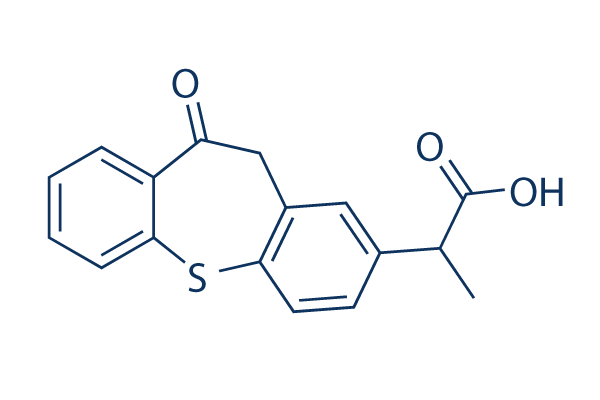
Chemical Structure
Molecular Weight: 298.36
Quality Control
Solubility
|
In vitro |
DMSO
: 60 mg/mL
(201.09 mM)
Ethanol : 31 mg/mL Water : Insoluble |
Molarity Calculator
|
In vivo |
|||||
In vivo Formulation Calculator (Clear solution)
Step 1: Enter information below (Recommended: An additional animal making an allowance for loss during the experiment)
Step 2: Enter the in vivo formulation (This is only the calculator, not formulation. Please contact us first if there is no in vivo formulation at the solubility Section.)
Calculation results:
Working concentration: mg/ml;
Method for preparing DMSO master liquid: mg drug pre-dissolved in μL DMSO ( Master liquid concentration mg/mL, Please contact us first if the concentration exceeds the DMSO solubility of the batch of drug. )
Method for preparing in vivo formulation: Take μL DMSO master liquid, next addμL PEG300, mix and clarify, next addμL Tween 80, mix and clarify, next add μL ddH2O, mix and clarify.
Method for preparing in vivo formulation: Take μL DMSO master liquid, next add μL Corn oil, mix and clarify.
Note: 1. Please make sure the liquid is clear before adding the next solvent.
2. Be sure to add the solvent(s) in order. You must ensure that the solution obtained, in the previous addition, is a clear solution before proceeding to add the next solvent. Physical methods such
as vortex, ultrasound or hot water bath can be used to aid dissolving.
Chemical Information, Storage & Stability
| Molecular Weight | 298.36 | Formula | C17H14O3S |
Storage (From the date of receipt) | |
|---|---|---|---|---|---|
| CAS No. | 74711-43-6 | Download SDF | Storage of Stock Solutions |
|
|
| Synonyms | CN100,Soleton | Smiles | CC(C1=CC2=C(C=C1)SC3=CC=CC=C3C(=O)C2)C(=O)O | ||
Mechanism of Action
| Targets/IC50/Ki |
COX-1
COX-2
|
|---|---|
| In vitro |
Zaltoprofen binds to specific sites on the protein of the bradykinin B2 receptor, hence we have examined the effect of this compound on bradykinin-induced responses of adult DRG neurons to investigate possible interaction sites. It most potently inhibits bradykinin-enhancement of capsaicin-induced Ca2+ uptake into DRG neurons. This chemical also significantly inhibits bradykinin-induced 12-lipoxygenase (12-LOX) activity and the slow bradykinin-induced onset of substance P release from DRG neurons. It produces an analgesic action on bradykinin-induced nociceptive responses by blocking the B(2) receptor-mediated pathway in the primary sensory neurons. This compound completely inhibits the bradykinin-induced increase of [Ca(2+)](i), which is inhibited by B(2) antagonist D-Arg-[Hyp(3), Thi(5,8), D-Phe(7)]-bradykinin, but not by B(1) antagonist. It at 1nmol shows strong analgesic action on BK (i.pl.)-induced nociceptive flexor responses, whereas loxoprofen or its active metabolite loxoprofen-SRS does not. This chemical also inhibits the nociception induced by [Tyr8]-BK, a specific agonist of B2-type BK receptor, but does not affect the nociception by [Lys-des-Arg9]-BK, a specific agonist of B1-type BK receptor. It is a non-steroidal anti-inflammatory drug (NSAID) causes potent inhibition of cyclooxygenase-2 with fewer side effects on the gastrointestinal tract. |
| In vivo |
Zaltoprofen improves the loss in body weight in both Con A-treated mice and carbon tetrachloride-treated rats. This compound (10 mg/kg) administrated at 8 h after Con A treatment is found to inhibit the Con A-induced reduction in body weight. It (10 mg/kg) combined with Con A results in four times greater food intake than that in mice treated with only Con A. |
References |
|
Tech Support
Tel: +1-832-582-8158 Ext:3
If you have any other enquiries, please leave a message.
Signaling Pathway Map

Products are for research use only. Not for human use. We do not sell to patients.
©Copyright 2013 Selleck Chemicals. All Rights Reserved.