
-
 Argentina
-
 Australia
-
 Austria
-
 Belgium
-
 Brazil
-
 Canada
-
 China
China
-
 Czech Republic
-
 Denmark
-
 Finland
-
 France
-
 Germany
-
 Greece
-
 Hong Kong
-
 Hungary
-
 Iceland
-
 India
India
-
 Ireland
-
 Israel
-
 Italy
Italy
-
 Japan
Japan
-
 Korea
Korea
-
 Luxembourg
-
 Malaysia
-
 Netherlands
-
 New Zealand
-
 Norway
-
 Poland
-
 Portugal
-
 Qatar
Qatar
-
 Romania
-
 Saudi Arabia
-
 Singapore
-
 Spain
Spain
-
 Sweden
-
 Switzerland
-
 Taiwan
-
 Turkey
-
 United Kingdom
-
 United States
research use only
NS-398 (NS398) COX inhibitor
Cat.No.S8433
Quality Control
Cell Culture, Treatment & Working Concentration
| Cell Lines | Assay Type | Concentration | Incubation Time | Formulation | Activity Description | PMID |
|---|---|---|---|---|---|---|
| RAW264.7 cells | Function assay | Evaluated for inhibition of COX-2 catalyzed PGE-2 production from LPS induced RAW 264.7 cells, IC50=0.5 μM | ||||
| MDA-MB-231 cell | Function assay | Reduction in PGE2 levels in MDA-MB-231 cell | ||||
| SKBr3 cells | Function assay | 24 h | Reduction in CYP19 mRNA expression in SKBr3 cells after 24h exposure to 25uM relative to control | |||
| SK-BR-3 cells | Cytotoxicity assay | 24 h | Cytotoxicity against human SK-BR-3 cells after 24 hrs by MTT assay relative to NS398, IC50=0.72 μM | |||
| SKBR3 cells | Function assay | Inhibition of aromatase in human SKBR3 cells by tritiated water release assay, IC50=0.68 μM | ||||
| RAW264.7 cells | Function assay | Antiinflammatory activity in mouse RAW264.7 cells assessed as inhibition of LPS-induced PGE2 production by EIA, IC50=4.8 μM | ||||
| PMA-Ion-stimulated human PBL | Function assay | 5 μM | 20 h | Inhibition of COX2 expression in PMA-Ion-stimulated human PBL at 5 uM after 20 hrs by Western blot analysis | ||
| HUVEC | Function assay | 18 h | Antiangiogenic activity against VEGFA-stimulated capillary differentiation in HUVEC after 18 hrs by matrigel assay | |||
| HUVEC | Function assay | 48 h | Antiangiogenic activity against VEGFA-stimulated cell proliferation in HUVEC after 48 hrs by BrdU incorporation assay | |||
| RAW264.7 cells | Function assay | 24 h | Antiinflammatory activity against mouse RAW264.7 cells assessed as inhibition of LPS-induced PGE2 production administered 1 hr prior to LPS-challenge measured after 24 hrs by EIA, IC50=0.00701 μM | |||
| HaCaT cells | Function assay | 24 h | Inhibition of PGE2 production in human HaCaT cells after 24 hrs by RIA, IC50=0.01 μM | |||
| RAW264.7 cells | Function assay | Inhibition of PGE2 production in LPS-induced mouse RAW264.7 cells, IC50=0.007 μM | ||||
| RAW264.7 cells | Function assay | 17-20 h | Inhibition of IFN-gamma/LPS-induced PGE2 production in mouse RAW264.7 cells after 17 to 20 hrs by EIA method, IC50=0.1 μM | |||
| SK-BR-3 cells | Function assay | Inhibition of CYP450 aromatase activity in SK-BR-3 cells, IC50=0.68 μM | ||||
| RAW264.7 cells | Function assay | Inhibition of COX2-mediated PGE2 production in LPS-stimulated mouse RAW264.7 cells by enzyme immunoassay, IC50=0.05 μM | ||||
| K562 cells | Function assay | 4 days | Inhibition of COX2 in human K562 cells assessed as blockade of AML1-ETO protein-dependent erythroid differentiation after 4 days by benzidine staining method | |||
| RAW264.7 cells | Function assay | Inhibition of COX2 in mouse RAW264.7 cells by enzyme immunoassay, IC50=0.81 μM | ||||
| Click to View More Cell Line Experimental Data | ||||||
Solubility
|
In vitro |
DMSO
: 62 mg/mL
(197.22 mM)
Water : Insoluble Ethanol : Insoluble |
Molarity Calculator
|
In vivo |
|||||
In vivo Formulation Calculator (Clear solution)
Step 1: Enter information below (Recommended: An additional animal making an allowance for loss during the experiment)
Step 2: Enter the in vivo formulation (This is only the calculator, not formulation. Please contact us first if there is no in vivo formulation at the solubility Section.)
Calculation results:
Working concentration: mg/ml;
Method for preparing DMSO master liquid: mg drug pre-dissolved in μL DMSO ( Master liquid concentration mg/mL, Please contact us first if the concentration exceeds the DMSO solubility of the batch of drug. )
Method for preparing in vivo formulation: Take μL DMSO master liquid, next addμL PEG300, mix and clarify, next addμL Tween 80, mix and clarify, next add μL ddH2O, mix and clarify.
Method for preparing in vivo formulation: Take μL DMSO master liquid, next add μL Corn oil, mix and clarify.
Note: 1. Please make sure the liquid is clear before adding the next solvent.
2. Be sure to add the solvent(s) in order. You must ensure that the solution obtained, in the previous addition, is a clear solution before proceeding to add the next solvent. Physical methods such
as vortex, ultrasound or hot water bath can be used to aid dissolving.
Chemical Information, Storage & Stability
| Molecular Weight | 314.36 | Formula | C13H18N2O5S |
Storage (From the date of receipt) | |
|---|---|---|---|---|---|
| CAS No. | 123653-11-2 | Download SDF | Storage of Stock Solutions |
|
|
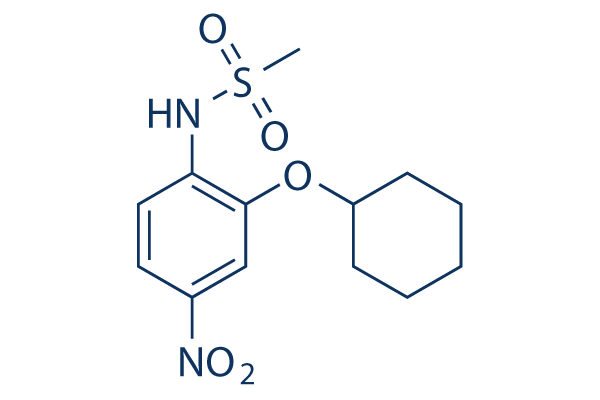
| Synonyms | N-(2-cyclohexyloxy-4-nitrophenyl)methane sulfonamide | SMILES | CS(=O)(=O)NC1=C(C=C(C=C1)[N+](=O)[O-])OC2CCCCC2 | ||
Read more about storage stability stock solution CAS number SMILES
Mechanism of Action
| Targets/IC50/Ki |
COX-2
(Cell-free assay) 3.8 μM
|
|---|---|
| In vitro |
NS-398 (NS398) inhibits COX-2 enzyme activity in a concentration dependent manner, the IC50 being 3.8 μM, whereas at 100μM it has no effect on COX-1 activity. At 10 μM, this compound treatment results in increased production of COX-2 and the pro-inflammatory cytokine. It (10 μM) induces apoptosis in LNCaP cells, but not in the more aggressive, androgen-unresponsive C4-2b cells. The C4-2b cells are observed to continue to proliferate when treated with NS-398 and continues to retain malignant phenotype characteristics. Its treatment results in C4-2b cell differentiation into an unusual neuroendocrinelike cell. These neuroendocrine-like cells produces both epithelial (cytokeratin 18 and prostate specific antigen) and neuronal (neuron-specific enolase and chromogranin A) proteins. Furthermore, this C4-2b cellular response to it is mediated by NF-kB transcription factor activation. It induces NF-kB and down-regulates Ikβ-α protein expression in LNCaP C4-2b cells. |
| In vivo |
NS398 could inhibit Cox-2 expression induced by acoustic injury and attenuate noise-induced hearing threshold shifts and cochlear hair cell loss. The inhibition of Cox-2 by this compound could attenuate noise-induced hearing loss (NIHL) and related hair cell damage.. |
References |
|
Applications
| Methods | Biomarkers | Images | PMID |
|---|---|---|---|
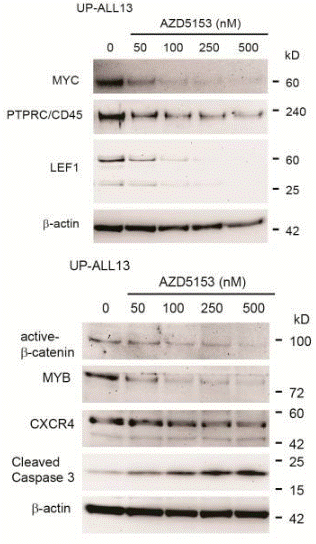
| Western blot | LEF1 / active-β-catenin / CXCR4 / Cleaved Caspase 3 p-CHK1 / CHK1 c-Myc |
|
30304769 |
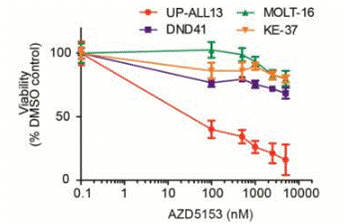
| Growth inhibition assay | Cell viability |
|
30304769 |
Tech Support
Tel: +1-832-582-8158 Ext:3
If you have any other enquiries, please leave a message.
Signaling Pathway Map

Products are for research use only. Not for human use. We do not sell to patients.
©Copyright 2013 Selleck Chemicals. All Rights Reserved.