
-
 Argentina
-
 Australia
-
 Austria
-
 Belgium
-
 Brazil
-
 Canada
-
 China
China
-
 Czech Republic
-
 Denmark
-
 Finland
-
 France
-
 Germany
-
 Greece
-
 Hong Kong
-
 Hungary
-
 Iceland
-
 India
India
-
 Ireland
-
 Israel
-
 Italy
Italy
-
 Japan
Japan
-
 Korea
Korea
-
 Luxembourg
-
 Malaysia
-
 Netherlands
-
 New Zealand
-
 Norway
-
 Poland
-
 Portugal
-
 Qatar
Qatar
-
 Romania
-
 Saudi Arabia
-
 Singapore
-
 Spain
Spain
-
 Sweden
-
 Switzerland
-
 Taiwan
-
 Turkey
-
 United Kingdom
-
 United States
research use only
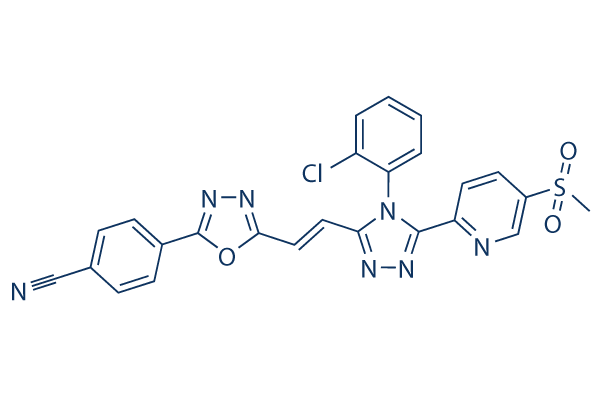
G007-LK PARP inhibitor
Cat.No.S7239
Quality Control
| Related Targets | HDAC ATM/ATR DNA-PK WRN DNA/RNA Synthesis Topoisomerase PPAR Sirtuin Casein Kinase eIF |
|---|---|
| Other PARP Inhibitors | XAV-939 AZD5305 (Saruparib) Veliparib (ABT-888) PJ34 HCl AG-14361 Iniparib (BSI-201) UPF 1069 A-966492 Pamiparib ME0328 |
Cell Culture, Treatment & Working Concentration
| Cell Lines | Assay Type | Concentration | Incubation Time | Formulation | Activity Description | PMID |
|---|---|---|---|---|---|---|
| HEK293 | Function assay | 24 hrs | Inhibition of TNKS1/2 in HEK293 cells assessed as inhibition of Wnt/beta-casein pathway after 24 hrs by luciferase reporter gene assay, IC50 = 0.05 μM. | 23473363 | ||
| Click to View More Cell Line Experimental Data | ||||||
Solubility
|
In vitro |
DMSO
: 69 mg/mL
(130.19 mM)
Water : Insoluble Ethanol : Insoluble |
Molarity Calculator
|
In vivo |
|||||
In vivo Formulation Calculator (Clear solution)
Step 1: Enter information below (Recommended: An additional animal making an allowance for loss during the experiment)
Step 2: Enter the in vivo formulation (This is only the calculator, not formulation. Please contact us first if there is no in vivo formulation at the solubility Section.)
Calculation results:
Working concentration: mg/ml;
Method for preparing DMSO master liquid: mg drug pre-dissolved in μL DMSO ( Master liquid concentration mg/mL, Please contact us first if the concentration exceeds the DMSO solubility of the batch of drug. )
Method for preparing in vivo formulation: Take μL DMSO master liquid, next addμL PEG300, mix and clarify, next addμL Tween 80, mix and clarify, next add μL ddH2O, mix and clarify.
Method for preparing in vivo formulation: Take μL DMSO master liquid, next add μL Corn oil, mix and clarify.
Note: 1. Please make sure the liquid is clear before adding the next solvent.
2. Be sure to add the solvent(s) in order. You must ensure that the solution obtained, in the previous addition, is a clear solution before proceeding to add the next solvent. Physical methods such
as vortex, ultrasound or hot water bath can be used to aid dissolving.
Chemical Information, Storage & Stability
| Molecular Weight | 529.96 | Formula | C25H16ClN7O3S |
Storage (From the date of receipt) | |
|---|---|---|---|---|---|
| CAS No. | 1380672-07-0 | Download SDF | Storage of Stock Solutions |
|
|
| Synonyms | N/A | SMILES | CS(=O)(=O)C1=CN=C(C=C1)C2=NN=C(N2C3=CC=CC=C3Cl)C=CC4=NN=C(O4)C5=CC=C(C=C5)C#N | ||
Read more about storage stability stock solution CAS number SMILES
Mechanism of Action
| Targets/IC50/Ki |
TNKS2
(Cell-free assay) 25 nM
TNKS1
(Cell-free assay) 46 nM
|
|---|---|
| In vitro |
G007-LK reduces Wnt/β-catenin signaling by preventing poly(ADP-ribosyl)ation-dependent AXIN degradation, thereby promoting β-catenin destabilization. This compound completely blocks ligand-driven Wnt/β-catenin signaling in cell culture and display approximately 50% inhibition of APC mutation–driven signaling in most CRC cell lines. It (0.2 μM) reduces the number of COLO-320DM cells in mitosis from 24% to 12% and decreases HCT-15 cells in S-phase from 28% to 18%. This chemical suppresses colony formation in CRC lines COLO-320DM and SW403. It suppresses organoids growth with IC50 of 80 nM.
|
| Kinase Assay |
TNKS1 and TNKS2 in vitro biochemical assays
|
|
G007-LK inhibitory activity at various doses (duplicates) is tested twice against TNKS1, TNSK2 Chemiluminescent Assay Kits, and the luminescence is measured on a GloMax Luminometer.
|
|
| In vivo |
G007-LK exhibits antitumor efficacy in xenograft and genetically engineered CRC models. In the COLO-320DM model, this compound reduces tankyrases 1 and tankyrases 2 protein levels, stabilizes AXIN1 and AXIN2, and decreases β-catenin level. Wnt/β-catenin signaling is clearly inhibited in a dose-dependent manner in the efficacy study tumors as indicated by reduced expression of β-catenin–activated genes NKD1, APCDD1, and TNFRSF19 (TROY), as well as increased expression of β-catenin–repressed gene CLIC3. This compound treatment increases expression of KRT20 and TM4SF4 in COLO-320DM tumors. It (20 mg/kg twice daily) achieves 61% tumor growth inhibition. This chemical reduces Wnt/β-catenin signaling and cell proliferation in normal intestine.
|
References |
|
Tech Support
Tel: +1-832-582-8158 Ext:3
If you have any other enquiries, please leave a message.
Signaling Pathway Map

Products are for research use only. Not for human use. We do not sell to patients.
©Copyright 2013 Selleck Chemicals. All Rights Reserved.