
-
 Argentina
-
 Australia
-
 Austria
-
 Belgium
-
 Brazil
-
 Canada
-
 China
China
-
 Czech Republic
-
 Denmark
-
 Finland
-
 France
-
 Germany
-
 Greece
-
 Hong Kong
-
 Hungary
-
 Iceland
-
 India
India
-
 Ireland
-
 Israel
-
 Italy
Italy
-
 Japan
Japan
-
 Korea
Korea
-
 Luxembourg
-
 Malaysia
-
 Netherlands
-
 New Zealand
-
 Norway
-
 Poland
-
 Portugal
-
 Qatar
Qatar
-
 Romania
-
 Saudi Arabia
-
 Singapore
-
 Spain
Spain
-
 Sweden
-
 Switzerland
-
 Taiwan
-
 Turkey
-
 United Kingdom
-
 United States
research use only
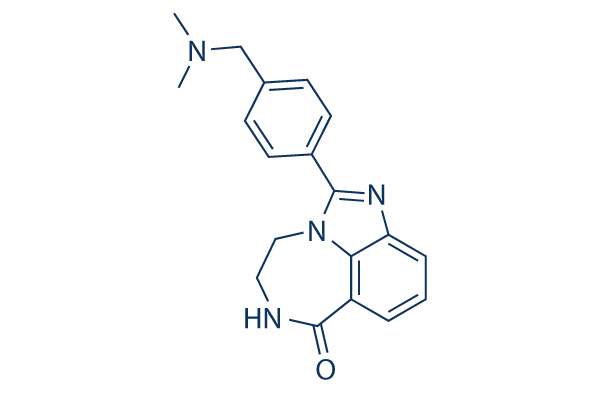
AG-14361 PARP inhibitor
Cat.No.S2178
Quality Control
| Related Targets | HDAC ATM/ATR DNA-PK WRN DNA/RNA Synthesis Topoisomerase PPAR Sirtuin Casein Kinase eIF |
|---|---|
| Other PARP Inhibitors | XAV-939 AZD5305 (Saruparib) Veliparib (ABT-888) PJ34 HCl Iniparib (BSI-201) G007-LK UPF 1069 A-966492 Pamiparib ME0328 |
Cell Culture, Treatment & Working Concentration
| Cell Lines | Assay Type | Concentration | Incubation Time | Formulation | Activity Description | PMID |
|---|---|---|---|---|---|---|
| LoVo cells | Function assay | Concentration that gives 50% growth inhibition in LoVo cells, activity expressed as GI50, GI50=11.2 μM | ||||
| Click to View More Cell Line Experimental Data | ||||||
Solubility
|
In vitro |
DMSO
: 51 mg/mL
(159.18 mM)
Ethanol : 21 mg/mL Water : Insoluble |
Molarity Calculator
|
In vivo |
|||||
In vivo Formulation Calculator (Clear solution)
Step 1: Enter information below (Recommended: An additional animal making an allowance for loss during the experiment)
Step 2: Enter the in vivo formulation (This is only the calculator, not formulation. Please contact us first if there is no in vivo formulation at the solubility Section.)
Calculation results:
Working concentration: mg/ml;
Method for preparing DMSO master liquid: mg drug pre-dissolved in μL DMSO ( Master liquid concentration mg/mL, Please contact us first if the concentration exceeds the DMSO solubility of the batch of drug. )
Method for preparing in vivo formulation: Take μL DMSO master liquid, next addμL PEG300, mix and clarify, next addμL Tween 80, mix and clarify, next add μL ddH2O, mix and clarify.
Method for preparing in vivo formulation: Take μL DMSO master liquid, next add μL Corn oil, mix and clarify.
Note: 1. Please make sure the liquid is clear before adding the next solvent.
2. Be sure to add the solvent(s) in order. You must ensure that the solution obtained, in the previous addition, is a clear solution before proceeding to add the next solvent. Physical methods such
as vortex, ultrasound or hot water bath can be used to aid dissolving.
Chemical Information, Storage & Stability
| Molecular Weight | 320.39 | Formula | C19H20N4O |
Storage (From the date of receipt) | |
|---|---|---|---|---|---|
| CAS No. | 328543-09-5 | Download SDF | Storage of Stock Solutions |
|
|
| Synonyms | N/A | SMILES | CN(C)CC1=CC=C(C=C1)C2=NC3=CC=CC4=C3N2CCNC4=O | ||
Read more about storage stability stock solution CAS number SMILES
Mechanism of Action
| Features |
The 1st high-potency PARP-1 inhibitor with the specificity & in vivo activity to enhance chemotherapy and radiation therapy of human cancers.
|
|---|---|
| Targets/IC50/Ki |
PARP1
(Cell-free assay) <5 nM(Ki)
|
| In vitro |
AG14361 is at least 1000-fold more potent than the benzamides. The IC50 for AG14361 is 29 nM in permeabilized SW620 cells and 14 nM in intact SW620 cells. Crystallographic analysis of AG14361 bound to the catalytic domain of chicken PARP-1 shows that the tricyclic ring system of AG14361 is located in a pocket composed of amino acid residues Trp861, His862, Gly863, Tyr896, Phe897, Ala898, Lys903, Ser904, Tyr907, and Glu988. AG14361 forms important hydrogen bonds with Ser904 and Gly863 and a water-mediated hydrogen bond with Glu988. AG14361-induced growth inhibition is not attributed to PARP-1-related effects because maximal PARP-1 inhibition is observed at much lower concentrations (≤1 μM) than the GI50. AG14361 at 0.4 μM does not affect cancer cell gene expression or growth, but it increases the antiproliferative activity, and inhibits recovery from potentially lethal γ-radiation damage in LoVo cells by 73%. In addition, 0.4 μM AG14361 does not substantially alter gene expression as shown by microarray analysis. A 17-hour exposure of A549 cells to 0.4 μM AG14361 does not change the expression of the 6800 genes. Thus, although 0.4 μM AG14361 inhibits cellular PARP-1 activity by more than 85%, it essentially does not change gene expression and cell proliferation, indicating that the cellular effects of this low concentration of AG14361 are specific for PARP-1 inhibition. Higher, growth-inhibitory concentrations of AG14361 affects gene expression, but these effects are not likely to be related to PARP-1 inhibition because cell proliferation is affected equally in PARP-/- and PARP-1+/+ cells. AG14361 is rapidly absorbed into the bloodstream and distributed to the tumor and liver with lower concentrations detected in the brain. Tissue-to-plasma concentration ratio indicates that AG14361 is retained in tumor tissue over time in both xenograft models, with tumor concentrations (≥15 μM for 2 hours) in excess of that required to inhibit PARP-1 activity in vitro. AG14361 enhances activity in all MMR-proficient cells (1.5–3.3-fold) but is more effective in MMR-deficient cells (3.7–5.2-fold potentiation), overcoming resistance. In contrast, benzylguanine only increases the efficacy in MMR-proficient cells but is ineffective in MMR-deficient cells. AG14361 enhances the growth-inhibitory and cytotoxic effects of topoisomerase I poisons. AG14361 increases the persistence of camptothecin-induced DNA single-strand breaks. |
| Kinase Assay |
PARP-1 Activity Assays
|
|
The activity of full-length recombinant human PARP-1 is measured in a reaction mixture containing 20 nM PARP-1, 500 μM NAD+ plus [32P]NAD+ (0.1–0.3 μCi per reaction mixture), and activated calf thymus DNA (10 μg/mL) at 25oC; the reaction is terminated after 4 minutes by adding ice-cold 10% (wt/vol) trichloroacetic acid. The reaction product [32P]ADP-ribose incorporated into acid-insoluble material is deposited onto Whatman GF/C glass fiber filters with a Bio-Dot microfiltration apparatus and quantified with a PhosphorImager. Inhibition of PARP-1 activity by AG14361 at 0–600 nM is measured, and the Ki for AG14361 is calculated by nonlinear regression analysis.
|
|
| In vivo |
AG14361 treatment before irradiation statistically significantly increases the sensitivity to radiation therapy of mice bearing LoVo xenografts. AG14361 statistically significantly increases blood flow in xenografts and thus potentially increases drug delivery to tumor xenografts. In vivo, nontoxic doses of AG14361 increases the delay of LoVo xenograft growth induced by x-irradiation by 2- to 3-fold. Coadministration of AG14361 statistically significantly increases activity against LoVo xenografts, with the tumor growth delay being increased from 3 days to 9 days by AG14361 at 5 mg/kg and to 10 days by AG14361 at 15 mg/kg. The combination of AG14361 causes complete regression of SW620 xenograft tumors. PARP-1 activity, detected by pharmacodynamic assay, in SW620 xenografts is inhibited by more than 75% for at least 4 hours after intraperitoneal administration of AG14361 (10 mg/kg), consistent with the concentration of AG14361 persisting in the tumor. |
References |
|
Tech Support
Tel: +1-832-582-8158 Ext:3
If you have any other enquiries, please leave a message.
Signaling Pathway Map

Products are for research use only. Not for human use. We do not sell to patients.
©Copyright 2013 Selleck Chemicals. All Rights Reserved.