
-
 Argentina
-
 Australia
-
 Austria
-
 Belgium
-
 Brazil
-
 Canada
-
 China
China
-
 Czech Republic
-
 Denmark
-
 Finland
-
 France
-
 Germany
-
 Greece
-
 Hong Kong
-
 Hungary
-
 Iceland
-
 India
India
-
 Ireland
-
 Israel
-
 Italy
Italy
-
 Japan
Japan
-
 Korea
Korea
-
 Luxembourg
-
 Malaysia
-
 Netherlands
-
 New Zealand
-
 Norway
-
 Poland
-
 Portugal
-
 Qatar
Qatar
-
 Romania
-
 Saudi Arabia
-
 Singapore
-
 Spain
Spain
-
 Sweden
-
 Switzerland
-
 Taiwan
-
 Turkey
-
 United Kingdom
-
 United States
research use only
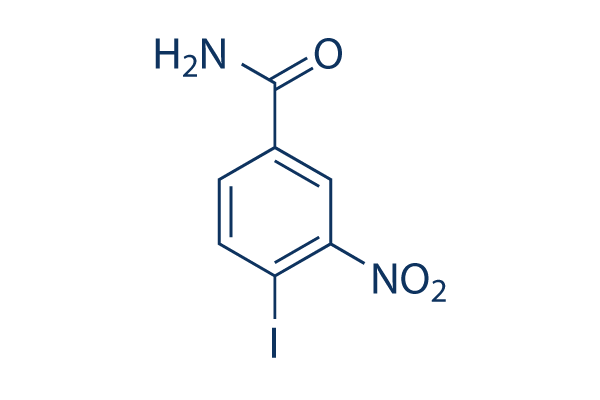
Iniparib (BSI-201) PARP inhibitor
Cat.No.S1087
Quality Control
| Related Targets | HDAC ATM/ATR DNA-PK WRN DNA/RNA Synthesis Topoisomerase PPAR Sirtuin Casein Kinase eIF |
|---|---|
| Other PARP Inhibitors | XAV-939 AZD5305 (Saruparib) Veliparib (ABT-888) PJ34 HCl AG-14361 G007-LK UPF 1069 A-966492 Pamiparib ME0328 |
Solubility
|
In vitro |
DMSO
: 58 mg/mL
(198.6 mM)
Ethanol : 28 mg/mL Water : Insoluble |
Molarity Calculator
|
In vivo |
|||||
In vivo Formulation Calculator (Clear solution)
Step 1: Enter information below (Recommended: An additional animal making an allowance for loss during the experiment)
Step 2: Enter the in vivo formulation (This is only the calculator, not formulation. Please contact us first if there is no in vivo formulation at the solubility Section.)
Calculation results:
Working concentration: mg/ml;
Method for preparing DMSO master liquid: mg drug pre-dissolved in μL DMSO ( Master liquid concentration mg/mL, Please contact us first if the concentration exceeds the DMSO solubility of the batch of drug. )
Method for preparing in vivo formulation: Take μL DMSO master liquid, next addμL PEG300, mix and clarify, next addμL Tween 80, mix and clarify, next add μL ddH2O, mix and clarify.
Method for preparing in vivo formulation: Take μL DMSO master liquid, next add μL Corn oil, mix and clarify.
Note: 1. Please make sure the liquid is clear before adding the next solvent.
2. Be sure to add the solvent(s) in order. You must ensure that the solution obtained, in the previous addition, is a clear solution before proceeding to add the next solvent. Physical methods such
as vortex, ultrasound or hot water bath can be used to aid dissolving.
Chemical Information, Storage & Stability
| Molecular Weight | 292.03 | Formula | C7H5IN2O3 |
Storage (From the date of receipt) | |
|---|---|---|---|---|---|
| CAS No. | 160003-66-7 | Download SDF | Storage of Stock Solutions |
|
|
| Synonyms | NSC-746045, IND-71677 | SMILES | C1=CC(=C(C=C1C(=O)N)[N+](=O)[O-])I | ||
Read more about storage stability stock solution CAS number SMILES
Mechanism of Action
| Targets/IC50/Ki |
PARP1
(Cell-free assay) |
|---|---|
| In vitro |
Iniparib (BSI-201) is described as a prodrug of 4-iodo-3-nitrosobenzamide, an agent that covalently inhibits PARP1 by binding to its first zinc finger under cell-free conditions. Treatment of 120 μM of this compound plus buthionine sulfoximine (BSO) induces a 95% cell death among 855-2 cells, and displays a similar effect in other human cancer cells. It inhibits the growth of E-ras 20 cells, the effect of which can be augmented 4-fold when BOS is added. Recently it shows no ability to inhibit PARP enzymatic or cellular activity, but can non-selectively modify cysteine-containing proteins in tumor cells, suggesting the mechanism of action is likely not via inhibition of PARP activity. At 100 μM, it inhibits ionizing radiation-induced single-strand breaks (SSBs) repair in human lymphoid cell lines based on large endogenous Epstein–Barr virus (EBV) circular episomes assay, resulting in 55% repair by 2 hours, which can be reversed surprisingly by knockdown of PARP1, indicating that the mechanism of inhibition does not involve trapping PARP at SSBs. This compound is not able to selectively kill homologous recombination (HR)-deficient cells between BRCA2-deficient PEO1 and BRCA2-revertant PEO4, or ATM-deficient GM16666 and ATM-restored GM16667 fibroblasts. It is cytotoxic to a variety of cell lines at concentrations above 40 μM reflecting a mechanism independent of PARP.
|
References |
|
Clinical Trial Information
(data from https://clinicaltrials.gov, updated on 2017-09-19)
| NCT Number | Recruitment | Conditions | Sponsor/Collaborators | Start Date | Phases |
|---|---|---|---|---|---|
| NCT01593228 | COMPLETED | Solid Tumors |
Sanofi |
2012-05 | PHASE3 |
| NCT00687765 | COMPLETED | Glioblastoma |
Sanofi |
2008-07 | PHASE1; PHASE2 |
| NCT01551680 | TERMINATED | Brain Metastases |
Institut du Cancer de Montpellier - Val d'Aurelle |
2012-09 | PHASE1 |
| NCT01455532 | COMPLETED | Neoplasm Malignant |
Sanofi |
2011-11 | PHASE1 |
| NCT01082549 | COMPLETED | Squamous Cell Lung Cancer |
Sanofi |
2010-03 | PHASE3 |
| NCT01213381 | COMPLETED | Advance Solid Tumors |
Sanofi |
2010-09 | PHASE1 |
Read more about Clinical Trials
Tech Support
Tel: +1-832-582-8158 Ext:3
If you have any other enquiries, please leave a message.
Signaling Pathway Map

Products are for research use only. Not for human use. We do not sell to patients.
©Copyright 2013 Selleck Chemicals. All Rights Reserved.