
-
 Argentina
-
 Australia
-
 Austria
-
 Belgium
-
 Brazil
-
 Canada
-
 China
China
-
 Czech Republic
-
 Denmark
-
 Finland
-
 France
-
 Germany
-
 Greece
-
 Hong Kong
-
 Hungary
-
 Iceland
-
 India
India
-
 Ireland
-
 Israel
-
 Italy
Italy
-
 Japan
Japan
-
 Korea
Korea
-
 Luxembourg
-
 Malaysia
-
 Netherlands
-
 New Zealand
-
 Norway
-
 Poland
-
 Portugal
-
 Qatar
Qatar
-
 Romania
-
 Saudi Arabia
-
 Singapore
-
 Spain
Spain
-
 Sweden
-
 Switzerland
-
 Taiwan
-
 Turkey
-
 United Kingdom
-
 United States
research use only
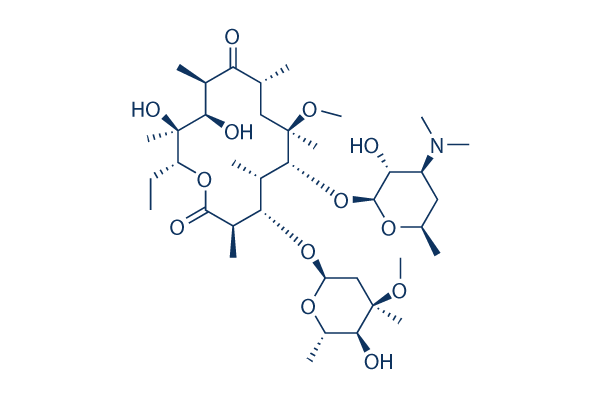
Clarithromycin P450 (e.g. CYP17) inhibitor
Cat.No.S2555
Quality Control
| Related Targets | Dehydrogenase HSP Transferase PDE phosphatase PPAR Vitamin Carbohydrate Metabolism Mitochondrial Metabolism Casein Kinase |
|---|---|
| Other P450 (e.g. CYP17) Inhibitors | Apigenin Baicalein Naringenin Diosmetin Alizarin Sodium Danshensu Naringin Benzbromarone Orteronel Isosilybin |
Solubility
|
In vitro |
DMSO
: 18 mg/mL
(24.06 mM)
Water : Insoluble Ethanol : Insoluble |
Molarity Calculator
|
In vivo |
|||||
In vivo Formulation Calculator (Clear solution)
Step 1: Enter information below (Recommended: An additional animal making an allowance for loss during the experiment)
Step 2: Enter the in vivo formulation (This is only the calculator, not formulation. Please contact us first if there is no in vivo formulation at the solubility Section.)
Calculation results:
Working concentration: mg/ml;
Method for preparing DMSO master liquid: mg drug pre-dissolved in μL DMSO ( Master liquid concentration mg/mL, Please contact us first if the concentration exceeds the DMSO solubility of the batch of drug. )
Method for preparing in vivo formulation: Take μL DMSO master liquid, next addμL PEG300, mix and clarify, next addμL Tween 80, mix and clarify, next add μL ddH2O, mix and clarify.
Method for preparing in vivo formulation: Take μL DMSO master liquid, next add μL Corn oil, mix and clarify.
Note: 1. Please make sure the liquid is clear before adding the next solvent.
2. Be sure to add the solvent(s) in order. You must ensure that the solution obtained, in the previous addition, is a clear solution before proceeding to add the next solvent. Physical methods such
as vortex, ultrasound or hot water bath can be used to aid dissolving.
Chemical Information, Storage & Stability
| Molecular Weight | 747.95 | Formula | C38H69NO13 |
Storage (From the date of receipt) | |
|---|---|---|---|---|---|
| CAS No. | 81103-11-9 | Download SDF | Storage of Stock Solutions |
|
|
| Synonyms | A-56268 | SMILES | CCC1C(C(C(C(=O)C(CC(C(C(C(C(C(=O)O1)C)OC2CC(C(C(O2)C)O)(C)OC)C)OC3C(C(CC(O3)C)N(C)C)O)(C)OC)C)C)O)(C)O | ||
Read more about storage stability stock solution CAS number SMILES
Mechanism of Action
| Targets/IC50/Ki |
CYP3A4
|
|---|---|
| In vitro |
Clarithromycin suppresses this production in a dose-dependent manner in both monocytes and THP-1 cells. This compound regulates three other promoters that have either the NF-kappa B or the AP-1 binding sequences: two synthetic (pAP-1-Luc and pNF-kappa B-Luc) and one naturally occurring (ELAM-Luc). It suppresses NF-kappaB activation induced by TNF-alpha in U-937 and Jurkat cells in a concentration-related manner. The chemical inhibits NF-kappaB activation induced by TNF-alpha in U-937, Jurkat, and A549 cells and PBMC and by SEA in PBMC. It prevents NF-kappaB-dependent reporter gene expression in U-937 cells. This agent results in a significant suppression of production of each cytokine in 71% and a significant increase in 29% of the human monocytes. It inhibits tumor necrosis factor (TNF)-alpha-induced IL-8 gene expression in a dose- and incubation time-dependent manner. This compound represses AP-1 binding in TNF-alpha-treated BET-1A cells. It represses IL-8 gene transcription mainly via the AP-1 binding site in human bronchial epithelial cells. The substance suppresses IL-1 beta gene expression in human nasal epithelial cells stimulated by H. influenzae endotoxin (HIE). It suppresses intercellular adhesion molecule-1 gene expression in nasal fibroblasts stimulated by IL-1 beta. This chemical reduces DNA-binding activity of NF-kappa B in both human nasal epithelial cells and fibroblasts stimulated by HIE or IL-1 beta, respectively.
|
References |
|
Clinical Trial Information
(data from https://clinicaltrials.gov, updated on 2026-03-20)
| NCT Number | Recruitment | Conditions | Sponsor/Collaborators | Start Date | Phases |
|---|---|---|---|---|---|
| NCT07485010 | NOT_YET_RECRUITING | Mycobacterium Abscessus Pulmonary Disease; Mycobacterium Abscessus Infection; Non-Tuberculous Mycobacterial (NTM) Infections; Non-Tuberculous Mycobacteria Pulmonary Disease |
The University of Queensland |
2027-04 | PHASE2 |
| NCT04415983 | RECRUITING | Helicobacter Pylori Infection |
Tanta University |
2020-06-01 | PHASE3 |
| NCT04310930 | RECRUITING | Pulmonary Disease Due to Mycobacteria (Diagnosis) |
The University of Queensland |
2020-03-02 | PHASE2; PHASE3 |
| NCT07104318 | NOT_YET_RECRUITING | Helicobacter Pylori |
VA Office of Research and Development |
2026-10-01 | PHASE3 |
| NCT03236987 | RECRUITING | Lung Infection; MAC Lung Disease |
Centre Hospitalier Universitaire, Amiens |
2018-02-05 | PHASE3 |
| NCT07341100 | ACTIVE_NOT_RECRUITING | Ovarian Epithelial Cancer |
Sichuan Kelun-Biotech Biopharmaceutical Co., Ltd. |
2026-01-16 | PHASE2 |
Read more about Clinical Trials
Tech Support
Tel: +1-832-582-8158 Ext:3
If you have any other enquiries, please leave a message.
Signaling Pathway Map

Products are for research use only. Not for human use. We do not sell to patients.
©Copyright 2013 Selleck Chemicals. All Rights Reserved.