
-
 Argentina
-
 Australia
-
 Austria
-
 Belgium
-
 Brazil
-
 Canada
-
 China
China
-
 Czech Republic
-
 Denmark
-
 Finland
-
 France
-
 Germany
-
 Greece
-
 Hong Kong
-
 Hungary
-
 Iceland
-
 India
India
-
 Ireland
-
 Israel
-
 Italy
Italy
-
 Japan
Japan
-
 Korea
Korea
-
 Luxembourg
-
 Malaysia
-
 Netherlands
-
 New Zealand
-
 Norway
-
 Poland
-
 Portugal
-
 Qatar
Qatar
-
 Romania
-
 Saudi Arabia
-
 Singapore
-
 Spain
Spain
-
 Sweden
-
 Switzerland
-
 Taiwan
-
 Turkey
-
 United Kingdom
-
 United States
research use only
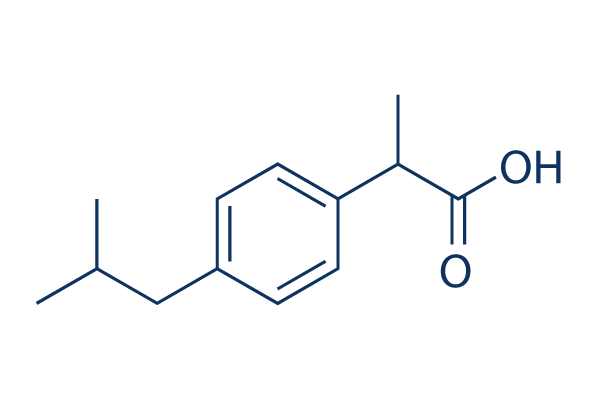
Ibuprofen (NSC 256857) COX inhibitor
Cat.No.S1638
Quality Control
Solubility
|
In vitro |
DMSO
: 41 mg/mL
(198.75 mM)
Ethanol : 41 mg/mL Water : Insoluble |
Molarity Calculator
|
In vivo |
|||||
In vivo Formulation Calculator (Clear solution)
Step 1: Enter information below (Recommended: An additional animal making an allowance for loss during the experiment)
Step 2: Enter the in vivo formulation (This is only the calculator, not formulation. Please contact us first if there is no in vivo formulation at the solubility Section.)
Calculation results:
Working concentration: mg/ml;
Method for preparing DMSO master liquid: mg drug pre-dissolved in μL DMSO ( Master liquid concentration mg/mL, Please contact us first if the concentration exceeds the DMSO solubility of the batch of drug. )
Method for preparing in vivo formulation: Take μL DMSO master liquid, next addμL PEG300, mix and clarify, next addμL Tween 80, mix and clarify, next add μL ddH2O, mix and clarify.
Method for preparing in vivo formulation: Take μL DMSO master liquid, next add μL Corn oil, mix and clarify.
Note: 1. Please make sure the liquid is clear before adding the next solvent.
2. Be sure to add the solvent(s) in order. You must ensure that the solution obtained, in the previous addition, is a clear solution before proceeding to add the next solvent. Physical methods such
as vortex, ultrasound or hot water bath can be used to aid dissolving.
Chemical Information, Storage & Stability
| Molecular Weight | 206.28 | Formula | C13H18O2 |
Storage (From the date of receipt) | |
|---|---|---|---|---|---|
| CAS No. | 15687-27-1 | Download SDF | Storage of Stock Solutions |
|
|
| Synonyms | Dolgesic,NSC 256857 | SMILES | CC(C)CC1=CC=C(C=C1)C(C)C(=O)O | ||
Read more about storage stability stock solution CAS number SMILES
Mechanism of Action
| Features |
Considered a core medicine in the WHO's "WHO Model List of Essential Medicines" (a list of the minimum medical requirements for a basic healthcare system).
|
|---|---|
| Targets/IC50/Ki |
COX-1
13 μM
COX-2
370 μM
|
| In vitro |
Ibuprofen (NSC 256857) works by inhibiting the enzyme cyclooxygenase COX-1 and COX-2, which convert arachidonic acid to prostaglandin H2 (PGH2). Its action is similar to aspirin, indomethacin and all other NSAIDs in intact cells, broken cells, and purified enzyme preparations. This compound inhibits the constitutive activation of NF-κB and IKKα in the androgen-independent prostate tumor cells PC-3 and DU-145. It sensitizes prostate cells to ionizing radiation and blocks stimulated activation of NF-κB following exposure to TNFα or ionizing radiation in the androgen-sensitive prostate tumor cell line LNCaP. Both of these cannot be attributed directly to inhibition of IκB-α kinase but to inhibition of an upstream regulator of IKKα. It exerts an anticancer effect by reducing survival of cancer cells. Ibuprofen is more efficacious than aspirin and acetaminophen, and comparable with (R)-flurbiprofen and indomethacin in induction of p75NTR protein (a tumor and metastasis suppressor) expression in cell lines from bladder and other organs.
|
| Kinase Assay |
Radiochemical enzyme assays for COX-1 and COX-2
|
|
10 μL of purified COX-1 (0.7-0.8 μg) or COX-2 (3.0 units, 0.3μg) is activated with 50 μL of cofactor solution [l-epinephrine (1.3 mg/mL), reduced glutathione (0.3 mg/mL), and hematin (1.3 mg/mL) in oxygen-free Tris-HCl buffer (pH 8.0)]. After [14C]arachidonic acid is added in 0.2 mL eight-strip test tubes and preincubated 10 minutes on ice, the enzyme solution (60 μL) is added to Ibuprofen (NSC 256857) solutions or DMSO (20 μL). Samples are incubated for 15 minutes at 37 °C, after which the reaction is terminated by addition of 10 μL of 2 M HCl and 5 μL of carrier solution (PGE2 and PGF2α, 0.2 μg/mL of each in EtOH). The unmetabolized arachidonic acid is separated from the prostaglandin products by column chromatography and eluted with n-hexane-dioxane-glacial acetic acid (70:30:1). The prostaglandin products are then eluted with EtOAc-MeOH (85:15), and the samples are counted in a Packard scintillation spectrometer. IC50 values are obtained by linear regression analysis.
|
|
| In vivo |
Ibuprofen (NSC 256857) reacts with the heme group of cyclooxygenase to prevent arachidonic acid conversion. Prior exposure to this compound in vivo protects cyclooxygenase completely from the irreversible effects of aspirin in platelets. Its treatment is effective in attenuating joint inflammation and early articular cartilage degeneration in the adult female Sprague-Dawley rat model induced by high-repetition and high-force (HRHF) task. It does this by blocking the increases in serum C1 and 2C (a biomarker of collagen I and II degradation) as well as the ratio of collagen degradation to synthesis (C1, 2C/CPII, the latter a biomarker of collage type II synthesis) induced by HRHF.
|
References |
|
Clinical Trial Information
(data from https://clinicaltrials.gov, updated on 2026-08-19)
| NCT Number | Recruitment | Conditions | Sponsor/Collaborators | Start Date | Phases |
|---|---|---|---|---|---|
| NCT07682558 | NOT_YET_RECRUITING | Cancer Pain; Cancer Palliative Care |
University Hospital, Basel, Switzerland |
2026-10 | PHASE3 |
| NCT07337902 | RECRUITING | Crohn's Disease (CD); Dysmenorrhea Primary |
University of North Carolina, Chapel Hill |
2026-03-18 | |
| NCT07625267 | WITHDRAWN | Acute Uncomplicated Diverticulitis |
Montefiore Medical Center |
2026-07-01 | PHASE4 |
| NCT04059172 | RECRUITING | Pain, Orofacial |
University of Colorado, Denver |
2019-12-10 | EARLY_PHASE1 |
| NCT07620665 | RECRUITING | Cholecystectomy, Laparoscopic; Cholecystectomy, Robotic |
Gangnam Severance Hospital |
2026-06-10 | |
| NCT05512754 | RECRUITING | Elevated Serum PSA |
University of Chicago |
2022-08-01 | PHASE4 |
Read more about Clinical Trials
Tech Support
Tel: +1-832-582-8158 Ext:3
If you have any other enquiries, please leave a message.
Signaling Pathway Map

Products are for research use only. Not for human use. We do not sell to patients.
©Copyright 2013 Selleck Chemicals. All Rights Reserved.