
-
 Argentina
-
 Australia
-
 Austria
-
 Belgium
-
 Brazil
-
 Canada
-
 China
China
-
 Czech Republic
-
 Denmark
-
 Finland
-
 France
-
 Germany
-
 Greece
-
 Hong Kong
-
 Hungary
-
 Iceland
-
 India
India
-
 Ireland
-
 Israel
-
 Italy
Italy
-
 Japan
Japan
-
 Korea
Korea
-
 Luxembourg
-
 Malaysia
-
 Netherlands
-
 New Zealand
-
 Norway
-
 Poland
-
 Portugal
-
 Qatar
Qatar
-
 Romania
-
 Saudi Arabia
-
 Singapore
-
 Spain
Spain
-
 Sweden
-
 Switzerland
-
 Taiwan
-
 Turkey
-
 United Kingdom
-
 United States
research use only
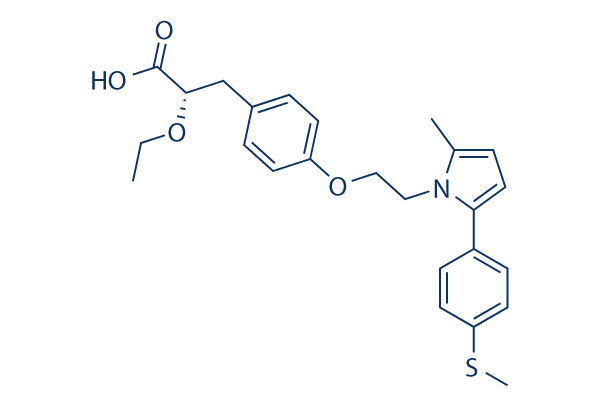
Saroglitazar PPAR agonist
Cat.No.S9674
Quality Control
| Related Targets | Dehydrogenase HSP Transferase P450 (e.g. CYP17) PDE phosphatase Vitamin Carbohydrate Metabolism Mitochondrial Metabolism Casein Kinase |
|---|---|
| Other PPAR Inhibitors | T0070907 GW9662 GW6471 WY-14643 (Pirinixic Acid) GSK3787 GW0742 AZ6102 Harmine Palmitoylethanolamide Astaxanthin |
Solubility
|
In vitro |
|
Molarity Calculator
|
In vivo |
|||||
In vivo Formulation Calculator (Clear solution)
Step 1: Enter information below (Recommended: An additional animal making an allowance for loss during the experiment)
Step 2: Enter the in vivo formulation (This is only the calculator, not formulation. Please contact us first if there is no in vivo formulation at the solubility Section.)
Calculation results:
Working concentration: mg/ml;
Method for preparing DMSO master liquid: mg drug pre-dissolved in μL DMSO ( Master liquid concentration mg/mL, Please contact us first if the concentration exceeds the DMSO solubility of the batch of drug. )
Method for preparing in vivo formulation: Take μL DMSO master liquid, next addμL PEG300, mix and clarify, next addμL Tween 80, mix and clarify, next add μL ddH2O, mix and clarify.
Method for preparing in vivo formulation: Take μL DMSO master liquid, next add μL Corn oil, mix and clarify.
Note: 1. Please make sure the liquid is clear before adding the next solvent.
2. Be sure to add the solvent(s) in order. You must ensure that the solution obtained, in the previous addition, is a clear solution before proceeding to add the next solvent. Physical methods such
as vortex, ultrasound or hot water bath can be used to aid dissolving.
Chemical Information, Storage & Stability
| Molecular Weight | 439.57 | Formula | C25H29NO4S |
Storage (From the date of receipt) | 2 years 4°C liquid |
|---|---|---|---|---|---|
| CAS No. | 495399-09-2 | -- | |||
| Synonyms | Lipaglyn, ZYH1 | SMILES | CCOC(CC1=CC=C(C=C1)OCCN2C(=CC=C2C3=CC=C(C=C3)SC)C)C(=O)O | ||
Read more about storage stability stock solution CAS number SMILES
Mechanism of Action
| Targets/IC50/Ki |
hPPARα
(Cell-free assay) 0.65 pM(EC50)
hPPARγ
(Cell-free assay) 3 nM(EC50)
|
|---|---|
| In vitro |
Saroglitazar is a novel nonthiazolidinediones (TZD) and nonfibric acid derivative designed to act as dual regulator of lipids and glucose metabolism by activating peroxisome proliferator-activated receptors (PPAR). The EC50 values of this compound assessed in HepG2 cells using PPAR transactivation assay for hPPARa and hPPARc are 0.65 pmol/L and 3 nmol/L, respectively. |
| In vivo |
In db/db mice, 12-day treatment with Saroglitazar (0.01–3 mg/kg per day, orally) causes dose-dependent reductions in serum triglycerides (TG), free fatty acids (FFA), and glucose. The ED50 for these effects is found to be 0.05, 0.19, and 0.19 mg/kg, respectively with highly significant (91%) reduction in serum insulin and AUC-glucose following oral glucose administration (59%) at 1 mg/kg dose. Significant reduction in serum TG (upto 90%) is also observed in Zucker fa/fa rats, Swiss albino mice, and in high fat -high cholesterol (HF-HC)-fed Golden Syrian hamsters. LDL cholesterol is significantly lowered in hApoB100/hCETP double transgenic mice and HF-HC diet fed Golden Syrian Hamsters. Hyperinsulinemic-Euglycemic clamp study in Zucker fa/fa rats demonstrates potent insulin-sensitizing activity. This compound also shows a significant decrease in SBP (22 mmHg) and increase (62.1%) in serum adiponectin levels in Zucker fa/fa rats. A 90-day repeated dose comparative study in Wistar rats and marmosets confirms efficacy (TG lowering) potential of this chemical and has indicated low risk of PPAR-associated side effects in humans. |
References |
Clinical Trial Information
(data from https://clinicaltrials.gov, updated on 2026-08-04)
| NCT Number | Recruitment | Conditions | Sponsor/Collaborators | Start Date | Phases |
|---|---|---|---|---|---|
| NCT07216235 | RECRUITING | Primary Biliary Cholangitis |
Zydus Therapeutics Inc. |
2026-03-24 | PHASE3 |
| NCT07424677 | NOT_YET_RECRUITING | Primary Biliary Cholangitis |
Zydus Therapeutics Inc. |
2026-06 | PHASE3 |
| NCT06427395 | ACTIVE_NOT_RECRUITING | Primary Biliary Cholangitis |
Zydus Therapeutics Inc. |
2024-07-16 | PHASE3 |
| NCT06825559 | RECRUITING | Cholestatic Liver Disease |
Zydus Therapeutics Inc. |
2025-08-05 | PHASE1 |
| NCT05045482 | RECRUITING | Hepatic Impairment; Cirrhosis; Cholestatic Liver Disease |
Zydus Therapeutics Inc. |
2021-10-21 | PHASE1 |
| NCT05011305 | COMPLETED | Nonalcoholic Steatohepatitis; Fibrosis |
Zydus Therapeutics Inc. |
2021-08-18 | PHASE2 |
Read more about Clinical Trials
Tech Support
Tel: +1-832-582-8158 Ext:3
If you have any other enquiries, please leave a message.
Signaling Pathway Map

Products are for research use only. Not for human use. We do not sell to patients.
©Copyright 2013 Selleck Chemicals. All Rights Reserved.