
-
 Argentina
-
 Australia
-
 Austria
-
 Belgium
-
 Brazil
-
 Canada
-
 China
China
-
 Czech Republic
-
 Denmark
-
 Finland
-
 France
-
 Germany
-
 Greece
-
 Hong Kong
-
 Hungary
-
 Iceland
-
 India
India
-
 Ireland
-
 Israel
-
 Italy
Italy
-
 Japan
Japan
-
 Korea
Korea
-
 Luxembourg
-
 Malaysia
-
 Netherlands
-
 New Zealand
-
 Norway
-
 Poland
-
 Portugal
-
 Qatar
Qatar
-
 Romania
-
 Saudi Arabia
-
 Singapore
-
 Spain
Spain
-
 Sweden
-
 Switzerland
-
 Taiwan
-
 Turkey
-
 United Kingdom
-
 United States
research use only
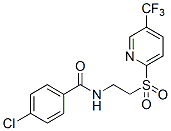
GSK3787 PPAR antagonist
Cat.No.S8025
Quality Control
Solubility
|
In vitro |
DMSO
: 79 mg/mL
(201.13 mM)
Water : Insoluble Ethanol : Insoluble |
Molarity Calculator
|
In vivo |
|||||
In vivo Formulation Calculator (Clear solution)
Step 1: Enter information below (Recommended: An additional animal making an allowance for loss during the experiment)
Step 2: Enter the in vivo formulation (This is only the calculator, not formulation. Please contact us first if there is no in vivo formulation at the solubility Section.)
Calculation results:
Working concentration: mg/ml;
Method for preparing DMSO master liquid: mg drug pre-dissolved in μL DMSO ( Master liquid concentration mg/mL, Please contact us first if the concentration exceeds the DMSO solubility of the batch of drug. )
Method for preparing in vivo formulation: Take μL DMSO master liquid, next addμL PEG300, mix and clarify, next addμL Tween 80, mix and clarify, next add μL ddH2O, mix and clarify.
Method for preparing in vivo formulation: Take μL DMSO master liquid, next add μL Corn oil, mix and clarify.
Note: 1. Please make sure the liquid is clear before adding the next solvent.
2. Be sure to add the solvent(s) in order. You must ensure that the solution obtained, in the previous addition, is a clear solution before proceeding to add the next solvent. Physical methods such
as vortex, ultrasound or hot water bath can be used to aid dissolving.
Chemical Information, Storage & Stability
| Molecular Weight | 392.78 | Formula | C15H12ClF3N2O3S |
Storage (From the date of receipt) | |
|---|---|---|---|---|---|
| CAS No. | 188591-46-0 | Download SDF | Storage of Stock Solutions |
|
|
| Synonyms | N/A | SMILES | C1=CC(=CC=C1C(=O)NCCS(=O)(=O)C2=NC=C(C=C2)C(F)(F)F)Cl | ||
Read more about storage stability stock solution CAS number SMILES
Mechanism of Action
| Targets/IC50/Ki |
PPARδ
6.6(pIC50)
|
|---|---|
| In vitro |
GSK3787 irreversibly antagonizes human and mouse PPARδ that covalently modifies Cys249 within the ligand binding pocket. This compound (1 μM) effectively antagonizes the agonist GW0742 stimulated transcription of CPT1a and PDK4 in human skeletal muscle cells, and effectively antagonize the basal gene expression of CPT1a. It shows no effective antiproliferative activity against colorectal cancer cells. This chemical (1 μM) completely antagonizes 50 nM GW0742-induced PPARβ/δ-dependent Angptl4 gene expression in wild-type fibroblasts and in keratinocytes. It (1 μM) largely antagonizes 50 nM GW0742-induced Angptl4 and Adrp mRNAs expression in skin cancer cell A341. This compound (1 μM) largely antagonizes GW0742-induced Angptl4 mRNAs expression in cancer cell lines MCF7 (breast), Huh7 (liver), and HepG2 (liver) cells but not in H1838 or A549 cells (lung). It (1 μM) largely antagonizes GW0742-induced increase of Adrp mRNA in Huh7 and HepG2 cells but not in H1838 cells. This chemical does not antagonize basal expression of either of these two PPARβ/δtarget genes in these cells. Neither GW0742 nor this compound has any effect on cell proliferation of these cells at concentrations ranging from 0.1 to 10 μM. It is able to modulate the association of both PPARβ/δ and PPARγ coregulator peptides in response to ligand activation. Efficacy of this chemical to modulate PPARγ activity is markedly lower than the efficacy of it to act as a PPARβ/δ antagonist. |
| Kinase Assay |
Saturation binding assay
|
|
Using 96-well culture plates, 50 nM purified human PPARG LBD and the desired concentration of [3H]GW3738 are diluted to a total volume of 100 μL with buffer consisting of 50 mM KCl, 5 mM EDTA, 10 mM dithiothreitol (DTT), 50 mM HEPES, at pH 7. Saturation binding assays are conducted using concentrations of this compound ranging from 1 to 250 nM. Nonspecific binding at each concentration of [3H]GW3738 is estimated in parallel incubations containing 50 μM unlabeled GW 3738. Plates are incubated for 2 h at room temperature. Free ligand is separated from receptor-bound ligand by size exclusion chromatography using commercially available 96-well format spin columns. Samples (50 μL) from each well of a single test plate are loaded onto a buffer- and temperature-equilibrated 96-well gel filtration block. The block is placed on top of a clean microtiter plate and centrifuged at 1100 g for 4 min. Scintillation fluid (180 ul) is added to each well of the plate containing the eluent, and the plates are sealed and allowed to equilibrate for at least 4 h before counting in a counter. The amount of nonspecific binding at each concentration of [3H]GW3738 is subtracted from all wells and plots of this chemical concentration versus counts per minute (cpm) bound are constructed. The Kd values for [3H]GW3738 are determined from a nonlinear least squares fit of the data to a simple binding model.
|
|
| In vivo |
GSK3787 antagonizes ligand-induced PPARβ/δ-dependent gene expression in vivo. Oral administration of this compound has no effect on the expression of Angptl4 and Adrp mRNA in mouse colon epithelium. Coadministration of this chemical (10 mg/kg) effectively prevents the GW0742-induced expression of both Angptl4 and Adrp mRNA in wild-type mouse colon epithelium, which is correlated with reduced promoter occupancy of PPARβ/δ on the Angptl4 and Adrp genes. Administration of this compound had no effect on glucose tolerance. |
References |
|
Tech Support
Tel: +1-832-582-8158 Ext:3
If you have any other enquiries, please leave a message.
Signaling Pathway Map

Products are for research use only. Not for human use. We do not sell to patients.
©Copyright 2013 Selleck Chemicals. All Rights Reserved.