
-
 Argentina
-
 Australia
-
 Austria
-
 Belgium
-
 Brazil
-
 Canada
-
 China
China
-
 Czech Republic
-
 Denmark
-
 Finland
-
 France
-
 Germany
-
 Greece
-
 Hong Kong
-
 Hungary
-
 Iceland
-
 India
India
-
 Ireland
-
 Israel
-
 Italy
Italy
-
 Japan
Japan
-
 Korea
Korea
-
 Luxembourg
-
 Malaysia
-
 Netherlands
-
 New Zealand
-
 Norway
-
 Poland
-
 Portugal
-
 Qatar
Qatar
-
 Romania
-
 Saudi Arabia
-
 Singapore
-
 Spain
Spain
-
 Sweden
-
 Switzerland
-
 Taiwan
-
 Turkey
-
 United Kingdom
-
 United States
research use only
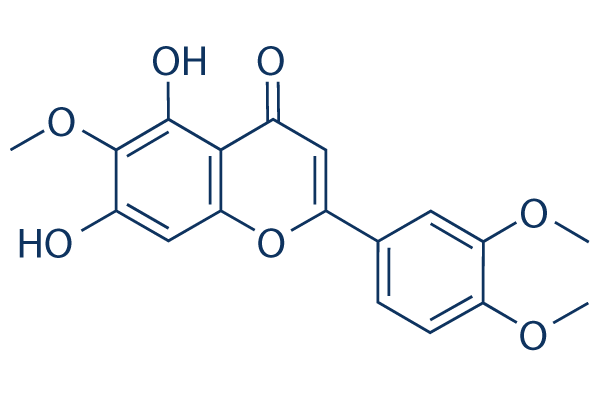
Eupatilin PPAR agonist
Cat.No.S3846
Quality Control
| Related Targets | Dehydrogenase HSP Transferase P450 (e.g. CYP17) PDE phosphatase Vitamin Carbohydrate Metabolism Mitochondrial Metabolism Casein Kinase |
|---|---|
| Other PPAR Inhibitors | T0070907 GW9662 GW6471 WY-14643 (Pirinixic Acid) GSK3787 GW0742 AZ6102 Harmine Palmitoylethanolamide Astaxanthin |
Solubility
|
In vitro |
DMSO
: 68 mg/mL
(197.49 mM)
|
Molarity Calculator
|
In vivo |
|||||
In vivo Formulation Calculator (Clear solution)
Step 1: Enter information below (Recommended: An additional animal making an allowance for loss during the experiment)
Step 2: Enter the in vivo formulation (This is only the calculator, not formulation. Please contact us first if there is no in vivo formulation at the solubility Section.)
Calculation results:
Working concentration: mg/ml;
Method for preparing DMSO master liquid: mg drug pre-dissolved in μL DMSO ( Master liquid concentration mg/mL, Please contact us first if the concentration exceeds the DMSO solubility of the batch of drug. )
Method for preparing in vivo formulation: Take μL DMSO master liquid, next addμL PEG300, mix and clarify, next addμL Tween 80, mix and clarify, next add μL ddH2O, mix and clarify.
Method for preparing in vivo formulation: Take μL DMSO master liquid, next add μL Corn oil, mix and clarify.
Note: 1. Please make sure the liquid is clear before adding the next solvent.
2. Be sure to add the solvent(s) in order. You must ensure that the solution obtained, in the previous addition, is a clear solution before proceeding to add the next solvent. Physical methods such
as vortex, ultrasound or hot water bath can be used to aid dissolving.
Chemical Information, Storage & Stability
| Molecular Weight | 344.32 | Formula | C18H16O7 |
Storage (From the date of receipt) | |
|---|---|---|---|---|---|
| CAS No. | 22368-21-4 | Download SDF | Storage of Stock Solutions |
|
|
| Synonyms | NSC 122413 | SMILES | COC1=C(C=C(C=C1)C2=CC(=O)C3=C(O2)C=C(C(=C3O)OC)O)OC | ||
Read more about storage stability stock solution CAS number SMILES
Mechanism of Action
| In vitro |
Eupatilin has been reported to induce apoptosis in human gastric cancer AGS cells, also triggers differentiation of these cells. Treatment of AGS cells with this compound induces cell cycle arrest at the G1 phase with the concomitant induction of p21cip1, a cell cycle inhibitor. It also markedly induces trefoil factor1(TFF1). This compound dramatically induces redistribution of tight junction proteins such as occludin and ZO-1, and F-actin at the junctional region between cells. It also induces phosphorylation of extracellular signal-regulated kinase 2 and p38 kinase. This chemical is known to inhibit the growth of MCF-10A-ras cells by inhibiting the expression of cell cycle regulators such as cyclinD1, cyclinB1, Cdk2, and Cdc2.
|
|---|---|
| In vivo |
Treatment with eupatilin significantly decreases serum alanine aminotransferase and serum aspartate aminotransferase as well as liver histologic changes. This compound also preventes hepatic glutathione depletion and increases malondialdehyde levels induced by Ischemia-reperfusion injury (IRI). It improves the acute hepatic IRI by reducing inflammation and apoptosis. Oral administration of this chemical (10 mg/kg) in a therapeutic paradigm significantly reduces brain infarction and improves neurological functions in tMCAO-challenged mice. Its administration reduces the number of Iba1-immunopositive cells across ischemic brain and induces their morphological changes from amoeboid into ramified in the ischemic core, which is accompanied with reduced microglial proliferation in ischemic brain. This agent suppresses NF-κB signaling activities in ischemic brain by reducing IKKα/β phosphorylation, IκBα phosphorylation, and IκBα degradation.
|
References |
|
Clinical Trial Information
(data from https://clinicaltrials.gov, updated on 2021-05-13)
| NCT Number | Recruitment | Conditions | Sponsor/Collaborators | Start Date | Phases |
|---|---|---|---|---|---|
| NCT04885751 | UNKNOWN | Rheumatoid Arthritis; Osteoarthritis; Ankylosing Spondylitis; Other Musculoskeletal Disorder; Gastric Ulcer; Enteritis; NSAID-Associated Gastropathy; NSAID (Non-Steroidal Anti-Inflammatory Drug) Induced Enteropathy |
Seoul National University Boramae Hospital |
2021-06-01 | PHASE4 |
Read more about Clinical Trials
Tech Support
Tel: +1-832-582-8158 Ext:3
If you have any other enquiries, please leave a message.
Signaling Pathway Map

Products are for research use only. Not for human use. We do not sell to patients.
©Copyright 2013 Selleck Chemicals. All Rights Reserved.