
-
 Argentina
-
 Australia
-
 Austria
-
 Belgium
-
 Brazil
-
 Canada
-
 China
China
-
 Czech Republic
-
 Denmark
-
 Finland
-
 France
-
 Germany
-
 Greece
-
 Hong Kong
-
 Hungary
-
 Iceland
-
 India
India
-
 Ireland
-
 Israel
-
 Italy
Italy
-
 Japan
Japan
-
 Korea
Korea
-
 Luxembourg
-
 Malaysia
-
 Netherlands
-
 New Zealand
-
 Norway
-
 Poland
-
 Qatar
Qatar
-
 Romania
-
 Saudi Arabia
-
 Singapore
-
 Spain
Spain
-
 Sweden
-
 Switzerland
-
 Taiwan
-
 Turkey
-
 United Kingdom
-
 United States
research use only
WY-14643 (Pirinixic Acid) PPAR activator
Cat.No.S8029
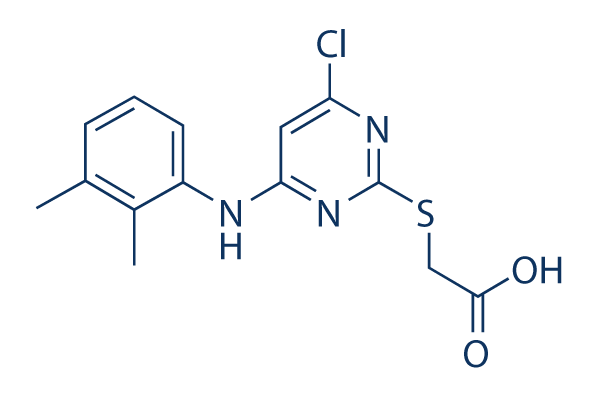
Chemical Structure
Molecular Weight: 323.8
Quality Control
| Related Targets | Dehydrogenase HSP Transferase P450 (e.g. CYP17) PDE phosphatase Vitamin Carbohydrate Metabolism Mitochondrial Metabolism Casein Kinase |
|---|---|
| Other PPAR Inhibitors | T0070907 GW9662 GW6471 GSK3787 GW0742 AZ6102 Harmine Palmitoylethanolamide Astaxanthin Eupatilin |
Cell Culture, Treatment & Working Concentration
| Cell Lines | Assay Type | Concentration | Incubation Time | Formulation | Activity Description | PMID |
|---|---|---|---|---|---|---|
| Hep G2 cells | Function assay | Agonist activity at mouse PPARalpha ligand binding domain expressed in human Hep G2 cells co-transfected with Gal4-DBD by luciferase reporter gene assay, EC50=0.04 μM | ||||
| MCF7 cells | Function assay | Agonist activity at human PPARalpha expressed in MCF7 cells co-transfected CPTI DR1-type RE after 6 hrs by luciferase reporter gene assay, EC50=0.542 μM | ||||
| U2OS cells | Function assay | Agonist activity at human PPARalpha in U2OS cells by transactivation assay, EC50=12 μM | ||||
| HEK293 cells | Function assay | Agonist activity at human PPARalpha expressed in HEK293 cells cotransfected with PPREx4-TK-luc assessed as activation of luciferase activity measured after 48 hrs by transactivation assay, EC50=23.33 μM | ||||
| COS7 cells | Function assay | Activation of human PPARalpha ligand binding domain expressed in COS7 cells by luciferase reporter gene assay, IC50=36.3 μM | ||||
| EAhy926 cells | Function assay | 10 uM | 12 h | Inhibition of tube formation in human EAhy926 cells at 10 uM pre-incubated for 12 hrs measured after 24 hrs by phase-contrast microscopy | ||
| mouse NIH3T3 cells | Function assay | 0.1-10 μM | Transactivation of mouse recombinant PPARalpha expressed in mouse NIH3T3 cells at 0.1 uM to 10 uM by PPRE activation based dual luciferase reporter gene assay relative to control | |||
| HepaR cells | Function assay | 25 μM | 1 day | Agonist activity at PPARalpha in human HepaR cells assessed as increase in HMGCS2 gene expression at 25 uM incubated for 1 day by quantitative PCR method relative to untreated control | ||
| Click to View More Cell Line Experimental Data | ||||||
Solubility
|
In vitro |
DMSO
: 64 mg/mL
(197.65 mM)
Ethanol : 64 mg/mL Water : Insoluble |
Molarity Calculator
|
In vivo |
|||||
In vivo Formulation Calculator (Clear solution)
Step 1: Enter information below (Recommended: An additional animal making an allowance for loss during the experiment)
Step 2: Enter the in vivo formulation (This is only the calculator, not formulation. Please contact us first if there is no in vivo formulation at the solubility Section.)
Calculation results:
Working concentration: mg/ml;
Method for preparing DMSO master liquid: mg drug pre-dissolved in μL DMSO ( Master liquid concentration mg/mL, Please contact us first if the concentration exceeds the DMSO solubility of the batch of drug. )
Method for preparing in vivo formulation: Take μL DMSO master liquid, next addμL PEG300, mix and clarify, next addμL Tween 80, mix and clarify, next add μL ddH2O, mix and clarify.
Method for preparing in vivo formulation: Take μL DMSO master liquid, next add μL Corn oil, mix and clarify.
Note: 1. Please make sure the liquid is clear before adding the next solvent.
2. Be sure to add the solvent(s) in order. You must ensure that the solution obtained, in the previous addition, is a clear solution before proceeding to add the next solvent. Physical methods such
as vortex, ultrasound or hot water bath can be used to aid dissolving.
Chemical Information, Storage & Stability
| Molecular Weight | 323.8 | Formula | C14H14ClN3O2S |
Storage (From the date of receipt) | |
|---|---|---|---|---|---|
| CAS No. | 50892-23-4 | Download SDF | Storage of Stock Solutions |
|
|
| Synonyms | NSC 310038 | Smiles | CC1=C(C(=CC=C1)NC2=CC(=NC(=N2)SCC(=O)O)Cl)C | ||
Mechanism of Action
| Targets/IC50/Ki |
PPARα
1.5 μM(EC50)
|
|---|---|
| In vitro |
WY 14643 (10 μM) almost completely inhibits interleukin-1-induced production of interleukin-6 and prostaglandin and expression of cyclooxygenase-2 in aortic smooth-muscle cells, through repression of NF-κB signaling. WY14643 (250 μM) reduces VCAM-1 expression levels significantly, to 52 % of TNF-α-stimulated human endothelial cells. Pretreatment of endothelial cells with WY 14643 (10 μM) before TNF-α stimulation reduces U937 cell adhesion by 50%. |
| In vivo |
WY 14643 (1 mg/kg i.v. bolus) administration at 30 min before left anterior descending occlusion, causes significant reduction in infarct size of ∼44% in rats subjected to regional myocardial ischemia (25 min) and reperfusion (2 h). WY 14643 (3 mg/kg) lowers basal plasma levels of glucose, triglycerides (-16% vs. untreated), and leptin (-52%), and also muscle triglyceride (-34%) and total long-chain acyl-CoAs (LCACoAs) (-41%) in high fat-fed rats. WY14643 substantially reduces visceral fat weight and total liver triglyceride content without increasing body weight gain. WY14643 enhances whole body insulin sensitivity (clamp glucose infusion rate increases 35% and glucose disposals 22%, vs. untreated). WY 14643 enhances insulin-mediated muscle glucose metabolic index (Rg') in red (47%) and white (63%) muscles as well as in white adipose tissue (90%), and reduces muscle triglyceride and LCACoA accumulation. |
References |
|
Tech Support
Tel: +1-832-582-8158 Ext:3
If you have any other enquiries, please leave a message.
Signaling Pathway Map

Products are for research use only. Not for human use. We do not sell to patients.
©Copyright 2013 Selleck Chemicals. All Rights Reserved.