
-
 Argentina
-
 Australia
-
 Austria
-
 Belgium
-
 Brazil
-
 Canada
-
 China
China
-
 Czech Republic
-
 Denmark
-
 Finland
-
 France
-
 Germany
-
 Greece
-
 Hong Kong
-
 Hungary
-
 Iceland
-
 India
India
-
 Ireland
-
 Israel
-
 Italy
Italy
-
 Japan
Japan
-
 Korea
Korea
-
 Luxembourg
-
 Malaysia
-
 Netherlands
-
 New Zealand
-
 Norway
-
 Poland
-
 Qatar
Qatar
-
 Romania
-
 Saudi Arabia
-
 Singapore
-
 Spain
Spain
-
 Sweden
-
 Switzerland
-
 Taiwan
-
 Turkey
-
 United Kingdom
-
 United States
research use only
AZ6102 PPAR inhibitor
Cat.No.S7767
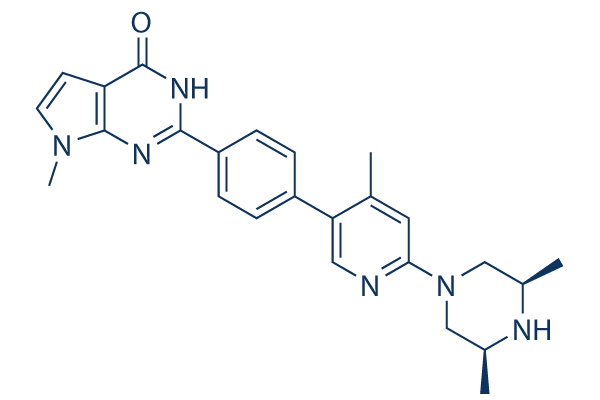
Chemical Structure
Molecular Weight: 428.53
Quality Control
| Related Targets | HDAC PARP ATM/ATR DNA-PK WRN DNA/RNA Synthesis Topoisomerase Sirtuin Casein Kinase eIF |
|---|---|
| Other PPAR Inhibitors | T0070907 GW9662 GW6471 WY-14643 (Pirinixic Acid) GSK3787 GW0742 Harmine Palmitoylethanolamide Astaxanthin Eupatilin |
Solubility
|
In vitro |
DMSO
: 28 mg/mL
(65.33 mM)
Warmed with 60°C water bath;
Ultrasonicated;
Water : Insoluble Ethanol : Insoluble |
Molarity Calculator
|
In vivo |
|||||
In vivo Formulation Calculator (Clear solution)
Step 1: Enter information below (Recommended: An additional animal making an allowance for loss during the experiment)
Step 2: Enter the in vivo formulation (This is only the calculator, not formulation. Please contact us first if there is no in vivo formulation at the solubility Section.)
Calculation results:
Working concentration: mg/ml;
Method for preparing DMSO master liquid: mg drug pre-dissolved in μL DMSO ( Master liquid concentration mg/mL, Please contact us first if the concentration exceeds the DMSO solubility of the batch of drug. )
Method for preparing in vivo formulation: Take μL DMSO master liquid, next addμL PEG300, mix and clarify, next addμL Tween 80, mix and clarify, next add μL ddH2O, mix and clarify.
Method for preparing in vivo formulation: Take μL DMSO master liquid, next add μL Corn oil, mix and clarify.
Note: 1. Please make sure the liquid is clear before adding the next solvent.
2. Be sure to add the solvent(s) in order. You must ensure that the solution obtained, in the previous addition, is a clear solution before proceeding to add the next solvent. Physical methods such
as vortex, ultrasound or hot water bath can be used to aid dissolving.
Chemical Information, Storage & Stability
| Molecular Weight | 428.53 | Formula | C25H28N6O |
Storage (From the date of receipt) | |
|---|---|---|---|---|---|
| CAS No. | 1645286-75-4 | Download SDF | Storage of Stock Solutions |
|
|
| Synonyms | AZ-6102 | Smiles | CC1CN(CC(N1)C)C2=NC=C(C(=C2)C)C3=CC=C(C=C3)C4=NC5=C(C=CN5C)C(=O)N4 | ||
Mechanism of Action
| Targets/IC50/Ki |
TNKS1
TNKS2
|
|---|---|
| In vitro |
AZ6102 inhibits TNKS1 and TNKS2 in enzymatic assays and TCF4 reporter assays (<5nM). This compound inhibits proliferation of Colo320DM (GI50 ~40nM), but has no anti-proliferative activity in the β-catenin mutant cell line HCT-116, or the BRCA mutant cell line MDA-MB-436. In Colo320DM, it stabilizes axin2 protein and modulates Wnt target genes in a dose and time dependent manner both in vitro and in vivo.
|
| In vivo |
Nude mice are administered 25 mg/kg of AZ-6102. This compound has a half-life of 4 hours and a CL of 24 mL/min.kg. Further analysis in mouse and rats shows that it has a moderate bioavailability at 12% and 18%, respectively. Western blot analysis for TNKS1, TNSK2 and Axin2 of treated DLD-1 cells shows that this chemical had qualitatively stronger and longer lasting stabilization of TNSK1, TNSK2 and Axin2 than XAV-939 at lower concentrations (at 24, 48 and 72h). It has good pharmacokinetics in preclinical species with low Caco2 efflux (to avoid possible tumor resistance mechanisms). In addition, it can be formulated in a clinically relevant intravenous solution at 20 mg/mL using SBECD as an excipient at pH4. The results of this compound used as an i.v. probe compound to explore the in vivo effects of the inhibition of TNKS1 and TNSK2 on tumor xenografts and normal tissue are forthcoming.
|
References |
|
Tech Support
Tel: +1-832-582-8158 Ext:3
If you have any other enquiries, please leave a message.
Signaling Pathway Map

Products are for research use only. Not for human use. We do not sell to patients.
©Copyright 2013 Selleck Chemicals. All Rights Reserved.