
-
 Argentina
-
 Australia
-
 Austria
-
 Belgium
-
 Brazil
-
 Canada
-
 China
China
-
 Czech Republic
-
 Denmark
-
 Finland
-
 France
-
 Germany
-
 Greece
-
 Hong Kong
-
 Hungary
-
 Iceland
-
 India
India
-
 Ireland
-
 Israel
-
 Italy
Italy
-
 Japan
Japan
-
 Korea
Korea
-
 Luxembourg
-
 Malaysia
-
 Netherlands
-
 New Zealand
-
 Norway
-
 Poland
-
 Portugal
-
 Qatar
Qatar
-
 Romania
-
 Saudi Arabia
-
 Singapore
-
 Spain
Spain
-
 Sweden
-
 Switzerland
-
 Taiwan
-
 Turkey
-
 United Kingdom
-
 United States
research use only
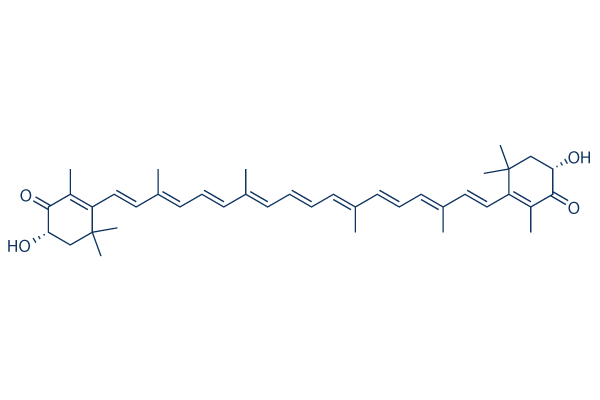
Astaxanthin PPAR modulator
Cat.No.S3834
Quality Control
| Related Targets | Dehydrogenase HSP Transferase P450 (e.g. CYP17) PDE phosphatase Vitamin Carbohydrate Metabolism Mitochondrial Metabolism Casein Kinase |
|---|---|
| Other PPAR Inhibitors | T0070907 GW9662 GW6471 WY-14643 (Pirinixic Acid) GSK3787 GW0742 AZ6102 Harmine Palmitoylethanolamide Eupatilin |
Solubility
|
In vitro |
DMSO
: 6 mg/mL
(10.05 mM)
Warmed with 60°C water bath;
Ultrasonicated;
Water : Insoluble Ethanol : Insoluble |
Molarity Calculator
|
In vivo |
|||||
In vivo Formulation Calculator (Clear solution)
Step 1: Enter information below (Recommended: An additional animal making an allowance for loss during the experiment)
Step 2: Enter the in vivo formulation (This is only the calculator, not formulation. Please contact us first if there is no in vivo formulation at the solubility Section.)
Calculation results:
Working concentration: mg/ml;
Method for preparing DMSO master liquid: mg drug pre-dissolved in μL DMSO ( Master liquid concentration mg/mL, Please contact us first if the concentration exceeds the DMSO solubility of the batch of drug. )
Method for preparing in vivo formulation: Take μL DMSO master liquid, next addμL PEG300, mix and clarify, next addμL Tween 80, mix and clarify, next add μL ddH2O, mix and clarify.
Method for preparing in vivo formulation: Take μL DMSO master liquid, next add μL Corn oil, mix and clarify.
Note: 1. Please make sure the liquid is clear before adding the next solvent.
2. Be sure to add the solvent(s) in order. You must ensure that the solution obtained, in the previous addition, is a clear solution before proceeding to add the next solvent. Physical methods such
as vortex, ultrasound or hot water bath can be used to aid dissolving.
Chemical Information, Storage & Stability
| Molecular Weight | 596.84 | Formula | C40H52O4 |
Storage (From the date of receipt) | |
|---|---|---|---|---|---|
| CAS No. | 472-61-7 | Download SDF | Storage of Stock Solutions |
|
|
| Synonyms | β-Carotene-4,4'-dione, Trans-Astaxanthin | SMILES | CC1=C(C(CC(C1=O)O)(C)C)C=CC(=CC=CC(=CC=CC=C(C)C=CC=C(C)C=CC2=C(C(=O)C(CC2(C)C)O)C)C)C | ||
Read more about storage stability stock solution CAS number SMILES
Mechanism of Action
| In vitro |
Astaxaxanthin is a carotenoid nutrient with molecular properties that precisely position it within cell membranes and circulating lipoproteins, thereby imbuing them with potent antioxidant and anti-inflammatory actions. This compound also effectively protects the double membrane system of mitochondria, to the point of boosting their energy production efficiency. In cultured cells, it protects the mitochondria against endogenous oxygen radicals, conserves their redox (antioxidant) capacity, and enhances their energy production efficiency. It has also protected human LDL against oxidative attack. This chemical specifically protects the mitochondria of cultured nerve cells against toxic attack and stimulates the proliferation of cultured nerve stem cells. It effectively protects cultured nerve cells against hydrogen peroxide toxicity, and down-regulates genes linked to cell death and up-regulates genes linked to cell survival.
|
|---|---|
| In vivo |
In pharmacokinetic studies, after ingestion of esterified natural astaxanthin, only unesterified astaxanthin appears in the blood. This compound's bioavailability is substantially affected by meal timing and by smoking. Supplementation with this chemical may lower lipid peroxidation in vivo. It significantly improves the memory performance of mice in the Morris water maze. It has demonstrated safety in numerous human clinical trials. The doses of this compound used in clinical trials have ranged from 1 mg/day to 40 mg/day (with the majority in the 6-12 mg range); single-dose pharmacokinetic studies use up to 100 mg per dose.
|
References |
|
Clinical Trial Information
(data from https://clinicaltrials.gov, updated on 2026-01-30)
| NCT Number | Recruitment | Conditions | Sponsor/Collaborators | Start Date | Phases |
|---|---|---|---|---|---|
| NCT07379437 | NOT_YET_RECRUITING | Brain Aging |
Capital Medical University |
2026-05-01 | |
| NCT07684391 | NOT_YET_RECRUITING | COPD |
China-Japan Friendship Hospital |
2026-07-01 | |
| NCT07063056 | RECRUITING | Triglycerides |
Medinutra LLC |
2025-07-18 | |
| NCT07507682 | RECRUITING | Asthma (Diagnosis); Airway Inflammation; Airway Hyperresponsiveness |
Middlesex University |
2026-05-15 | |
| NCT07630870 | ACTIVE_NOT_RECRUITING | Healthy |
China Medical University Hospital |
2025-08-01 | |
| NCT07509970 | COMPLETED | Conditions or Focus of Study; Exercise-Induced Fatigue; Soccer Performance |
Beijing Sport University |
2026-01-01 |
Read more about Clinical Trials
Tech Support
Tel: +1-832-582-8158 Ext:3
If you have any other enquiries, please leave a message.
Signaling Pathway Map

Products are for research use only. Not for human use. We do not sell to patients.
©Copyright 2013 Selleck Chemicals. All Rights Reserved.