research use only

Go 6983 PKC inhibitor

Cat.No.S2911
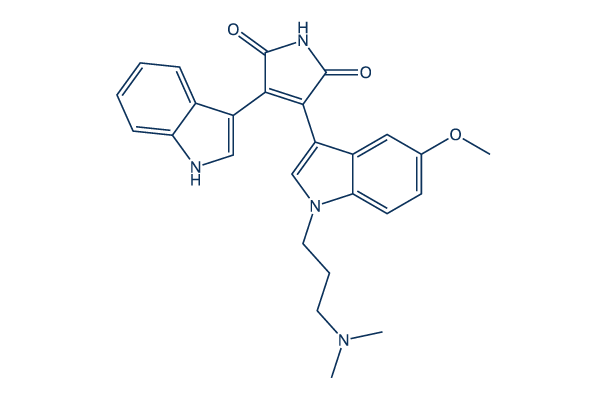
Go 6983 (GOE 6983, Gö 6983) is a pan-PKC inhibitor against for PKCα, PKCβ, PKCγ and PKCδ with IC50 of 7 nM, 7 nM, 6 nM and 10 nM, respectively; this compound is less potent to PKCζ and inactive to PKCμ.
Go 6983 PKC inhibitor Chemical Structure

Chemical Structure

Molecular Weight: 442.51

Quality Control

Cell Culture, Treatment & Working Concentration

Cell Lines Assay Type Concentration Incubation Time Formulation Activity Description PMID
PC12 Function assay 0.5 μM GO6983 blocked the effect of PMA on the activation of Akt and MAPK induced by IGF-1 10788447
PC-3 Function assay 1 μM 2 h Gö6983 abrogates the TPA-induced RGFR transactivation response 15897236
HCT116 Function assay 2 μM 8 h attenuated PMA-induced FLIP mRNA expression 16052516
HT29 Function assay 2 μM 8 h attenuated PMA-induced FLIP mRNA expression 16052516
KM20 Function assay 2 μM 8 h attenuated PMA-induced FLIP mRNA expression 16052516
KM12C Function assay 2 μM 8 h attenuated PMA-induced FLIP mRNA expression 16052516
Caco-2 Function assay 2 μM 8 h completely attenuated PMA-induced FLIP mRNA expression 16052516
A549 Function assay 10 μM 1 h markedly inhibited ATPγS-stimulated NADPH oxidase activity and H2O2 and/or ROS generation 23326583
HeLa Function assay 2 μM 48 h suppressed the effect of PMA on apicularen A-induced cytotoxicity 24447339
A673 qHTS assay qHTS of pediatric cancer cell lines to identify multiple opportunities for drug repurposing: Primary screen for A673 cells 29435139
NB-EBc1 qHTS assay qHTS of pediatric cancer cell lines to identify multiple opportunities for drug repurposing: Primary screen for NB-EBc1 cells 29435139
SK-N-SH qHTS assay qHTS of pediatric cancer cell lines to identify multiple opportunities for drug repurposing: Primary screen for SK-N-SH cells 29435139
LAN-5 qHTS assay qHTS of pediatric cancer cell lines to identify multiple opportunities for drug repurposing: Primary screen for LAN-5 cells 29435139
NB1643 qHTS assay qHTS of pediatric cancer cell lines to identify multiple opportunities for drug repurposing: Confirmatory screen for NB1643 cells 29435139
SK-N-MC qHTS assay qHTS of pediatric cancer cell lines to identify multiple opportunities for drug repurposing: Confirmatory screen for SK-N-MC cells 29435139
LAN-5 qHTS assay qHTS of pediatric cancer cell lines to identify multiple opportunities for drug repurposing: Confirmatory screen for LAN-5 cells 29435139
DAOY qHTS assay qHTS of pediatric cancer cell lines to identify multiple opportunities for drug repurposing: Confirmatory screen for DAOY cells 29435139
BT-37 qHTS assay qHTS of pediatric cancer cell lines to identify multiple opportunities for drug repurposing: Confirmatory screen for BT-37 cells 29435139
TC32 qHTS assay qHTS of pediatric cancer cell lines to identify multiple opportunities for drug repurposing: Confirmatory screen for TC32 cells 29435139
Rh41 qHTS assay qHTS of pediatric cancer cell lines to identify multiple opportunities for drug repurposing: Confirmatory screen for Rh41 cells 29435139
Rh30 qHTS assay qHTS of pediatric cancer cell lines to identify multiple opportunities for drug repurposing: Confirmatory screen for Rh30 cells 29435139
OHS-50 qHTS assay qHTS of pediatric cancer cell lines to identify multiple opportunities for drug repurposing: Confirmatory screen for OHS-50 cells 29435139
SK-N-SH qHTS assay qHTS of pediatric cancer cell lines to identify multiple opportunities for drug repurposing: Confirmatory screen for SK-N-SH cells 29435139
HEK293 Function assay Inhibition of Cav1.2 calcium current measured using whole cell patch clamp in human HEK293 cells transfected with rabbit L-type calcium channel subunits, IC50 = 20 μM. ChEMBL
Click to View More Cell Line Experimental Data

Chemical Information, Storage & Stability

Molecular Weight 442.51 Formula

C26H26N4O3

Storage (From the date of receipt)
CAS No. 133053-19-7 Download SDF Storage of Stock Solutions

Synonyms GOE 6983, Gö 6983 Smiles CN(C)CCCN1C=C(C2=C1C=CC(=C2)OC)C3=C(C(=O)NC3=O)C4=CNC5=CC=CC=C54

Solubility

In vitro
Batch:

DMSO : 89 mg/mL ( (201.12 mM) Moisture-absorbing DMSO reduces solubility. Please use fresh DMSO.)

Water : Insoluble

Ethanol : Insoluble

Molarity Calculator

Mass Concentration Volume Molecular Weight

In vivo
Batch:

In vivo Formulation Calculator (Clear solution)

Step 1: Enter information below (Recommended: An additional animal making an allowance for loss during the experiment)

mg/kg g μL

Step 2: Enter the in vivo formulation (This is only the calculator, not formulation. Please contact us first if there is no in vivo formulation at the solubility Section.)

% DMSO % % Tween 80 % ddH2O
%DMSO %

Calculation results:

Working concentration: mg/ml;

Method for preparing DMSO master liquid: mg drug pre-dissolved in μL DMSO ( Master liquid concentration mg/mL, Please contact us first if the concentration exceeds the DMSO solubility of the batch of drug. )

Method for preparing in vivo formulation: Take μL DMSO master liquid, next addμL PEG300, mix and clarify, next addμL Tween 80, mix and clarify, next add μL ddH2O, mix and clarify.

Method for preparing in vivo formulation: Take μL DMSO master liquid, next add μL Corn oil, mix and clarify.

Note: 1. Please make sure the liquid is clear before adding the next solvent.
2. Be sure to add the solvent(s) in order. You must ensure that the solution obtained, in the previous addition, is a clear solution before proceeding to add the next solvent. Physical methods such
as vortex, ultrasound or hot water bath can be used to aid dissolving.

Mechanism of Action

Targets/IC50/Ki
PKCγ [1]
(Cell-free assay)
6 nM
PKCα [1]
(Cell-free assay)
7 nM
PKCβ [1]
(Cell-free assay)
7 nM
PKCδ [1]
(Cell-free assay)
10 nM
PKCζ [1]
(Cell-free assay)
60 nM
In vitro

Go 6983 (300 μM) suppresses PKCμ auto-phosphorylation by 20% reduction in NIH3T3 transfected with PKCμ. [1]

In hearts reperfused with PMNs and this compound (100 nM), left ventricular developed pressure (LVDP) and the rate of LVDP recoveres to 89% and 74% of baseline values, respectively, significantly higher than PMNs alone. This chemical (100 nM) significantly reduces PMNs adherence to the endothelium and infiltration into the myocardium compared with Ischemia followed by reperfusion (I/R)+ PMN hearts, and significantly inhibits superoxide release from PMNs by 90%. It attenuates post-I/R cardiac contractile dysfunction in the presence of PMNs, which may be related in part to decreased superoxide production. [2]

This inhibitor significantly inhibits antigen-induced superoxide release from leukocytes of patients previously sensitized to tree pollen. It inhibited intracellular Ca(2+) accumulation in human vascular tissue, suggesting a mechanism for its vasodilator properties. [3]

This compound (1 μM) combined with Ro-31-8425 (390 nM) slightly inhibits Angiotensin II–induced PLD2 activity in PGSMCs. [4]

It is isoform-specific PKC inhibitor that target the ATP binding site. It inhibits ΔPfPKB activity with an IC50 of 1 μM. In this chemical (5 μM)-treated cells, the number of rings in the following cycle is markedly less compared with the control cultures. This treatment (5 μM) results in an almost 60% decrease in formation of new rings in P. falciparum cultures. [5]

Kinase Assay
Binding assay
Phosphorylation reactions are carried out in a total volume of 100 μL, containing buffer C (50 mM Tris-HC1, pH 7.5, 10 mM β-mercaptoethanol), 4 mM MgCl2, 10 μg PS, 100 nM TPA, 5 μL of a Sf158 cell extract as a source of recombinant PKCμ or of Sf9 cell extracts as a source of other recombinant PKC isoenzymes, 10 μg of syntide 2 as substrate, and 35 μM ATP containing 1 μCi [γ-32P]ATP. In some experiments PS and TPA are omitted or various inhibitors at concentrations indicated in the text are added. After incubation for 10 min at 30℃, the reaction is terminated by transferring 50 μL of the assay mixture onto a 20 mm square piece of phosphocellulose paper, which is washed 3 times in deionized water and twice in acetone. The radioactivity on each paper is determined by liquid scintillation counting.
In vivo

Go6983 (22.0 μg/mouse, i.v.) strongly inhibits tumor metastasis by 51.2 % in a mouse pulmonary B16BL6 tumor model. [6]

References
  • https://pubmed.ncbi.nlm.nih.gov/11230348/
  • https://pubmed.ncbi.nlm.nih.gov/15024016/
  • https://pubmed.ncbi.nlm.nih.gov/19259669/

Applications

Methods Biomarkers Images PMID
Western blot PKCη / PKCα / PKCδ / PKCε S2911-WB1 22892130

Tech Support

Handling Instructions

Tel: +1-832-582-8158 Ext:3

If you have any other enquiries, please leave a message.

Please enter your name.
Please enter your email. Please enter a valid email address.
Please write something to us.

Signaling Pathway Map