
-
 Argentina
-
 Australia
-
 Austria
-
 Belgium
-
 Brazil
-
 Canada
-
 China
China
-
 Czech Republic
-
 Denmark
-
 Finland
-
 France
-
 Germany
-
 Greece
-
 Hong Kong
-
 Hungary
-
 Iceland
-
 India
India
-
 Ireland
-
 Israel
-
 Italy
Italy
-
 Japan
Japan
-
 Korea
Korea
-
 Luxembourg
-
 Malaysia
-
 Netherlands
-
 New Zealand
-
 Norway
-
 Poland
-
 Portugal
-
 Qatar
Qatar
-
 Romania
-
 Saudi Arabia
-
 Singapore
-
 Spain
Spain
-
 Sweden
-
 Switzerland
-
 Taiwan
-
 Turkey
-
 United Kingdom
-
 United States
research use only
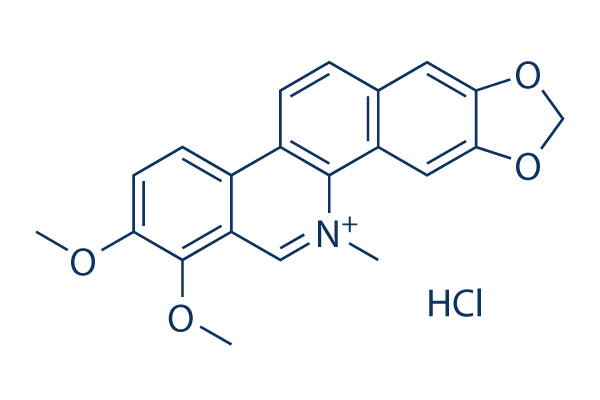
Chelerythrine Chloride (NSC 646662) PKC inhibitor
Cat.No.S1292
Quality Control
Solubility
|
In vitro |
DMSO
: 3 mg/mL
(7.79 mM)
Water : Insoluble Ethanol : Insoluble |
Molarity Calculator
|
In vivo |
|||||
In vivo Formulation Calculator (Clear solution)
Step 1: Enter information below (Recommended: An additional animal making an allowance for loss during the experiment)
Step 2: Enter the in vivo formulation (This is only the calculator, not formulation. Please contact us first if there is no in vivo formulation at the solubility Section.)
Calculation results:
Working concentration: mg/ml;
Method for preparing DMSO master liquid: mg drug pre-dissolved in μL DMSO ( Master liquid concentration mg/mL, Please contact us first if the concentration exceeds the DMSO solubility of the batch of drug. )
Method for preparing in vivo formulation: Take μL DMSO master liquid, next addμL PEG300, mix and clarify, next addμL Tween 80, mix and clarify, next add μL ddH2O, mix and clarify.
Method for preparing in vivo formulation: Take μL DMSO master liquid, next add μL Corn oil, mix and clarify.
Note: 1. Please make sure the liquid is clear before adding the next solvent.
2. Be sure to add the solvent(s) in order. You must ensure that the solution obtained, in the previous addition, is a clear solution before proceeding to add the next solvent. Physical methods such
as vortex, ultrasound or hot water bath can be used to aid dissolving.
Chemical Information, Storage & Stability
| Molecular Weight | 384.83 | Formula | C21H18NO4.HCl |
Storage (From the date of receipt) | |
|---|---|---|---|---|---|
| CAS No. | 3895-92-9 | Download SDF | Storage of Stock Solutions |
|
|
| Synonyms | Broussonpapyrine chloride | SMILES | C[N+]1=C2C(=C3C=CC(=C(C3=C1)OC)OC)C=CC4=CC5=C(C=C42)OCO5.[Cl-] | ||
Read more about storage stability stock solution CAS number SMILES
Mechanism of Action
| Features |
Chelerythrine is at least 100-fold more selective for PKCs than for other kinases.
|
|---|---|
| Targets/IC50/Ki |
PKC
(Cell-free assay) 0.66 μM
|
| In vitro |
Chelerythrine Chloride (NSC 646662) interacts with the catalytic domain of PKC, is a competitive inhibitor with respect to the phosphate acceptor (histone IIIS) with Ki value of 0.7 μM and a non-competitive inhibitor with respect to ATP. It shows potent cytotoxic effects against L-1210 cells with IC50 of 0.53 μM. This compound does not alter any activity of PKA, TPK and Ca/CM-PK, and its inhibitory effect on PKC activity does not vary among the various substrates including GS, MLC, MBP and Fibrinogen. It inhibits PKC activity in crude cell extracts from SQ-20B cells in a dose dependent manner. Chelerythrine decreases cell viability as determined by the MTT assay in a dose-dependent manner in SCC35, JSQ3, SQ20B and SCC61 cells. At 5 μM, it suppresses VEGF-induced expression of ICAM-1, VCAM-1, and E-selectin in HUVECs. It also suppresses VEGF-induced NF-κB activity in HUVECs at the same concentration and all suppresses basal and VEGF-induced leukocyte adhesiveness in HUVECs. At concentrations of 6 mM-30 mM, it rapidly induces pyknosis, shrinkage and subsequent cell death in cardiac myocytes. Chelerythrine(30 μM)-induced myocyte death is accompanied by nuclear fragmentation and activation of caspase-3 and -9 in primary culture of neonatal rat ventricular myocytes. At 10 μM, it causes cytochrome c release from mitochondria, suggesting that ROS mediates chelerythrine-induced cytochrome c release in cardiac myocytes. It displaces the fluorescently labeled BH3 domain peptide from a recombinant GST-BcLXL fusion protein with IC50 of 1.5 μM. At 2.5 μM and 5 μM for 16 hours, it induces a substantial decrease in mitochondrial potential as indicated by an increase in JC-1 green fluorescence in human neuroblastoma SH-SY5Y cells. At 5 μM, it also induces the appearance of sub-G1 DNA that is indicative of apoptosis in SH-SY5Y cells. At 10 μM, it induces mitochondrial potential change, CytC release from the mitochondria in SH-SY5Y cells. |
| Kinase Assay |
assay for protein kinase C
|
|
The purified protein kinase C is prepared from rat brain. Briefly, the incubation mixture (200 μL) contains 20 mM Tris/HCl buffer (pH 7.5), 10 mM MgCl2, 200 μg/mL histones, micelles makes with 700 μM phosphatidyl serine and 180 μM 1,2-dioleine in 0.3% triton X100, 0.2 mM CaCl2, 100 μM ATP, [γ-32P ]-ATP (105 dpm), Chelerythrine Chloride (NSC 646662) to be tested (solubilized in dimethylsulphoxyde) and the enzyme (0.5 μg protein). After incubation at 30℃ for 3 minutes, the reaction is terminated by the addition of 3 mL of 20% trichloroacetic acid. Acid-precipitable materials are collected on Whatman GFE filters and extensively washed with ice-cold 20% trichloroacetic acid. The radioactivity on the filters is measured using a liquid scintillation counter. Protein kinase C activity is corrected for non-specific activity by assaying in the absence of micelles and CaCl2.
|
|
| In vivo |
Chelerythrine Chloride (NSC 646662) (5 mg/kg i.p.) results in tumor growth delay in mice bearing SQ-20B xenografts. This compound (5 mg/kg) treatment significantly increases TUNEL-positive nuclei in the myocardium as well as cleaved forms of caspase-3 and -9 in adult rat. |
References |
|
Tech Support
Tel: +1-832-582-8158 Ext:3
If you have any other enquiries, please leave a message.
Signaling Pathway Map

Products are for research use only. Not for human use. We do not sell to patients.
©Copyright 2013 Selleck Chemicals. All Rights Reserved.