| S8185 |
FPS-ZM1
|
FPS-ZM1 is a blood-brain-barrier permeant, non-toxic, tertiary amide compound which is a high affinity RAGE-specific inhibitor, blocking Aβ binding to the V domain of RAGE.
|
-
Circ J, 2025, 10.1253/circj.CJ-24-0878
-
Clin Immunol, 2024, 262:110178
-
Pharmacol Res, 2023, 192:106791
|
|
| S4261 |
EUK 134
|
EUK 134, a synthetic superoxide dismutase (SOD)/catalase mimetic, exhibits potent antioxidant activities, and inhibits the formation of β-amyloid and related amyloid fibril.
|
-
Signal Transduct Target Ther, 2025, 10(1):171
-
Front Aging Neurosci, 2022, 14:1013943
-
Chem Biol Interact, 2021, 351:109756
|
|
| S3922 |
(-)-epigallocatechin
|
(-)-Epigallocatechin, widespread in plants, has been shown to exhibit anti-tumor, anti-cancer and anti-inflammatory functions.
|
-
Front Pharmacol, 2024, 15:1403424
-
J Inflamm Res, 2023, 16:2007-2020
-
Eur J Pharmacol, 2020, 173323
|
|
| S3923 |
Ginsenoside Rg1
|
Ginsenoside Rg1 (Ginsenoside A2, Panaxoside A, Panaxoside Rg1, Sanchinoside C1, Sanchinoside Rg1), one of the major active components of ginseng, is identified as a protopanaxatriol-type and has pharmacological actions such as neuroprotective and anti-tumor effects on various cancer types. This compound reduces cerebral Aβ levels and NF-κB nuclear translocation.
|
-
Kaohsiung J Med Sci, 2025, e70078.
-
iScience, 2024, 27(10):110862
-
Waste Biomass Valori, 2024, 10.1007/s12649-023-02147-y
|
|
| S3811 |
Ginsenoside Re
|
Ginsenoside Re (Ginsenoside B2, Panaxoside Re, Sanchinoside Re, Chikusetsusaponin Ivc), an extract from Panax notoginseng, is a major ginsenoside in ginseng and belongs to 20(S)-protopanaxatriol group. It has diverse in vitro and in vivo effects, including vasorelaxant, antioxidant, antihyperlipidemic, and angiogenic actions. This compound decreases the β-amyloid protein (Aβ). It plays a role in antiinflammation through inhibition of JNK and NF-κB.
|
-
J Ethnopharmacol, 2021, S0378-8741(21)00169-0
|
|
| S0486 |
Hoechst 34580
|
Hoechst 34580 (HOE 34580) is a cell-permeable blue fluorescent dye to stain DNA and nuclei. This compound is also a good candidate for treating the Alzheimer's disease by inhibiting amyloid beta (Aβ) formation with IC50 of 0.86 μM.
|
-
Front Nutr, 2022, 9:961182
|
|
| E2948 |
β-Amyloid (25-35)
|
β-Amyloid (25-35) (Amyloid beta-peptide (25-35), Aβ25-35, β-Amyloid peptide (25-35)) is a highly toxic synthetic derivative of Amyloid beta-peptide (Aβ-peptides) which forms fibrillary aggregates. This compound, with the sequence GSNKGAIIGLM, is involved in the pathogenesis of Alzheimer's disease.
|
|
|
| E3560 |
Incised notopterygium rhizome Extract
|
Incised Notopterygium Rhizome Extract is extracted from Notopterygium incisum, which rescues cognitive deficits in APP/PS1 Alzheimer's disease mice by attenuating amyloid-beta, tau, and neuroinflammation pathology.
|
|
|
| S0529 |
PBD-150
|
PBD-150 is a potent human glutaminyl cyclase (hQC) Y115E-Y117E variant inhibitor with Ki of 60 nM.
|
|
|
| S5101 |
Tabersonine hydrochloride
|
Tabersonine, an ingredient extracted from the bean of Voacanga africana, is a potent inhibitor against Aβ(1−42) aggregation and toxicity.
|
|
|
| E0077 |
Simufilam
|
Simufilam(PTI-125) is a potent, orally active small drug against AD, which interacts to filamin and controls the actin cytoskeleton. This compound reduces tau hyperphosphorylation, amyloid and tau formation by preventing and reversing the binding of Aβ42 to α7 nAChR.
|
|
|
| S9087 |
Tenuifolin
|
Tenuifolin, a secondary saponin isolated from hydrolysates of polygalasaponins, inhibits beta-amyloid synthesis in vitro and has nootropic activity in vivo via acetylcholine esterase inhibition and increases norepinephrine and dopamine production.
|
-
CNS Neurosci Ther, 2025, 31(8):e70588
|
|
| S6733 |
Edonerpic maleate
|
Edonerpic maleate (T-817) is a novel neurotrophic agent which can inhibit amyloid-β peptides (Aβ).
|
|
|
| S9428 |
Brazilin
|
Brazilin (Natural Red 24) is a red pigment obtained from the wood of the brazilwood family. It is used to dye fabric and has diverse biological activities, including neuroprotective, anti-inflammatory, antibacterial, and antioxidant properties.
|
-
J Cell Mol Med, 2025, 29(13):e70688
|
|
| S2418 |
Frentizole
|
Frentizole (Frentizol) is a novel inhibitor of amyloid beta peptide (Abeta) binding alcohol dehydrogenase (ABAD) interaction with IC50 of 200 μM. This compound is a nontoxic antiviral and immunosuppressive agent used clinically in rheumatoid arthritis and systemic lupus erythematosus.
|
|
|
| S3405 |
CRANAD-2
|
CRANAD-2, a near-infrared (NIR) Amyloid-beta (Aβ) plaque-specific fluorescent probe, penetrates the blood brain barrier and has a high affinity for Aβ aggregates with a Kd of 38 nM.
|
|
|
| S2215 |
DAPT
|
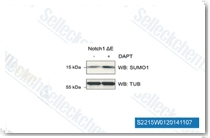
DAPT is a novel γ-secretase inhibitor, which inhibits Aβ production with IC50 of 20 nM in HEK 293 cells. DAPT enhances the apoptosis of human tongue carcinoma cells and regulates autophagy.
|
-
Signal Transduct Target Ther, 2025, 10(1):334
-
Cell Host Microbe, 2025, 33(3):408-419.e8
-
Nat Commun, 2025, 16(1):8693
|
|
| S1575 |
RO4929097 (RG-4733)
|
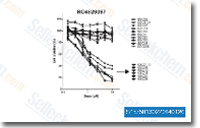
RO4929097 (RG-4733) is a γ secretase inhibitor with IC50 of 4 nM in a cell-free assay, inhibiting cellular processing of Aβ40 and Notch with EC50 of 14 nM and 5 nM, respectively. Phase 2.
|
-
Nat Commun, 2025, 16(1):10435
-
Cell Rep Med, 2025, S2666-3791(25)00102-8
-
Cell Death Dis, 2025, 16(1):150
|
|
| S5742 |
Deferoxamine mesylate
|
Deferoxamine mesylate is the mesylate salt of Deferoxamine, which forms iron complexes and is used as a chelating agent. Deferoxamine is a ferroptosis inhibitor that stabilizes HIF-1α expression and improves HIF-1α transactivity in hypoxic and hyperglycemic states in vitro. Deferoxamine decreases beta-amyloid (Aβ) deposition and induces autophagy.Please do not prepare stock solutions with normal saline or PBS, as precipitation may occur.
|
-
Cancer Cell, 2025, S1535-6108(25)00132-1
-
Nat Commun, 2025, 16(1):4919
-
Nat Commun, 2025, 16(1):6617
|
|
| S1262 |
Avagacestat (BMS-708163)
|
Avagacestat (BMS-708163) is a potent, selective, and orally bioavailable γ-secretase inhibitor of Aβ40 and Aβ42 with IC50 values of 0.3 nM and 0.27 nM, respectively. This compound demonstrates a 193-fold selectivity against Notch and has reached Phase 2 clinical trials.
|
-
Nat Commun, 2022, 13(1):6345
-
Sci Rep, 2022, 12(1):7
-
Cell, 2021, 184(2):521-533.e14
|
|
| S2660 |
MK-0752
|
MK-0752 is a moderately potent γ-secretase inhibitor, which reduces Aβ40 production with IC50 of 5 nM. Phase 1/2.
|
-
Nat Cell Biol, 2024, 26(3):353-365
-
Cancers (Basel), 2023, 15(6)1883
-
J Cancer Res Clin Oncol, 2023, 149(16):14691-14699
|
|
| S1594 |
Semagacestat (LY450139)
|
Semagacestat (LY450139) is a γ-secretase blocker for Aβ42, Aβ40 and Aβ38 with IC50 of 10.9 nM, 12.1 nM and 12.0 nM, respectively. It also inhibits Notch signaling with IC50 of 14.1 nM in H4 human glioma cell. This compound has reached Phase 3 clinical trials.
|
-
Cell Rep Med, 2025, S2666-3791(25)00102-8
-
Biochim Biophys Acta Mol Basis Dis, 2025, 1871(8):167992
-
Cancers (Basel), 2023, 15(6)1883
|
|
| S1528 |
LY2811376
|
LY2811376 is the first orally available non-peptidic β-secretase(BACE1) inhibitor with IC50 of 239 nM-249 nM, that act to decrease Aβ secretion with EC50 of 300 nM, demonstrated to have 10-fold selectivity towards BACE1 over BACE2, and more than 50-fold inhibition over other aspartic proteases including cathepsin D, pepsin, or renin. Phase 1.
|
-
Glycobiology, 2023, 33(4):325-341
-
J Agric Food Chem, 2022, 70(5):1536-1546
-
Sci Rep, 2022, 12(1):7
|
|
| S9664 |
Colivelin
|
Colivelin (CLN) is a brain-penetrant neuroprotective peptide with potent long-term capacity against Aβ deposition, neuronal apoptosis, and synaptic plasticity deficits in neurodegenerative disease. Colivelin is an activator of STAT3.
|
-
J Clin Invest, 2025, 135(11)e181243
-
J Adv Res, 2025, S2090-1232(25)00444-8
-
Stem Cell Res Ther, 2025, 16(1):40
|
|
| S4760 |
(2-Hydroxypropyl)-β-cyclodextrin (HP-β-CD)
|
(2-Hydroxypropyl)-β-cyclodextrin (HP-β-CD, HP-β-cyclodextrin, Hydroxypropyl betadex, Hydroxypropyl-β-cyclodextrin) is a well-known sugar used in drug delivery, genetic vectors, environmental protection, and the treatment of Niemann-Pick disease type C1 (NPC1). It is an inhibitor of amyloid-β aggregation and widely used drug delivery vehicle to improve stability and bioavailability.
|
-
bioRxiv , 2023, 10.1101/2023.07.14.548985
-
Technol Cancer Res Treat, 2021, 20:15330338211027916
-
Oncotarget, 2015, 6(30):29497-512
|
|
| S8185 |
FPS-ZM1
|
FPS-ZM1 is a blood-brain-barrier permeant, non-toxic, tertiary amide compound which is a high affinity RAGE-specific inhibitor, blocking Aβ binding to the V domain of RAGE. |
- Circ J, 2025, 10.1253/circj.CJ-24-0878
- Clin Immunol, 2024, 262:110178
- Pharmacol Res, 2023, 192:106791
|
|
| S4261 |
EUK 134
|
EUK 134, a synthetic superoxide dismutase (SOD)/catalase mimetic, exhibits potent antioxidant activities, and inhibits the formation of β-amyloid and related amyloid fibril. |
- Signal Transduct Target Ther, 2025, 10(1):171
- Front Aging Neurosci, 2022, 14:1013943
- Chem Biol Interact, 2021, 351:109756
|
|
| S3923 |
Ginsenoside Rg1
|
Ginsenoside Rg1 (Ginsenoside A2, Panaxoside A, Panaxoside Rg1, Sanchinoside C1, Sanchinoside Rg1), one of the major active components of ginseng, is identified as a protopanaxatriol-type and has pharmacological actions such as neuroprotective and anti-tumor effects on various cancer types. This compound reduces cerebral Aβ levels and NF-κB nuclear translocation. |
- Kaohsiung J Med Sci, 2025, e70078.
- iScience, 2024, 27(10):110862
- Waste Biomass Valori, 2024, 10.1007/s12649-023-02147-y
|
|
| S3811 |
Ginsenoside Re
|
Ginsenoside Re (Ginsenoside B2, Panaxoside Re, Sanchinoside Re, Chikusetsusaponin Ivc), an extract from Panax notoginseng, is a major ginsenoside in ginseng and belongs to 20(S)-protopanaxatriol group. It has diverse in vitro and in vivo effects, including vasorelaxant, antioxidant, antihyperlipidemic, and angiogenic actions. This compound decreases the β-amyloid protein (Aβ). It plays a role in antiinflammation through inhibition of JNK and NF-κB. |
- J Ethnopharmacol, 2021, S0378-8741(21)00169-0
|
|
| S0486 |
Hoechst 34580
|
Hoechst 34580 (HOE 34580) is a cell-permeable blue fluorescent dye to stain DNA and nuclei. This compound is also a good candidate for treating the Alzheimer's disease by inhibiting amyloid beta (Aβ) formation with IC50 of 0.86 μM. |
- Front Nutr, 2022, 9:961182
|
|
| E3560 |
Incised notopterygium rhizome Extract
|
Incised Notopterygium Rhizome Extract is extracted from Notopterygium incisum, which rescues cognitive deficits in APP/PS1 Alzheimer's disease mice by attenuating amyloid-beta, tau, and neuroinflammation pathology. |
|
|
| S0529 |
PBD-150
|
PBD-150 is a potent human glutaminyl cyclase (hQC) Y115E-Y117E variant inhibitor with Ki of 60 nM. |
|
|
| S5101 |
Tabersonine hydrochloride
|
Tabersonine, an ingredient extracted from the bean of Voacanga africana, is a potent inhibitor against Aβ(1−42) aggregation and toxicity. |
|
|
| E0077 |
Simufilam
|
Simufilam(PTI-125) is a potent, orally active small drug against AD, which interacts to filamin and controls the actin cytoskeleton. This compound reduces tau hyperphosphorylation, amyloid and tau formation by preventing and reversing the binding of Aβ42 to α7 nAChR. |
|
|
| S9087 |
Tenuifolin
|
Tenuifolin, a secondary saponin isolated from hydrolysates of polygalasaponins, inhibits beta-amyloid synthesis in vitro and has nootropic activity in vivo via acetylcholine esterase inhibition and increases norepinephrine and dopamine production. |
- CNS Neurosci Ther, 2025, 31(8):e70588
|
|
| S6733 |
Edonerpic maleate
|
Edonerpic maleate (T-817) is a novel neurotrophic agent which can inhibit amyloid-β peptides (Aβ). |
|
|
| S2418 |
Frentizole
|
Frentizole (Frentizol) is a novel inhibitor of amyloid beta peptide (Abeta) binding alcohol dehydrogenase (ABAD) interaction with IC50 of 200 μM. This compound is a nontoxic antiviral and immunosuppressive agent used clinically in rheumatoid arthritis and systemic lupus erythematosus. |
|
|
| S2215 |
DAPT
|
DAPT is a novel γ-secretase inhibitor, which inhibits Aβ production with IC50 of 20 nM in HEK 293 cells. DAPT enhances the apoptosis of human tongue carcinoma cells and regulates autophagy. |
- Signal Transduct Target Ther, 2025, 10(1):334
- Cell Host Microbe, 2025, 33(3):408-419.e8
- Nat Commun, 2025, 16(1):8693
|
|
| S1575 |
RO4929097 (RG-4733)
|
RO4929097 (RG-4733) is a γ secretase inhibitor with IC50 of 4 nM in a cell-free assay, inhibiting cellular processing of Aβ40 and Notch with EC50 of 14 nM and 5 nM, respectively. Phase 2. |
- Nat Commun, 2025, 16(1):10435
- Cell Rep Med, 2025, S2666-3791(25)00102-8
- Cell Death Dis, 2025, 16(1):150
|
|
| S5742 |
Deferoxamine mesylate
|
Deferoxamine mesylate is the mesylate salt of Deferoxamine, which forms iron complexes and is used as a chelating agent. Deferoxamine is a ferroptosis inhibitor that stabilizes HIF-1α expression and improves HIF-1α transactivity in hypoxic and hyperglycemic states in vitro. Deferoxamine decreases beta-amyloid (Aβ) deposition and induces autophagy.Please do not prepare stock solutions with normal saline or PBS, as precipitation may occur. |
- Cancer Cell, 2025, S1535-6108(25)00132-1
- Nat Commun, 2025, 16(1):4919
- Nat Commun, 2025, 16(1):6617
|
|
| S1262 |
Avagacestat (BMS-708163)
|
Avagacestat (BMS-708163) is a potent, selective, and orally bioavailable γ-secretase inhibitor of Aβ40 and Aβ42 with IC50 values of 0.3 nM and 0.27 nM, respectively. This compound demonstrates a 193-fold selectivity against Notch and has reached Phase 2 clinical trials. |
- Nat Commun, 2022, 13(1):6345
- Sci Rep, 2022, 12(1):7
- Cell, 2021, 184(2):521-533.e14
|
|
| S2660 |
MK-0752
|
MK-0752 is a moderately potent γ-secretase inhibitor, which reduces Aβ40 production with IC50 of 5 nM. Phase 1/2. |
- Nat Cell Biol, 2024, 26(3):353-365
- Cancers (Basel), 2023, 15(6)1883
- J Cancer Res Clin Oncol, 2023, 149(16):14691-14699
|
|
| S1594 |
Semagacestat (LY450139)
|
Semagacestat (LY450139) is a γ-secretase blocker for Aβ42, Aβ40 and Aβ38 with IC50 of 10.9 nM, 12.1 nM and 12.0 nM, respectively. It also inhibits Notch signaling with IC50 of 14.1 nM in H4 human glioma cell. This compound has reached Phase 3 clinical trials. |
- Cell Rep Med, 2025, S2666-3791(25)00102-8
- Biochim Biophys Acta Mol Basis Dis, 2025, 1871(8):167992
- Cancers (Basel), 2023, 15(6)1883
|
|
| S1528 |
LY2811376
|
LY2811376 is the first orally available non-peptidic β-secretase(BACE1) inhibitor with IC50 of 239 nM-249 nM, that act to decrease Aβ secretion with EC50 of 300 nM, demonstrated to have 10-fold selectivity towards BACE1 over BACE2, and more than 50-fold inhibition over other aspartic proteases including cathepsin D, pepsin, or renin. Phase 1. |
- Glycobiology, 2023, 33(4):325-341
- J Agric Food Chem, 2022, 70(5):1536-1546
- Sci Rep, 2022, 12(1):7
|
|
| S9664 |
Colivelin
|
Colivelin (CLN) is a brain-penetrant neuroprotective peptide with potent long-term capacity against Aβ deposition, neuronal apoptosis, and synaptic plasticity deficits in neurodegenerative disease. Colivelin is an activator of STAT3. |
- J Clin Invest, 2025, 135(11)e181243
- J Adv Res, 2025, S2090-1232(25)00444-8
- Stem Cell Res Ther, 2025, 16(1):40
|
|
| S4760 |
(2-Hydroxypropyl)-β-cyclodextrin (HP-β-CD)
|
(2-Hydroxypropyl)-β-cyclodextrin (HP-β-CD, HP-β-cyclodextrin, Hydroxypropyl betadex, Hydroxypropyl-β-cyclodextrin) is a well-known sugar used in drug delivery, genetic vectors, environmental protection, and the treatment of Niemann-Pick disease type C1 (NPC1). It is an inhibitor of amyloid-β aggregation and widely used drug delivery vehicle to improve stability and bioavailability. |
- bioRxiv , 2023, 10.1101/2023.07.14.548985
- Technol Cancer Res Treat, 2021, 20:15330338211027916
- Oncotarget, 2015, 6(30):29497-512
|
|