
-
 Argentina
-
 Australia
-
 Austria
-
 Belgium
-
 Brazil
-
 Canada
-
 China
China
-
 Czech Republic
-
 Denmark
-
 Finland
-
 France
-
 Germany
-
 Greece
-
 Hong Kong
-
 Hungary
-
 Iceland
-
 India
India
-
 Ireland
-
 Israel
-
 Italy
Italy
-
 Japan
Japan
-
 Korea
Korea
-
 Luxembourg
-
 Malaysia
-
 Netherlands
-
 New Zealand
-
 Norway
-
 Poland
-
 Qatar
Qatar
-
 Romania
-
 Saudi Arabia
-
 Singapore
-
 Spain
Spain
-
 Sweden
-
 Switzerland
-
 Taiwan
-
 Turkey
-
 United Kingdom
-
 United States
research use only
Semagacestat (LY450139) Secretase inhibitor
Cat.No.S1594
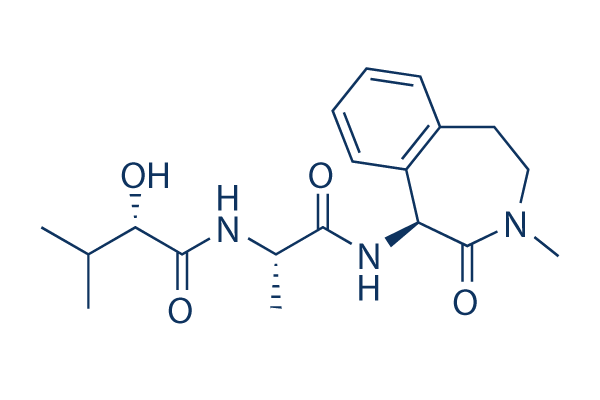
Chemical Structure
Molecular Weight: 361.44
Quality Control
| Related Targets | HDAC Caspase Proteasome MMP HCV Protease Cysteine Protease Tyrosinase HIV Protease DPP Serine Protease |
|---|---|
| Other Secretase Inhibitors | DAPT RO4929097 (RG-4733) LY411575 Nirogacestat (PF-03084014) Dibenzazepine (YO-01027) MK-0752 Avagacestat (BMS-708163) MDL-28170 L-685,458 Itanapraced (CHF 5074) |
Cell Culture, Treatment & Working Concentration
| Cell Lines | Assay Type | Concentration | Incubation Time | Formulation | Activity Description | PMID |
|---|---|---|---|---|---|---|
| CHO cells | Function assay | Inhibition of gamma-secretase in CHO cells assessed expressing APPSw assessed as inhibition of amyloid beta(1 to x) secretion after overnight incubation by ELISA, ED50=0.015 μM | ||||
| human SH-SY5Y cells | Function assay | Inhibition of gamma secretase-mediated amyloid beta (1 to 40) production in human SH-SY5Y cells, IC50=0.038 μM | ||||
| African green monkey CV1 cells | Function assay | Inhibition of gamma-secretase expressed in african green monkey CV1 cells coexpressing Gal4 DNA-binding/transactivation domain assessed as inhibition of notch processing by luciferase reporter assay, IC50=0.31623 μM | ||||
| Click to View More Cell Line Experimental Data | ||||||
Solubility
|
In vitro |
DMSO
: 73 mg/mL
(201.96 mM)
Ethanol : 41 mg/mL Water : Insoluble |
Molarity Calculator
|
In vivo |
|||||
In vivo Formulation Calculator (Clear solution)
Step 1: Enter information below (Recommended: An additional animal making an allowance for loss during the experiment)
Step 2: Enter the in vivo formulation (This is only the calculator, not formulation. Please contact us first if there is no in vivo formulation at the solubility Section.)
Calculation results:
Working concentration: mg/ml;
Method for preparing DMSO master liquid: mg drug pre-dissolved in μL DMSO ( Master liquid concentration mg/mL, Please contact us first if the concentration exceeds the DMSO solubility of the batch of drug. )
Method for preparing in vivo formulation: Take μL DMSO master liquid, next addμL PEG300, mix and clarify, next addμL Tween 80, mix and clarify, next add μL ddH2O, mix and clarify.
Method for preparing in vivo formulation: Take μL DMSO master liquid, next add μL Corn oil, mix and clarify.
Note: 1. Please make sure the liquid is clear before adding the next solvent.
2. Be sure to add the solvent(s) in order. You must ensure that the solution obtained, in the previous addition, is a clear solution before proceeding to add the next solvent. Physical methods such
as vortex, ultrasound or hot water bath can be used to aid dissolving.
Chemical Information, Storage & Stability
| Molecular Weight | 361.44 | Formula | C19H27N3O4 |
Storage (From the date of receipt) | |
|---|---|---|---|---|---|
| CAS No. | 425386-60-3 | Download SDF | Storage of Stock Solutions |
|
|
| Synonyms | N/A | Smiles | CC(C)C(C(=O)NC(C)C(=O)NC1C2=CC=CC=C2CCN(C1=O)C)O | ||
Mechanism of Action
| Features |
The best characterized γ-secretase inhibitor that has reached the clinic.
|
|---|---|
| Targets/IC50/Ki |
Aβ42
(H4 human glioma cells) 10.9 nM
Aβ38
(H4 human glioma cells) 12.0 nM
Aβ40
(H4 human glioma cells) 12.1 nM
Notch
(H4 human glioma cells) 14.1 nM
|
| In vitro |
Semagacestat (LY450139) reduces the secretion of Aβ42, Aβ40 and Aβ38 from H4 human glioma cells stably overexpressing human wild-type APP into the culture medium, with IC50 of 10.9 nM, 12.1 nM and 12.0 nM, respectively, without affecting cell viability. It also increases β-CTF in cell lysates with ECmax of 16.0 nM, and the increase can be unexpectedly attenuated at high concentrations. This compound inhibits Notch signaling with IC50 of 14.1 nM, and shows minimal Notch-sparing selectivity with Notch IC50/Aβ42 IC50 only 1.3. It causes a concentration-dependent decrease in Aβ40 secreted into the medium with IC50 of 111 nM from murine CTX expressing endogenous murine APP, but murine Aβ42 formation in CTX is roughly 12-fold less than Aβ40 in accordance with data for neurons from wild type mice.
|
| Kinase Assay |
Cellular APP processing assay and Notch signaling assay
|
|
H4 human glioma cells stably overexpressing human wild-type APP695 are treated with Semagacestat (LY450139) at various concentrations for 24 hours. Levels of Aβ42, Aβ40, and Aβ38 in the media are measured using separate ELISA kits. The expression vector of the constitutively active form of Notch (NotchΔE), encoding bases 1-60 and 5193-6657 of the human Notch1 coding region (NM_017617), is constructed into a pcDNA3.1 vector with a sequence modification from mouse to human. Notch signaling activity is evaluated using Cignal RBP-Jk Reporter Assay kit. RBP-Jk protein [CSL/CBF1/Su(H)/Lag1] is a transcription factor activated with Notch intracellular domain produced by γ-secretase. H4 cells are transiently transfected with the human NotchΔE expression vector and the RBP-Jk-responsive luciferase construct using Lipofectamine 2000, and then exposed to various concentrations of this compound for 16 hours. Notch signaling is measured based on luciferase activity in the cell lysate using the Dual-Glo Luciferase Assay System.
|
|
| In vivo |
Oral administration of Semagacestat (LY450139) (1 mg/kg) to 5.5-month old APP-transgenic Tg2576 mice significantly ameliorates memory deficits on spatial working memory using the Y-maze task, which disappears after 8 days subchronic dosing. It decreases hippocampal levels of both Aβ42 and Aβ40 at 10 mg/kg (22-23% reduction) and 30 mg/kg (36-41% reduction) and increases β-CTF at 0.3-10 mg/kg in a dose dependent manner with no inhibition on the processing of other γ-secretase substrates, such as Notch, N-cadherin or EphA4, in the brain, but impairs normal cognition in wild-type mice and 3-month-old Tg2576 mice failing to restore cognitive deficits in the Y-maze test.
|
References |
|
Clinical Trial Information
(data from https://clinicaltrials.gov, updated on 2024-05-22)
| NCT Number | Recruitment | Conditions | Sponsor/Collaborators | Start Date | Phases |
|---|---|---|---|---|---|
| NCT01035138 | Completed | Alzheimer''s Disease |
Eli Lilly and Company |
December 2009 | Phase 3 |
| NCT00762411 | Completed | Alzheimer''s Disease |
Eli Lilly and Company |
September 2008 | Phase 3 |
| NCT00594568 | Completed | Alzheimer''s Disease |
Eli Lilly and Company |
March 2008 | Phase 3 |
| NCT00765115 | Completed | Alzheimer Disease |
Eli Lilly and Company |
July 2006 | Phase 1 |
Tech Support
Tel: +1-832-582-8158 Ext:3
If you have any other enquiries, please leave a message.

Products are for research use only. Not for human use. We do not sell to patients.
©Copyright 2013 Selleck Chemicals. All Rights Reserved.