
-
 Argentina
-
 Australia
-
 Austria
-
 Belgium
-
 Brazil
-
 Canada
-
 China
China
-
 Czech Republic
-
 Denmark
-
 Finland
-
 France
-
 Germany
-
 Greece
-
 Hong Kong
-
 Hungary
-
 Iceland
-
 India
India
-
 Ireland
-
 Israel
-
 Italy
Italy
-
 Japan
Japan
-
 Korea
Korea
-
 Luxembourg
-
 Malaysia
-
 Netherlands
-
 New Zealand
-
 Norway
-
 Poland
-
 Portugal
-
 Qatar
Qatar
-
 Romania
-
 Saudi Arabia
-
 Singapore
-
 Spain
Spain
-
 Sweden
-
 Switzerland
-
 Taiwan
-
 Turkey
-
 United Kingdom
-
 United States
research use only
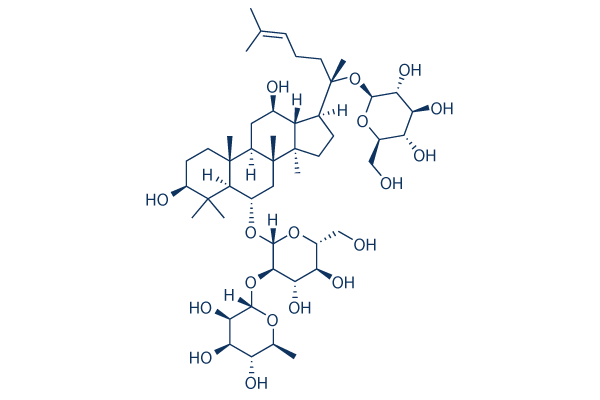
Ginsenoside Re Beta Amyloid inhibitor
Cat.No.S3811
Quality Control
Solubility
|
In vitro |
DMSO
: 100 mg/mL
(105.57 mM)
Ethanol : 20 mg/mL Water : Insoluble |
Molarity Calculator
|
In vivo |
|||||
In vivo Formulation Calculator (Clear solution)
Step 1: Enter information below (Recommended: An additional animal making an allowance for loss during the experiment)
Step 2: Enter the in vivo formulation (This is only the calculator, not formulation. Please contact us first if there is no in vivo formulation at the solubility Section.)
Calculation results:
Working concentration: mg/ml;
Method for preparing DMSO master liquid: mg drug pre-dissolved in μL DMSO ( Master liquid concentration mg/mL, Please contact us first if the concentration exceeds the DMSO solubility of the batch of drug. )
Method for preparing in vivo formulation: Take μL DMSO master liquid, next addμL PEG300, mix and clarify, next addμL Tween 80, mix and clarify, next add μL ddH2O, mix and clarify.
Method for preparing in vivo formulation: Take μL DMSO master liquid, next add μL Corn oil, mix and clarify.
Note: 1. Please make sure the liquid is clear before adding the next solvent.
2. Be sure to add the solvent(s) in order. You must ensure that the solution obtained, in the previous addition, is a clear solution before proceeding to add the next solvent. Physical methods such
as vortex, ultrasound or hot water bath can be used to aid dissolving.
Chemical Information, Storage & Stability
| Molecular Weight | 947.15 | Formula | C48H82O18 |
Storage (From the date of receipt) | |
|---|---|---|---|---|---|
| CAS No. | 52286-59-6 | Download SDF | Storage of Stock Solutions |
|
|
| Synonyms | Panaxoside Re, Sanchinoside Re, Chikusetsusaponin Ivc | SMILES | CC1C(C(C(C(O1)OC2C(C(C(OC2OC3CC4(C(CC(C5C4(CCC5C(C)(CCC=C(C)C)OC6C(C(C(C(O6)CO)O)O)O)C)O)C7(C3C(C(CC7)O)(C)C)C)C)CO)O)O)O)O)O | ||
Read more about storage stability stock solution CAS number SMILES
Mechanism of Action
| Targets/IC50/Ki |
Aβ
JNK
NF-κB
|
|---|---|
| In vitro |
Ginsenoside Re inhibits Ca2+ accumulation in mitochondria during cardiac ischemia/reperfusion, which is attributable to nitric oxide (NO)-induced Ca2+ channel inhibition and K+ channel activation in cardiac myocytes. This compound activates endothelial NO synthase (eNOS) to release NO, resulting in activation of the slowly activating delayed rectifier K+ current. However, it does not stimulate proliferation of androgen-responsive LNCaP cells and estrogen-responsive MCF-7 cells, implying that this chemical does not activate a genomic pathway of sex hormone receptors. It induces phosphorylation of Akt in cardiomyocytes in a concentration-dependent manner. This compound is a partial agonist of the AR, ERα, and PR. It is a partial antagonist, but not an agonist, of the genomic pathway of AR or ERα. |
| In vivo |
The absorption of Ginsenoside Re is fast in gastrointestinal tract. This compound may be metabolized mainly to Rh1 and F1 by intestinal microflora before absorption into blood; and it is quickly cleared from the body. In cardiovascular system, this chemical possesses negative effects on cardiac contractility and autorhythmicity, anti-arrhythmic and anti-ischemic effects, angiogenic regeneration activities and cardiac electrophysiological functions. It reaches peak concentration in plasma within about 45 minutes after oral administration of total panax notoginsenoside (TPNG) powder in rats, suggesting a rapid absorption in gastrointestinal tract. The absolute bioavailability of this compound is 7.06%. In pharmacokinetic study using ICR mice, the time to reach the peak plasma concentration after oral administration is 0.4 ± 0.2 hour and the oral bioavailability is 0.19-0.28%. This chemical is rapidly cleared from the body within 0.2 ± 0.03 hour for male mice and 0.5 ± 0.08 hour for female mice after intravenous administration. Its administration in ob/ob mice significantly reduces fasting blood glucose levels, improves glucose tolerance and systemic insulin sensitivity without affecting body weight. These events are mediated, at least in part, by the changes in skeletal muscle gene expression. |
References |
|
Clinical Trial Information
(data from https://clinicaltrials.gov, updated on 2019-09-09)
| NCT Number | Recruitment | Conditions | Sponsor/Collaborators | Start Date | Phases |
|---|---|---|---|---|---|
| NCT00781534 | COMPLETED | Diabetes |
Washington University School of Medicine |
2003-09 | EARLY_PHASE1 |
Read more about Clinical Trials
Tech Support
Tel: +1-832-582-8158 Ext:3
If you have any other enquiries, please leave a message.
Signaling Pathway Map

Products are for research use only. Not for human use. We do not sell to patients.
©Copyright 2013 Selleck Chemicals. All Rights Reserved.