
-
 Argentina
-
 Australia
-
 Austria
-
 Belgium
-
 Brazil
-
 Canada
-
 China
China
-
 Czech Republic
-
 Denmark
-
 Finland
-
 France
-
 Germany
-
 Greece
-
 Hong Kong
-
 Hungary
-
 Iceland
-
 India
India
-
 Ireland
-
 Israel
-
 Italy
Italy
-
 Japan
Japan
-
 Korea
Korea
-
 Luxembourg
-
 Malaysia
-
 Netherlands
-
 New Zealand
-
 Norway
-
 Poland
-
 Portugal
-
 Qatar
Qatar
-
 Romania
-
 Saudi Arabia
-
 Singapore
-
 Spain
Spain
-
 Sweden
-
 Switzerland
-
 Taiwan
-
 Turkey
-
 United Kingdom
-
 United States
research use only
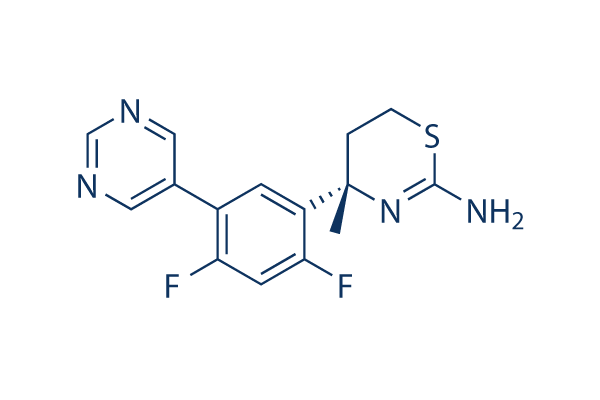
LY2811376 BACE inhibitor
Cat.No.S1528
Quality Control
| Related Targets | HDAC Caspase Proteasome Secretase MMP HCV Protease Cysteine Protease Tyrosinase HIV Protease DPP |
|---|---|
| Other BACE Inhibitors | Verubecestat (MK-8931) LY2886721 Verubecestat (MK-8931) Trifluoroacetate AZD3839 Lanabecestat (AZD3293) Elenbecestat LX2343 Loganin Dieckol |
Cell Culture, Treatment & Working Concentration
| Cell Lines | Assay Type | Concentration | Incubation Time | Formulation | Activity Description | PMID |
|---|---|---|---|---|---|---|
| HEK293 cells | Function assay | Inhibition of BACE1 in HEK293 cells expressing APPswedish mutant assessed as inhibition of amyloid beta production by ELISA, EC50=0.3 μM | ||||
| Click to View More Cell Line Experimental Data | ||||||
Solubility
|
In vitro |
Ethanol : 64 mg/mL
DMSO
: 16 mg/mL
(49.94 mM)
Water : Insoluble |
Molarity Calculator
|
In vivo |
|||||
In vivo Formulation Calculator (Clear solution)
Step 1: Enter information below (Recommended: An additional animal making an allowance for loss during the experiment)
Step 2: Enter the in vivo formulation (This is only the calculator, not formulation. Please contact us first if there is no in vivo formulation at the solubility Section.)
Calculation results:
Working concentration: mg/ml;
Method for preparing DMSO master liquid: mg drug pre-dissolved in μL DMSO ( Master liquid concentration mg/mL, Please contact us first if the concentration exceeds the DMSO solubility of the batch of drug. )
Method for preparing in vivo formulation: Take μL DMSO master liquid, next addμL PEG300, mix and clarify, next addμL Tween 80, mix and clarify, next add μL ddH2O, mix and clarify.
Method for preparing in vivo formulation: Take μL DMSO master liquid, next add μL Corn oil, mix and clarify.
Note: 1. Please make sure the liquid is clear before adding the next solvent.
2. Be sure to add the solvent(s) in order. You must ensure that the solution obtained, in the previous addition, is a clear solution before proceeding to add the next solvent. Physical methods such
as vortex, ultrasound or hot water bath can be used to aid dissolving.
Chemical Information, Storage & Stability
| Molecular Weight | 320.36 | Formula | C15H14F2N4S |
Storage (From the date of receipt) | |
|---|---|---|---|---|---|
| CAS No. | 1194044-20-6 | Download SDF | Storage of Stock Solutions |
|
|
| Synonyms | N/A | SMILES | CC1(CCSC(=N1)N)C2=C(C=C(C(=C2)C3=CN=CN=C3)F)F | ||
Read more about storage stability stock solution CAS number SMILES
Mechanism of Action
| Features |
Approximately 10-fold selectivity toward BACE1 over BACE2.
|
|---|---|
| Targets/IC50/Ki |
BACE1
239 nM-249 nM
Aβ
~300 nM(EC50)
|
| In vitro |
LY2811376 demonstrates concentration-dependent inhibition of hBACE1 with an IC50 of 239 and 249 nM against a small synthetic peptide or a larger chimeric protein substrate, respectively. This compound treatment yields a concentration-dependent decrease in Aβ secretion in APP-overexpressing HEK293 cells. It inhibits Aβ secretion with EC50 of ~100 nM in primary neuronal cultures of PDAPP transgenic mouse.
|
| Kinase Assay |
Determination of enzymatic efficiency
|
|
The stock solution for each FRET peptide substrate is prepared at 30 mM in dimethylsulfoxide (DMSO). The huBACE1:Fc muBACE1:Fc preparation is concentrated through YM10 Centricon. to a final concentration of at least 7 mg/mL. The optimal enzyme concentration for each FRET peptide substrate is determined individually at 30μM FRET peptide substrate in 50 mM ammonium acetate, pH 4.6, 1 mg/mL BSA and 1 mM Triton X-100. The enzymatic efficiency (kcat /Km) of either of the BACE1 orthologs toward individual FRET peptide substrates at 15, 30 and 100μM is determined under the optimal conditions for each substrate. The progress of the reaction is monitored by measuring an increase of the emission signal at 420 nm with excitation wavelength set at 320 nm, using a GEMINI fluorescence plate reader. Amino acid conjugated aminobenzoate is used to convert the emission signal in the relative fluorescence units into the molar concentration of product generated in the reaction mixture. The initial phase of the timedependence curve is fitted with a linear function whose slope is used to calculate the initial rate for huBACE1:Fc toward each peptide substrate. The kcat /Km values are calculated from the linear dependence of the initial rate on the concentration of each peptide.
|
|
| In vivo |
Administration of LY2811376 (10, 30, and 100 mg/kg doses) results in dose-dependent, significant reductions in Aβ, as well as sAPPβ and C99, the proximal cleavage products of APP proteolysis by BACE1 in APPV717F mouse model of Aβ pathology. After treatment with this compound (5 mg/kg), reductions in Aβ1-x are observed in plasma, with a maximal 85% reduction observed from 4 to 12 h after dosing in beagle dogs.
|
References |
|
Clinical Trial Information
(data from https://clinicaltrials.gov, updated on 2009-07-15)
| NCT Number | Recruitment | Conditions | Sponsor/Collaborators | Start Date | Phases |
|---|---|---|---|---|---|
| NCT00838084 | COMPLETED | Alzheimer's Disease |
Eli Lilly and Company |
2008-12 | PHASE1 |
| NCT00838084 | Completed | Alzheimer''s Disease |
Eli Lilly and Company |
2008-12 | Phase 1 |
Read more about Clinical Trials
Tech Support
Tel: +1-832-582-8158 Ext:3
If you have any other enquiries, please leave a message.
Signaling Pathway Map

Products are for research use only. Not for human use. We do not sell to patients.
©Copyright 2013 Selleck Chemicals. All Rights Reserved.