
-
 Australia
-
 Austria
-
 Belgium
-
 Brazil
-
 Canada
-
 China
China
-
 Czech Republic
-
 Denmark
-
 Finland
-
 France
-
 Germany
-
 Greece
-
 Hong Kong
-
 Hungary
-
 Iceland
-
 India
India
-
 Ireland
-
 Israel
-
 Italy
Italy
-
 Japan
Japan
-
 Korea
Korea
-
 Luxembourg
-
 Malaysia
-
 Netherlands
-
 New Zealand
-
 Norway
-
 Poland
-
 Qatar
Qatar
-
 Romania
-
 Saudi Arabia
-
 Singapore
-
 Spain
Spain
-
 Sweden
-
 Switzerland
-
 Taiwan
-
 Turkey
-
 United Kingdom
-
 United States
research use only
(2-Hydroxypropyl)-β-cyclodextrin (HP-β-CD) Hydrotropic Agents inhibitor
Cat.No.S4760
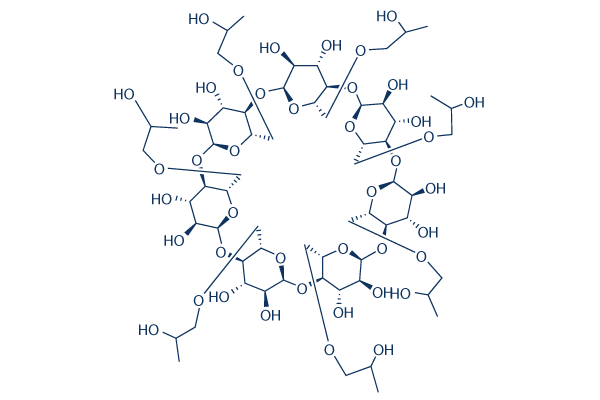
Chemical Structure
Molecular Weight: 1541.54
Quality Control
| Related Targets | Adrenergic Receptor AChR 5-HT Receptor COX Calcium Channel Histamine Receptor Dopamine Receptor GABA Receptor TRP Channel Cholinesterase (ChE) |
|---|---|
| Other Hydrotropic Agents Inhibitors | SBE-β-CD PEG300 CMC-Na Tween 80 PEG400 Corn Oil Methyl-β-cyclodextrin (MβCD) 1-Methoxy PMS Pluronic F-68 NOTA |
Solubility
|
In vitro |
DMSO
: 100 mg/mL
(64.87 mM)
Water : 100 mg/mL Ethanol : 100 mg/mL |
Molarity Calculator
|
In vivo |
|||||
In vivo Formulation Calculator (Clear solution)
Step 1: Enter information below (Recommended: An additional animal making an allowance for loss during the experiment)
Step 2: Enter the in vivo formulation (This is only the calculator, not formulation. Please contact us first if there is no in vivo formulation at the solubility Section.)
Calculation results:
Working concentration: mg/ml;
Method for preparing DMSO master liquid: mg drug pre-dissolved in μL DMSO ( Master liquid concentration mg/mL, Please contact us first if the concentration exceeds the DMSO solubility of the batch of drug. )
Method for preparing in vivo formulation: Take μL DMSO master liquid, next addμL PEG300, mix and clarify, next addμL Tween 80, mix and clarify, next add μL ddH2O, mix and clarify.
Method for preparing in vivo formulation: Take μL DMSO master liquid, next add μL Corn oil, mix and clarify.
Note: 1. Please make sure the liquid is clear before adding the next solvent.
2. Be sure to add the solvent(s) in order. You must ensure that the solution obtained, in the previous addition, is a clear solution before proceeding to add the next solvent. Physical methods such
as vortex, ultrasound or hot water bath can be used to aid dissolving.
Chemical Information, Storage & Stability
| Molecular Weight | 1541.54 | Formula | C63H112O42 |
Storage (From the date of receipt) | |
|---|---|---|---|---|---|
| CAS No. | 128446-35-5 | Download SDF | Storage of Stock Solutions |
|
|
| Synonyms | HP-β-cyclodextrin, Hydroxypropyl betadex, Hydroxypropyl-β-cyclodextrin | Smiles | CC(COCC1C2C(C(C(O1)OC3C(OC(C(C3O)O)OC4C(OC(C(C4O)O)OC5C(OC(C(C5O)O)OC6C(OC(C(C6O)O)OC7C(OC(C(C7O)O)OC8C(OC(O2)C(C8O)O)COCC(C)O)COCC(C)O)COCC(C)O)COCC(C)O)COCC(C)O)COCC(C)O)O)O)O | ||
Mechanism of Action
| Targets/IC50/Ki |
amyloid-β aggregation
|
|---|---|
| In vitro |
HP-β-CD molecules were not only nontoxic to cells, but also greatly inhibited Aβ fibrillization and reduced Aβ-induced toxicity in a concentration-dependent manner. Too low concentrations of HP-β-CD caused insufficient interactions with Aβ, while too high concentrations of HP-β-CD caused HP-β-CD to self-aggregate into inactive species. HP-β-CD interacted preferentially with some of the hydrophobic residues of Aβ, which prevented Aβ oligomers from further growing into mature fibrils via peptide elongation and lateral association. |
| In vivo |
HP-β-CD, due to its excellent biocompatibility, has been widely used in drug delivery systems, environmental remediation, food additives, and pharmacotherapy. HP-β-CD can readily cross the BBB and target nerve cells. HP-β-CD is well tolerated in the animal species tested (rats, mice and dogs), particularly when dosed orally, and shows only limited toxicity. After a single 200 mg/kg intravenous dose in rats and dogs, 14C-HP-β-CD was eliminated rapidly (more than 90% in 4 h), almost completely as the intact compound and mostly by renal excretion. The excretion in faeces and expired air was minimal. The plasma elimination half-life was 0.4 h in rats and 0.8 h in dogs. After oral administration of HP-β-CD in both rats and dogs, 86% was excreted via the faeces in both species, where as less than 5% was excreted in the urine. The absolute bioavailability was estimated at 3.3% in the dog and less in the rat. In both rats and dogs following intravenous administration, tissue distribution was limited: in rats the highest concentration was found in the kidney and lung and in dogs, the highest concentrations were in the kidney and the liver. Plasma levels of unchanged HP-β-CD declined rapidly and showed a bi-phasic decline after single intravenous and oral dosing in healthy volunteers. The utility of a 45%w/v HP-β-CD aqueous dosing vehicle in preclinical studies is very common. This vehicle is useful with poorly aqueous drugs. |
References |
|
Clinical Trial Information
(data from https://clinicaltrials.gov, updated on 2024-05-22)
| NCT Number | Recruitment | Conditions | Sponsor/Collaborators | Start Date | Phases |
|---|---|---|---|---|---|
| NCT02912793 | Completed | Niemann-Pick Disease Type C1 |
Cyclo Therapeutics Inc. |
March 20 2017 | Phase 1|Phase 2 |
Tech Support
Tel: +1-832-582-8158 Ext:3
If you have any other enquiries, please leave a message.

Products are for research use only. Not for human use. We do not sell to patients.
©Copyright 2013 Selleck Chemicals. All Rights Reserved.