
-
 Argentina
-
 Australia
-
 Austria
-
 Belgium
-
 Brazil
-
 Canada
-
 China
China
-
 Czech Republic
-
 Denmark
-
 Finland
-
 France
-
 Germany
-
 Greece
-
 Hong Kong
-
 Hungary
-
 Iceland
-
 India
India
-
 Ireland
-
 Israel
-
 Italy
Italy
-
 Japan
Japan
-
 Korea
Korea
-
 Luxembourg
-
 Malaysia
-
 Netherlands
-
 New Zealand
-
 Norway
-
 Poland
-
 Portugal
-
 Qatar
Qatar
-
 Romania
-
 Saudi Arabia
-
 Singapore
-
 Spain
Spain
-
 Sweden
-
 Switzerland
-
 Taiwan
-
 Turkey
-
 United Kingdom
-
 United States
research use only
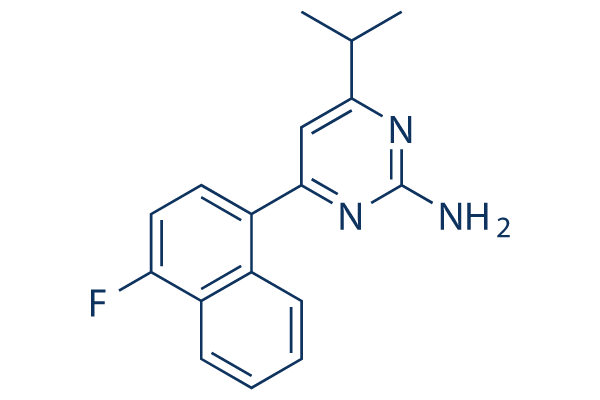
RS-127445 5-HT Receptor antagonist
Cat.No.S2698
Quality Control
Solubility
|
In vitro |
DMSO
: 56 mg/mL
(199.05 mM)
Ethanol : 8 mg/mL Water : Insoluble |
Molarity Calculator
|
In vivo |
|||||
In vivo Formulation Calculator (Clear solution)
Step 1: Enter information below (Recommended: An additional animal making an allowance for loss during the experiment)
Step 2: Enter the in vivo formulation (This is only the calculator, not formulation. Please contact us first if there is no in vivo formulation at the solubility Section.)
Calculation results:
Working concentration: mg/ml;
Method for preparing DMSO master liquid: mg drug pre-dissolved in μL DMSO ( Master liquid concentration mg/mL, Please contact us first if the concentration exceeds the DMSO solubility of the batch of drug. )
Method for preparing in vivo formulation: Take μL DMSO master liquid, next addμL PEG300, mix and clarify, next addμL Tween 80, mix and clarify, next add μL ddH2O, mix and clarify.
Method for preparing in vivo formulation: Take μL DMSO master liquid, next add μL Corn oil, mix and clarify.
Note: 1. Please make sure the liquid is clear before adding the next solvent.
2. Be sure to add the solvent(s) in order. You must ensure that the solution obtained, in the previous addition, is a clear solution before proceeding to add the next solvent. Physical methods such
as vortex, ultrasound or hot water bath can be used to aid dissolving.
Chemical Information, Storage & Stability
| Molecular Weight | 281.33 | Formula | C17H16FN3 |
Storage (From the date of receipt) | |
|---|---|---|---|---|---|
| CAS No. | 199864-87-4 | Download SDF | Storage of Stock Solutions |
|
|
| Synonyms | MT500 | SMILES | CC(C)C1=NC(=NC(=C1)C2=CC=C(C3=CC=CC=C32)F)N | ||
Read more about storage stability stock solution CAS number SMILES
Mechanism of Action
| Targets/IC50/Ki |
5-HT2B
10.4(pIC50)
5-HT2B
9.5(pKi)
|
|---|---|
| In vitro |
RS-127445 is a novel high affinity, selective 5-HT2B receptor antagonist devoid of detectable intrinsic activity. This compound is found to have nM affinity and 1000 fold selectivity for the 5-HT2B receptor. It is thus among the highest affinity, most selective 5- HT2B receptor ligands. This chemical potently blocks the 5-HT evoked increase in inositol phosphate formation and blocks the 5-HT evoked increases in intracellular calcium concentrations with a potency 1000 times greater than that of yohimbine.
|
| Kinase Assay |
Radioligand binding
|
|
The selectivity of RS-127445 for 5-HT2B receptors is examined by testing this compound for affinity at over 100 additional ion channel or receptor binding sites. CHO-K1 cells expressing human 5-HT2A, 5-HT2B or 5-HT2C receptors are harvested using 2 mM EDTA in phosphate buffered saline. Cell membranes are prepared by four cycles of homogenization and centrifugation (48,000×g for 15 min). Each assay is established so as to achieve steady state conditions and to optimize specific binding. For the 5-HT2A receptor, membranes from 1×10⁶ cells are incubated with 0.2 nM [3 H]-ketanserin at 32 °C for 60 min. Nonspecific binding is determined using 10 μM methysergide. For the 5-HT2B receptor, membranes from 1.5×10⁶ cells are incubated with 0.2 nM [3 H]-5-HT at 48 °C for 120 min. Nonspecific binding is determined using 10 μM 5-HT. For the 5-HT2Creceptor, membranes from 3×10 5 cells are incubated with 0.5 nM [3 H]-mesuler -gine at 32 °C for 60 min. Nonspecific binding is determined using 10μM methysergide. Assays are terminated by vacuum filtration through glass fibre filters(GF/B) which has been pretreated with 0.1% polyethyleneimine. Total and bound radioactivity is determined by liquid scintillation counting. Greater than 90% specific binding is achieved in each of these assays.
|
|
| In vivo |
LD50: Mice 391.4mg/kg (i.v.); Rats 370.1mg/kg (i.v.); Rabbits 142.3mg/kg (i.v.) |
References |
|
Tech Support
Tel: +1-832-582-8158 Ext:3
If you have any other enquiries, please leave a message.
Signaling Pathway Map

Products are for research use only. Not for human use. We do not sell to patients.
©Copyright 2013 Selleck Chemicals. All Rights Reserved.