
-
 Argentina
-
 Australia
-
 Austria
-
 Belgium
-
 Brazil
-
 Canada
-
 China
China
-
 Czech Republic
-
 Denmark
-
 Finland
-
 France
-
 Germany
-
 Greece
-
 Hong Kong
-
 Hungary
-
 Iceland
-
 India
India
-
 Ireland
-
 Israel
-
 Italy
Italy
-
 Japan
Japan
-
 Korea
Korea
-
 Luxembourg
-
 Malaysia
-
 Netherlands
-
 New Zealand
-
 Norway
-
 Poland
-
 Qatar
Qatar
-
 Romania
-
 Saudi Arabia
-
 Singapore
-
 Spain
Spain
-
 Sweden
-
 Switzerland
-
 Taiwan
-
 Turkey
-
 United Kingdom
-
 United States
research use only
HC-030031 TRP Channel inhibitor
Cat.No.S2918
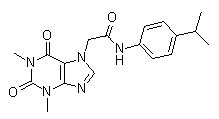
Chemical Structure
Molecular Weight: 355.39
Quality Control
| Related Targets | CFTR CRM1 CD markers AChR Calcium Channel Sodium Channel Potassium Channel GABA Receptor ATPase GluR |
|---|---|
| Other TRP Channel Inhibitors | 2-APB (2-Aminoethyl Diphenylborinate) SKF96365 AMG-517 Capsazepine GSK2193874 GSK1016790A EIPA (L593754) ML-SI3 HC-067047 SB705498 |
Cell Culture, Treatment & Working Concentration
| Cell Lines | Assay Type | Concentration | Incubation Time | Formulation | Activity Description | PMID |
|---|---|---|---|---|---|---|
| IMR90 cells | Function assay | 40 mins | Antagonist activity at human TRPA1 expressed in human IMR90 cells assessed as inhibition of acrolein-induced calcium influx after 40 mins by fluorescence analysis, IC50=1.8 μM | |||
| HEK293 cells | Function assay | Antagonist activity at human TRPA1 channel expressed in HEK293 cells assessed as inhibition of cinnamaldehyde-induced intracellular calcium influx by FLIPR, IC50=4.9 μM | ||||
| Click to View More Cell Line Experimental Data | ||||||
Solubility
|
In vitro |
DMSO
: 71 mg/mL
(199.78 mM)
Water : Insoluble Ethanol : Insoluble |
Molarity Calculator
|
In vivo |
|||||
In vivo Formulation Calculator (Clear solution)
Step 1: Enter information below (Recommended: An additional animal making an allowance for loss during the experiment)
Step 2: Enter the in vivo formulation (This is only the calculator, not formulation. Please contact us first if there is no in vivo formulation at the solubility Section.)
Calculation results:
Working concentration: mg/ml;
Method for preparing DMSO master liquid: mg drug pre-dissolved in μL DMSO ( Master liquid concentration mg/mL, Please contact us first if the concentration exceeds the DMSO solubility of the batch of drug. )
Method for preparing in vivo formulation: Take μL DMSO master liquid, next addμL PEG300, mix and clarify, next addμL Tween 80, mix and clarify, next add μL ddH2O, mix and clarify.
Method for preparing in vivo formulation: Take μL DMSO master liquid, next add μL Corn oil, mix and clarify.
Note: 1. Please make sure the liquid is clear before adding the next solvent.
2. Be sure to add the solvent(s) in order. You must ensure that the solution obtained, in the previous addition, is a clear solution before proceeding to add the next solvent. Physical methods such
as vortex, ultrasound or hot water bath can be used to aid dissolving.
Chemical Information, Storage & Stability
| Molecular Weight | 355.39 | Formula | C18H21N5O3 |
Storage (From the date of receipt) | |
|---|---|---|---|---|---|
| CAS No. | 349085-38-7 | Download SDF | Storage of Stock Solutions |
|
|
| Synonyms | TOSLAB 829227 | Smiles | CC(C)C1=CC=C(C=C1)NC(=O)CN2C=NC3=C2C(=O)N(C(=O)N3C)C | ||
Mechanism of Action
| Targets/IC50/Ki |
TRPA1
|
|---|---|
| In vitro |
HC-030031 is a substituted theophylline derivative. This compound is a potent and selective TRPA1 inhibitor. It can block both inward and outward currents elicited by AITC or formalin rapidly and reversibly and also blocks the activation of TRPA1 by N-methylmaleimide and by electrophillic prostaglandins. It does not block currents mediated by TRPV1, TRPV3, TRPV4 hERG, or NaV1.2 channels.
|
| In vivo |
HC-030031 can be delivered to animals orally, by inhalation, or by injection. Oral administration (100 mg/kg) of this compound significantly reversed mechanical hypersensitivity in rat models of chronic inflammatory or neuropathic pain, while local injection (100 μg) into inflamed mouse hind paws attenuated mechanical, but not heat, hypersensitivity.
|
References |
|
Tech Support
Tel: +1-832-582-8158 Ext:3
If you have any other enquiries, please leave a message.

Products are for research use only. Not for human use. We do not sell to patients.
©Copyright 2013 Selleck Chemicals. All Rights Reserved.