
-
 Argentina
-
 Australia
-
 Austria
-
 Belgium
-
 Brazil
-
 Canada
-
 China
China
-
 Czech Republic
-
 Denmark
-
 Finland
-
 France
-
 Germany
-
 Greece
-
 Hong Kong
-
 Hungary
-
 Iceland
-
 India
India
-
 Ireland
-
 Israel
-
 Italy
Italy
-
 Japan
Japan
-
 Korea
Korea
-
 Luxembourg
-
 Malaysia
-
 Netherlands
-
 New Zealand
-
 Norway
-
 Poland
-
 Portugal
-
 Qatar
Qatar
-
 Romania
-
 Saudi Arabia
-
 Singapore
-
 Spain
Spain
-
 Sweden
-
 Switzerland
-
 Taiwan
-
 Turkey
-
 United Kingdom
-
 United States
research use only
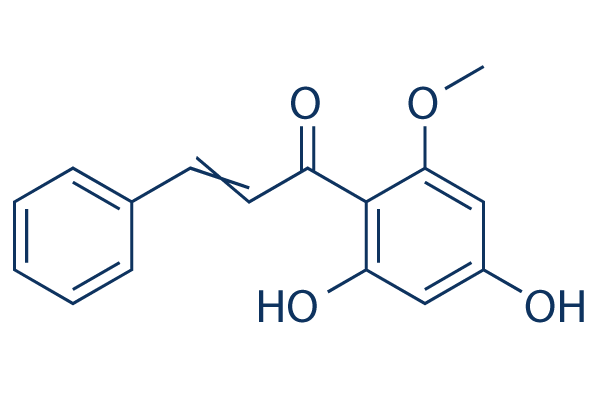
Cardamonin TRP Channel antagonist
Cat.No.S3942
Quality Control
| Related Targets | CFTR CRM1 CD markers AChR Calcium Channel Sodium Channel Potassium Channel GABA Receptor ATPase GluR |
|---|---|
| Other TRP Channel Inhibitors | 2-APB (2-Aminoethyl Diphenylborinate) SKF96365 AMG-517 Capsazepine GSK2193874 GSK1016790A HC-030031 EIPA (L593754) ML-SI3 HC-067047 |
Solubility
|
In vitro |
DMSO
: 54 mg/mL
(199.79 mM)
Ethanol : 54 mg/mL Water : Insoluble |
Molarity Calculator
|
In vivo |
|||||
In vivo Formulation Calculator (Clear solution)
Step 1: Enter information below (Recommended: An additional animal making an allowance for loss during the experiment)
Step 2: Enter the in vivo formulation (This is only the calculator, not formulation. Please contact us first if there is no in vivo formulation at the solubility Section.)
Calculation results:
Working concentration: mg/ml;
Method for preparing DMSO master liquid: mg drug pre-dissolved in μL DMSO ( Master liquid concentration mg/mL, Please contact us first if the concentration exceeds the DMSO solubility of the batch of drug. )
Method for preparing in vivo formulation: Take μL DMSO master liquid, next addμL PEG300, mix and clarify, next addμL Tween 80, mix and clarify, next add μL ddH2O, mix and clarify.
Method for preparing in vivo formulation: Take μL DMSO master liquid, next add μL Corn oil, mix and clarify.
Note: 1. Please make sure the liquid is clear before adding the next solvent.
2. Be sure to add the solvent(s) in order. You must ensure that the solution obtained, in the previous addition, is a clear solution before proceeding to add the next solvent. Physical methods such
as vortex, ultrasound or hot water bath can be used to aid dissolving.
Chemical Information, Storage & Stability
| Molecular Weight | 270.28 | Formula | C16H14O4 |
Storage (From the date of receipt) | |
|---|---|---|---|---|---|
| CAS No. | 18956-16-6 | Download SDF | Storage of Stock Solutions |
|
|
| Synonyms | Alpinetin chalcone | SMILES | COC1=CC(=CC(=C1C(=O)C=CC2=CC=CC=C2)O)O | ||
Read more about storage stability stock solution CAS number SMILES
Mechanism of Action
| Targets/IC50/Ki |
hTRPA1
454 nM
|
|---|---|
| In vitro |
Cardamonin selectively blocks TRPA1 activation while does not interact with TRPV1 nor TRPV4 channel. A concentration-dependent inhibitory effect is observed with IC50 of 454 nM. This compound does not significantly reduce HEK293 cell viability, nor does it impair cardiomyocyte constriction. In vitro, this chemical (25 and 50 μM) concentration dependently inhibits endothelium permeability and down-regulates phosphorylation of P38 in rat lung microvascular endothelial cells induced by lipopolysaccharide (LPS). In RAW 264.7 macrophage cells, it also shows selective inhibition of P38 phosphorylation induced by LPS. This compound inhibits the growth of several cancer cell types including breast cancer, glioblastoma, ovarian, prostate, and lung. Treatment of this chemical in CRC cell lines induces cell cycle arrest mostly in the S phase of cell cycle. It activates both apoptosis and induces cell cycle arrest to inhibit the cell proliferation. This natural product is known to inhibit various signaling pathways which play a major role in the process of inflammation and cancer. It inhibits the phosphorylation and translocation of both STAT3 and NF-κB. It also inhibits angiogenesis through downregulation of miR-21 expression.
|
| In vivo |
Cardamonin (30 and 100 mg/kg) significantly elevates the survival rate of septic mice, alleviates ALI and lung microvascular leak, and lowers the serum levels of proinflammatory cytokines TNF-α, IL-1β,and IL-6. This compound inhibits Azoxymethane-induced colorectal cancer (CRC). Its treatment inhibits the tumor incidence, tumor multiplicity, Ki-67 and β-catenin positive cells. The preclinical pharmacokinetics and ADME characterization of this chemical in mice reports that it is highly permeable with an effective permeability value in ileum is (Peff) 3 × 10⁻⁴ which is highly significant. Within 30 minutes of oral dosing, it is distributed to various tissues.
|
References |
|
Tech Support
Tel: +1-832-582-8158 Ext:3
If you have any other enquiries, please leave a message.

Products are for research use only. Not for human use. We do not sell to patients.
©Copyright 2013 Selleck Chemicals. All Rights Reserved.