
-
 Argentina
-
 Australia
-
 Austria
-
 Belgium
-
 Brazil
-
 Canada
-
 China
China
-
 Czech Republic
-
 Denmark
-
 Finland
-
 France
-
 Germany
-
 Greece
-
 Hong Kong
-
 Hungary
-
 Iceland
-
 India
India
-
 Ireland
-
 Israel
-
 Italy
Italy
-
 Japan
Japan
-
 Korea
Korea
-
 Luxembourg
-
 Malaysia
-
 Netherlands
-
 New Zealand
-
 Norway
-
 Poland
-
 Portugal
-
 Qatar
Qatar
-
 Romania
-
 Saudi Arabia
-
 Singapore
-
 Spain
Spain
-
 Sweden
-
 Switzerland
-
 Taiwan
-
 Turkey
-
 United Kingdom
-
 United States
research use only
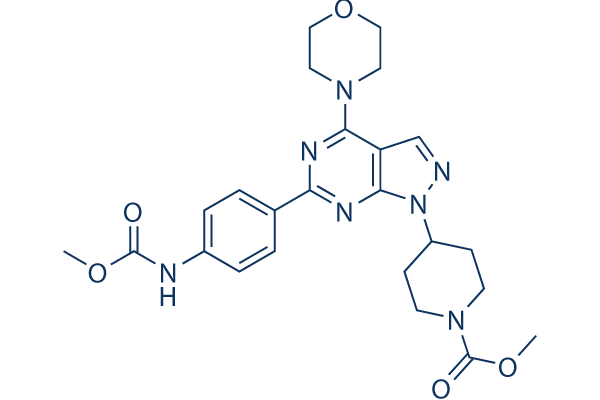
WYE-354 mTOR inhibitor
Cat.No.S1266
Quality Control
| Related Targets | PI3K Akt GSK-3 ATM/ATR DNA-PK AMPK PDPK1 PTEN PI4K PP2A |
|---|---|
| Other mTOR Inhibitors | Torin 1 Torin 2 AZD8055 Ridaforolimus (Deforolimus, MK-8669) Sapanisertib (MLN0128, INK-128) Torkinib (PP242) MHY1485 Vistusertib (AZD2014) KU-0063794 OSI-027 |
Cell Culture, Treatment & Working Concentration
| Cell Lines | Assay Type | Concentration | Incubation Time | Formulation | Activity Description | PMID |
|---|---|---|---|---|---|---|
| HEK293 cells | Function assay | Inhibition of flag-tagged truncated human mTOR (1360-2549) expressed in HEK293 cells by DELFIA assay, IC50=0.0043 μM | ||||
| LNCAP cells | Cytotoxicity assay | 3 days | Cytotoxicity against human LNCAP cells after 3 days by MTS assay, IC50=0.355 μM | |||
| Click to View More Cell Line Experimental Data | ||||||
Solubility
|
In vitro |
DMSO
: 99 mg/mL
(199.78 mM)
Water : Insoluble Ethanol : Insoluble |
Molarity Calculator
|
In vivo |
|||||
In vivo Formulation Calculator (Clear solution)
Step 1: Enter information below (Recommended: An additional animal making an allowance for loss during the experiment)
Step 2: Enter the in vivo formulation (This is only the calculator, not formulation. Please contact us first if there is no in vivo formulation at the solubility Section.)
Calculation results:
Working concentration: mg/ml;
Method for preparing DMSO master liquid: mg drug pre-dissolved in μL DMSO ( Master liquid concentration mg/mL, Please contact us first if the concentration exceeds the DMSO solubility of the batch of drug. )
Method for preparing in vivo formulation: Take μL DMSO master liquid, next addμL PEG300, mix and clarify, next addμL Tween 80, mix and clarify, next add μL ddH2O, mix and clarify.
Method for preparing in vivo formulation: Take μL DMSO master liquid, next add μL Corn oil, mix and clarify.
Note: 1. Please make sure the liquid is clear before adding the next solvent.
2. Be sure to add the solvent(s) in order. You must ensure that the solution obtained, in the previous addition, is a clear solution before proceeding to add the next solvent. Physical methods such
as vortex, ultrasound or hot water bath can be used to aid dissolving.
Chemical Information, Storage & Stability
| Molecular Weight | 495.53 | Formula | C24H29N7O5 |
Storage (From the date of receipt) | |
|---|---|---|---|---|---|
| CAS No. | 1062169-56-5 | Download SDF | Storage of Stock Solutions |
|
|
| Synonyms | N/A | SMILES | COC(=O)NC1=CC=C(C=C1)C2=NC3=C(C=NN3C4CCN(CC4)C(=O)OC)C(=N2)N5CCOCC5 | ||
Read more about storage stability stock solution CAS number SMILES
Mechanism of Action
| Targets/IC50/Ki |
mTOR
5 nM
|
|---|---|
| In vitro |
WYE-354 also inhibits several PI3Ks at micromolar levels. In HEK293 cells, this compound (0.2 μM–5 μM) effectively inhibits both mTORC1 and mTORC2. It (0.3 μM–10 μM) significantly blocks mTOR signaling and Akt activation in U87MG and MDA361 cells. Furthermore, this chemical potently inhibits proliferation in tumor cell lines including MDA-MB-361, MDA-MB-231, MDA-MB-468, LNCap, A498, and HCT116, with IC50 values ranging from 0.28 μM to 2.3 μM. The apoptosis induced by this compound is accompanied by G1 cell cycle arrest and caspases activation.
In endothelial HUVEC cells, it (10 nM–1 μM) also inhibits both mTORC1 and mTORC2 signaling, as revealed by dephosphorylation of S6 ribosomal protein and Akt, respectively. Furthermore, this chemical (10 nM–1 μM) activates mitogen-activated protein kinase (MAPK) signaling, which may be due to its inhibition of mTORC1.
|
| Kinase Assay |
mTOR inhibitor assays
|
|
The assays are performed in 96-well plates for 2 hours at room temperature in 25 μL containing 6 nM Flag-TOR(3.5), 1 μM His6-S6K, and 100 μM ATP. The assays are performed and detected by DELFIA employing the Eu-phospho-p70S6K T389 antibody. For inhibitor versus ATP matrix competition, mTOR kinase reactions are carried out with varying concentrations of ATP (0, 25, 50 100, 200, 400, and 800 μM) in combination with varying concentrations of this compound. The assays contained 12 nM Flag-TOR(3.5), 1 μM His-S6K, and are incubated for 30 min. The assay results are similarly detected by DELFIA and processed for generation of double-reciprocal plots.
|
|
| In vivo |
In a mice xenograft model of PTEN-null PC3MM2 tumor, WYE-354 (50 mg/kg) effectively inhibits mTOR signaling and tumor growth.
|
References |
|
Tech Support
Tel: +1-832-582-8158 Ext:3
If you have any other enquiries, please leave a message.
Signaling Pathway Map

Products are for research use only. Not for human use. We do not sell to patients.
©Copyright 2013 Selleck Chemicals. All Rights Reserved.