
-
 Argentina
-
 Australia
-
 Austria
-
 Belgium
-
 Brazil
-
 Canada
-
 China
China
-
 Czech Republic
-
 Denmark
-
 Finland
-
 France
-
 Germany
-
 Greece
-
 Hong Kong
-
 Hungary
-
 Iceland
-
 India
India
-
 Ireland
-
 Israel
-
 Italy
Italy
-
 Japan
Japan
-
 Korea
Korea
-
 Luxembourg
-
 Malaysia
-
 Netherlands
-
 New Zealand
-
 Norway
-
 Poland
-
 Portugal
-
 Qatar
Qatar
-
 Romania
-
 Saudi Arabia
-
 Singapore
-
 Spain
Spain
-
 Sweden
-
 Switzerland
-
 Taiwan
-
 Turkey
-
 United Kingdom
-
 United States
research use only
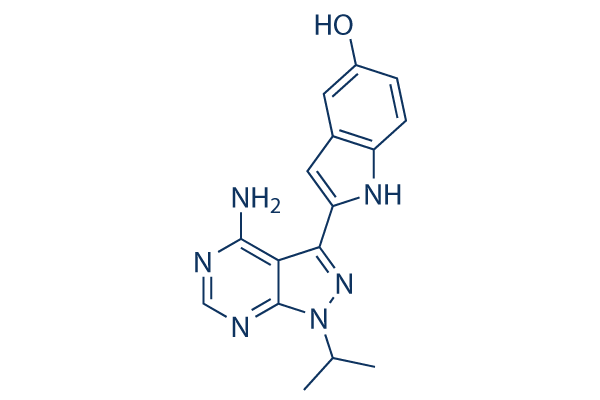
Torkinib (PP242) mTOR inhibitor
Cat.No.S2218
Quality Control
| Related Targets | PI3K Akt GSK-3 ATM/ATR DNA-PK AMPK PDPK1 PTEN PI4K PP2A |
|---|---|
| Other mTOR Inhibitors | Torin 1 Torin 2 AZD8055 Ridaforolimus (Deforolimus, MK-8669) Sapanisertib (MLN0128, INK-128) MHY1485 Vistusertib (AZD2014) KU-0063794 OSI-027 3BDO |
Cell Culture, Treatment & Working Concentration
| Cell Lines | Assay Type | Concentration | Incubation Time | Formulation | Activity Description | PMID |
|---|---|---|---|---|---|---|
| HT-p21 | Function Assay | 50-1250 nM | 24 h | DMSO | inhibits phosphorylation of S6 kinase (target of mTORC1) and its downstream target phospho-S6 | |
| U87vIII | Function Assay | 0.04-2.5 μM | 24 h | inhibits mTORC1 and mTORC2 activities | ||
| U87vIII | Function Assay | 2.5/5 μM | 12 h | inhibits gap closing in a dose-dependent manner | ||
| PC12 | Function Assay | 40 nM | induces lysosomal biogenesis and alleviated α-SYN accumulation | |||
| 3T3-L1 | Function Assay | 15 μM | 4 h | suppresses expression of the Egr1 protein | ||
| Rh30 | Function Assay | 1 μM | 2 h | inhibits both mTORC1-mediated phosphorylation of S6K1 and mTORC2-mediated phosphorylation of Akt | ||
| HT29 | Function Assay | 1 μM | 2 h | inhibits both mTORC1-mediated phosphorylation of S6K1 and mTORC2-mediated phosphorylation of Akt | ||
| Rh30 | Function Assay | 1 μM | 2 h | suppresses the basal or IGF-1-stimulated cell adhesion | ||
| HT29 | Function Assay | 1 μM | 2 h | suppresses the basal or IGF-1-stimulated cell adhesion | ||
| U87 | Growth Inhibition Assay | 25 nM | 24 h | increases DUSP10 knocked-down induced cell inhibition | ||
| AGS | Cell Viability Assay | 0-1000 nM | 24/48 h | DMSO | decreases cell viability in time and dose dependent manner | |
| MKN45 | Cell Viability Assay | 0-1000 nM | 24/48 h | DMSO | decreases cell viability in time and dose dependent manner | |
| MKN28 | Cell Viability Assay | 0-1000 nM | 24/48 h | DMSO | decreases cell viability in time and dose dependent manner | |
| KATO3 | Cell Viability Assay | 0-1000 nM | 24/48 h | DMSO | decreases cell viability in time and dose dependent manner | |
| SGC7901 | Cell Viability Assay | 0-1000 nM | 24/48 h | DMSO | decreases cell viability in time and dose dependent manner | |
| N87 | Cell Viability Assay | 0-1000 nM | 24/48 h | DMSO | decreases cell viability in time and dose dependent manner | |
| HMEC | Cell Viability Assay | 0-1000 nM | 24/48 h | DMSO | decreases cell viability in time and dose dependent manner | |
| HUVEC | Cell Viability Assay | 0-1000 nM | 24/48 h | DMSO | decreases cell viability in time and dose dependent manner | |
| MG63 | Function Assay | 50-1000 nM | 0.5 h | dose dependently (50–1000 nM) inhibits phosphorylation of Akt | ||
| U2OS | Function Assay | 50-1000 nM | 0.5 h | dose dependently (50–1000 nM) inhibits phosphorylation of Akt | ||
| Saos-2 | Function Assay | 50-1000 nM | 0.5 h | dose dependently (50–1000 nM) inhibits phosphorylation of Akt | ||
| Saos-2 | Function Assay | 100 nM | 0.5 h | prevents osteosarcoma cell migration | ||
| MG63 | Apoptosis Assay | 100 nM | 36 h | promotes apoptosis | ||
| U2OS | Apoptosis Assay | 100 nM | 36 h | promotes apoptosis | ||
| Saos-2 | Apoptosis Assay | 100 nM | 36 h | promotes apoptosis | ||
| HT1376 | Growth Inhibition Assay | IC50=1.88 ± 1.1 μM | ||||
| T24 | Growth Inhibition Assay | IC50=1.37 ± 0.4 μM | ||||
| UM-UC-3 | Growth Inhibition Assay | IC50=0.63 ±0.1 μM | ||||
| DLD-1 | Cell Viability Assay | 0-1000 nM | 24 h | inhibits the growth in a dose-dependent manner | ||
| Caco2 | Cell Viability Assay | 0-1000 nM | 24 h | inhibits the growth in a dose-dependent manner | ||
| HT29 | Cell Viability Assay | 0-1000 nM | 24 h | inhibits the growth in a dose-dependent manner | ||
| H116 | Cell Viability Assay | 0-1000 nM | 24 h | inhibits the growth in a dose-dependent manner | ||
| Hct-8 | Cell Viability Assay | 0-1000 nM | 24 h | inhibits the growth in a dose-dependent manner | ||
| Colo320 | Cell Viability Assay | 0-1000 nM | 24 h | inhibits the growth in a dose-dependent manner | ||
| Sw948 | Cell Viability Assay | 0-1000 nM | 24 h | inhibits the growth in a dose-dependent manner | ||
| Colo205 | Cell Viability Assay | 0-1000 nM | 24 h | inhibits the growth in a dose-dependent manner | ||
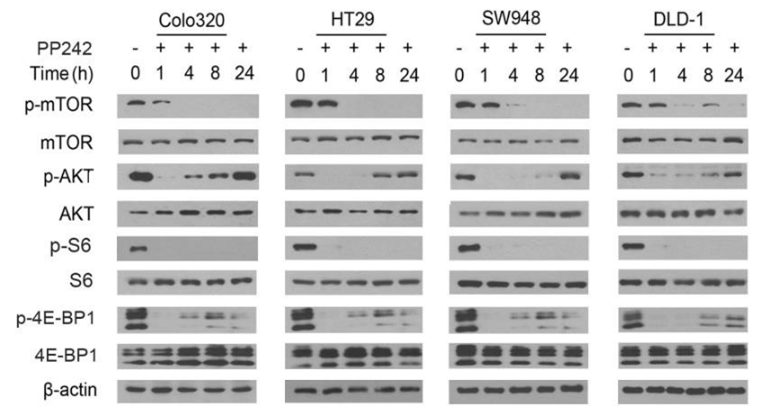
| Colo320 | Function Assay | 1 μM | 0-24 h | abolishes the S6S235/236 but partially reduces the 4E-BP1T36/45 | ||
| HT29 | Function Assay | 1 μM | 0-24 h | abolishes the S6S235/236 but partially reduces the 4E-BP1T36/45 | ||
| Sw948 | Function Assay | 1 μM | 0-24 h | abolishes the S6S235/236 but partially reduces the 4E-BP1T36/45 | ||
| DLD-1 | Function Assay | 1 μM | 0-24 h | abolishes the S6S235/236 but partially reduces the 4E-BP1T36/45 | ||
| SW620 | Growth Inhibition Assay | IC50=7.8 μM | ||||
| SW480 | Growth Inhibition Assay | IC50=4.6 μM | ||||
| SK-CO-1 | Growth Inhibition Assay | IC50=4 μM | ||||
| LS-513 | Growth Inhibition Assay | IC50=3.9 μM | ||||
| SW1116 | Growth Inhibition Assay | IC50=0.84 μM | ||||
| LS-174T | Growth Inhibition Assay | IC50=0.84 μM | ||||
| HCT 116 | Growth Inhibition Assay | IC50=0.41 μM | ||||
| HCT 15 | Growth Inhibition Assay | IC50=0.3 μM | ||||
| COLO 205 | Growth Inhibition Assay | IC50=0.24 μM | ||||
| HT-29 | Growth Inhibition Assay | IC50=0.23 μM | ||||
| COLO 201 | Growth Inhibition Assay | IC50=0.23 μM | ||||
| Caco-2 | Growth Inhibition Assay | IC50=0.22 μM | ||||
| SW48 | Growth Inhibition Assay | IC50=0.09 μM | ||||
| DND-1 | Growth Inhibition Assay | 0.25/0.5/1 μM | DMSO | inhibits cell growth dose dependently | ||
| TMD8 | Growth Inhibition Assay | 0.25/0.5/1 μM | DMSO | inhibits cell growth dose dependently | ||
| Jurkat | Growth Inhibition Assay | 0.25/0.5/1 μM | DMSO | inhibits cell growth dose dependently | ||
| KOPT-K1 | Growth Inhibition Assay | 0.25/0.5/1 μM | DMSO | inhibits cell growth dose dependently | ||
| TMD7 | Growth Inhibition Assay | 0.25/0.5/1 μM | DMSO | inhibits cell growth dose dependently | ||
| THP-1 | Growth Inhibition Assay | 0.25/0.5/1 μM | DMSO | inhibits cell growth dose dependently | ||
| 786-O | Function Assay | 0.1/0.5 μM | 24 h | DMSO | increases E-cadherin mRNA levels dose dependently | |
| 786-O | Function Assay | 0-0.5 μM | 24 h | DMSO | results in a dose dependent increase in E-cadherin protein expression | |
| OCI-AML3 | Apoptosis Assay | 2.5 μM | 72 h | induces apoptosis | ||
| Jurkat | Function Assay | 100/200/400 nM | 18 h | inhibits mTORC1-dependent S6 S235/236 phosphorylation | ||
| p210 BCR-Abl | Function Assay | 100/200/400 nM | 18 h | inhibits mTORC1-dependent S6 S235/236 phosphorylation | ||
| Jurkat | Growth Inhibition Assay | 400nM | 24/48 h | synergize with 17-AAG to suppress cell proliferation | ||
| p210 BCR-Abl | Growth Inhibition Assay | 400nM | 24/48 h | synergize with 17-AAG to suppress cell proliferation | ||
| 8226 | Function Assay | 100-1000 nM | 30 min | DMSO | activates ERK | |
| MM1.S | Function Assay | 100-1000 nM | 30 min | DMSO | activates ERK | |
| 8226 | Function Assay | 0.5 μM | 30 min | DMSO | induces activation of RAF and phosphorylation of MEK | |
| MM1.S | Function Assay | 0.5 μM | 30 min | DMSO | induces activation of RAF and phosphorylation of MEK | |
| MCF-7 | Function Assay | 50/200/500 nM | 30 min | dose-dependently (50–500 nM) suppresses phosphorylation of Akt | ||
| T47D | Function Assay | 50/200/500 nM | 30 min | dose-dependently (50–500 nM) suppresses phosphorylation of Akt | ||
| MDA-MB-231 | Function Assay | 50/200/500 nM | 30 min | dose-dependently (50–500 nM) suppresses phosphorylation of Akt | ||
| Bcap-37 | Function Assay | 50/200/500 nM | 30 min | dose-dependently (50–500 nM) suppresses phosphorylation of Akt | ||
| MCF-7 | Apoptosis Assay | 200 nM | 36 h | DMSO | induces apoptosis | |
| MDA-MB-231 | Apoptosis Assay | 200 nM | 36 h | DMSO | induces apoptosis | |
| Bcap-37 | Apoptosis Assay | 200 nM | 36 h | DMSO | induces apoptosis | |
| LS174T | Function Assay | 10/100/1000 nM | 6 h | DMSO | inhibits mTORC1 activity by the dephosphorylation of S6 ribosomal protein | |
| DLD-1 | Function Assay | 10/100/1000 nM | 6 h | DMSO | inhibits mTORC1 activity by the dephosphorylation of S6 ribosomal protein | |
| SW480 | Function Assay | 10/100/1000 nM | 6 h | DMSO | inhibits mTORC1 activity by the dephosphorylation of S6 ribosomal protein | |
| SW-48 | Growth Inhibition Assay | IC50=0.1 μM | ||||
| HCT-15 | Growth Inhibition Assay | IC50=0.3 μM | ||||
| HCT 116 | Growth Inhibition Assay | IC50=0.6 μM | ||||
| SW620-R | Growth Inhibition Assay | IC50=1.3 μM | ||||
| SK-CO-1 | Growth Inhibition Assay | IC50=2.1 μM | ||||
| SW620 | Growth Inhibition Assay | IC50=11 μM | ||||
| BaF3 | Growth Inhibition Assay | GI50=1.449 μM | ||||
| NIH 3T3 | Function Assay | 2 μM | 18 h | inhibits mTORC2 phosphorylation of Akt on Ser473 and mTORC1 phosphorylation of 4E-BP1 on Thr37/46 | ||
| HCT15 | Function Assay | 0.5/2 μM | 4 h | prevents S6K1 phosphorylation of ribosomal protein S6 at Ser240/244 and mTORC2 phosphorylation of Akt at Ser473 | ||
| SW620 | Function Assay | 0.5/2 μM | 4 h | blocks all three mTOR outputs | ||
| Click to View More Cell Line Experimental Data | ||||||
Solubility
|
In vitro |
DMSO
: 61 mg/mL
(197.83 mM)
Water : Insoluble Ethanol : Insoluble |
Molarity Calculator
|
In vivo |
|||||
In vivo Formulation Calculator (Clear solution)
Step 1: Enter information below (Recommended: An additional animal making an allowance for loss during the experiment)
Step 2: Enter the in vivo formulation (This is only the calculator, not formulation. Please contact us first if there is no in vivo formulation at the solubility Section.)
Calculation results:
Working concentration: mg/ml;
Method for preparing DMSO master liquid: mg drug pre-dissolved in μL DMSO ( Master liquid concentration mg/mL, Please contact us first if the concentration exceeds the DMSO solubility of the batch of drug. )
Method for preparing in vivo formulation: Take μL DMSO master liquid, next addμL PEG300, mix and clarify, next addμL Tween 80, mix and clarify, next add μL ddH2O, mix and clarify.
Method for preparing in vivo formulation: Take μL DMSO master liquid, next add μL Corn oil, mix and clarify.
Note: 1. Please make sure the liquid is clear before adding the next solvent.
2. Be sure to add the solvent(s) in order. You must ensure that the solution obtained, in the previous addition, is a clear solution before proceeding to add the next solvent. Physical methods such
as vortex, ultrasound or hot water bath can be used to aid dissolving.
Chemical Information, Storage & Stability
| Molecular Weight | 308.34 | Formula | C16H16N6O |
Storage (From the date of receipt) | |
|---|---|---|---|---|---|
| CAS No. | 1092351-67-1 | Download SDF | Storage of Stock Solutions |
|
|
| Synonyms | N/A | SMILES | CC(C)N1C2=NC=NC(=C2C(=N1)C3=CC4=C(N3)C=CC(=C4)O)N | ||
Read more about storage stability stock solution CAS number SMILES
Mechanism of Action
| Features |
One of the first selective inhibitors that targets ATP domain of mTOR.
|
|---|---|
| Targets/IC50/Ki |
mTOR
(Cell-free assay) 8 nM
p110δ
(Cell-free assay) 0.10 μM
DNA-PK
(Cell-free assay) 0.41 μM
PDGFR
(Cell-free assay) 0.41 μM
|
| In vitro |
PP242 exhibits potent selectivity for mTOR over other PI3K family kinases such as p110α, p110β, p110γ, p110δ, and DNA-PK with IC50 of 1.96 μM, 2.2 μM, 1.27 μM, 0.102 μM, and 0.408 μM, respectively. This compound displays some inhibitory activity against Ret, PKCα, PKCβ, and JAK2, while exhibits remarkable selectivity against 215 other protein kinases. Unlike rapamycin, this inhibitor inhibits both mTORC1 and mTORC2. In BT549 cells, this chemical treatment (0.04-10 μM) inhibits the phosphorylation of Akt, the mTOR substrate p70S6K, and its downstream target S6 in a dose-dependent manner. It potently inhibits PKCα with IC50 of 49 nM. Low concentrations of this compound inhibit the phosphorylation of Akt S473 and higher concentrations partially inhibit Akt T308-P in addition to S473-P. As this agent is a more effective mTORC1 inhibitor than rapamycin, it inhibits the proliferation of primary MEFs, and the phosphorylation of 4EBP1 at T36/45 and S65, more potently than rapamycin. This compound but not rapamycin potently inhibits cap-dependent translation, by causing a higher level of binding between 4EBP1 and eIF4E than rapamycin. It potently inhibits the proliferation of p190-transformed murine BM, SUP-B15, and K562 cells with GI50 of 12 nM, 90 nM, and 85 nM, respectively. This inhibitor also inhibits the growth of solid tumor cell lines such as SKOV3, PC3, 786-O, and U87 with GI50 of 0.49 μM, 0.19 μM, 2.13 μM, and 1.57 μM, respectively. It is also more effective than rapamycin in achieving cytoreduction and apoptosis in multiple myeloma (MM) cells.
|
| Kinase Assay |
In vitro mTOR (FRAP1) kinase assay
|
|
Recombinant mTOR is incubated with this compound at 2-fold dilutions over a concentration range of 50-0.001 μM in an assay containing 50 mM HEPES, pH 7.5, 1 mM EGTA, 10 mM MgCl2, 0.01% Tween, 10 μM ATP (2.5 μCi of γ-32P-ATP), and 3 μg/mL BSA. Rat recombinant PHAS-1/4EBP1 (2 mg/mL) is used as a substrate. Reactions are terminated by spotting onto nitrocellulose, which is washed with 1 M NaCl/1% phosphoric acid (approximately 6 times, 5-10 minutes each). Sheets are dried and the transferred radioactivity quantitated by phosphorimaging. IC50 value is calculated by fitting the data to a sigmoidal dose-response curve using the Prism software package.
|
|
| In vivo |
Administration of PP242 is able to completely inhibit the phosphorylation of Akt at S473 and T308 in fat and liver of mice. This compound only partially inhibits the phosphorylation of Akt in skeletal muscle and is more effective at inhibiting the phosphorylation of T308 than S473, despite able to fully inhibit the phosphorylation of 4EBP1 and S6. Oral administration of this chemical potently delays the leukemia onset in the mice model, and induces leukemia regression by inhibiting mTORC2 and mTORC1 activation that correlates with loss in cell size. This treatment potently inhibits the growth of 8226 cells in mice.
|
References |
|
Applications
| Methods | Biomarkers | Images | PMID |
|---|---|---|---|
| Western blot | p-mTOR / mTOR / p-AKT / AKT / p-S6 / S6 / p-4E-BP1 / 4E-BP-1 |
|
23991179 |
| Growth inhibition assay | Cell viability |

|
23991179 |
Tech Support
Tel: +1-832-582-8158 Ext:3
If you have any other enquiries, please leave a message.
Frequently Asked Questions
Question 1:
Do you have any suggestions about potential candidates for vehicles that we could use for in vivo studies of it?
Answer:
In the recommended solvent (30% PEG400 + 0.5% Tween80 + 5% Propylene glycol), it is a suspension, and this formulation is for oral gavage. For IV injection, this compound can be dissolved in 2% DMSO+30% PEG 300+5% Tween 80+ddH2O at 5mg/ml as a clear solution.
Signaling Pathway Map

Products are for research use only. Not for human use. We do not sell to patients.
©Copyright 2013 Selleck Chemicals. All Rights Reserved.