
-
 Argentina
-
 Australia
-
 Austria
-
 Belgium
-
 Brazil
-
 Canada
-
 China
China
-
 Czech Republic
-
 Denmark
-
 Finland
-
 France
-
 Germany
-
 Greece
-
 Hong Kong
-
 Hungary
-
 Iceland
-
 India
India
-
 Ireland
-
 Israel
-
 Italy
Italy
-
 Japan
Japan
-
 Korea
Korea
-
 Luxembourg
-
 Malaysia
-
 Netherlands
-
 New Zealand
-
 Norway
-
 Poland
-
 Portugal
-
 Qatar
Qatar
-
 Romania
-
 Saudi Arabia
-
 Singapore
-
 Spain
Spain
-
 Sweden
-
 Switzerland
-
 Taiwan
-
 Turkey
-
 United Kingdom
-
 United States
research use only
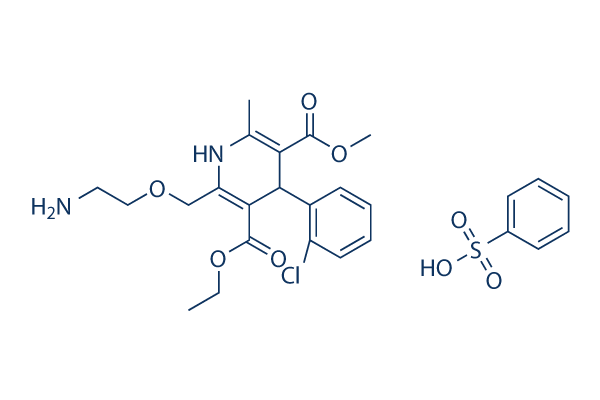
Amlodipine Besylate Calcium Channel inhibitor
Cat.No.S1813
Quality Control
| Related Targets | CFTR CRM1 CD markers AChR Sodium Channel Potassium Channel GABA Receptor TRP Channel ATPase GluR |
|---|---|
| Other Calcium Channel Inhibitors | Bay K 8644 BAPTA-AM Tetrandrine Flunarizine 2HCl Nilvadipine Cilnidipine YM-58483 (BTP2) Ionomycin Imperatorin Manidipine 2HCl |
Solubility
|
In vitro |
DMSO
: 113 mg/mL
(199.27 mM)
Ethanol : 14 mg/mL Water : Insoluble |
Molarity Calculator
|
In vivo |
|||||
In vivo Formulation Calculator (Clear solution)
Step 1: Enter information below (Recommended: An additional animal making an allowance for loss during the experiment)
Step 2: Enter the in vivo formulation (This is only the calculator, not formulation. Please contact us first if there is no in vivo formulation at the solubility Section.)
Calculation results:
Working concentration: mg/ml;
Method for preparing DMSO master liquid: mg drug pre-dissolved in μL DMSO ( Master liquid concentration mg/mL, Please contact us first if the concentration exceeds the DMSO solubility of the batch of drug. )
Method for preparing in vivo formulation: Take μL DMSO master liquid, next addμL PEG300, mix and clarify, next addμL Tween 80, mix and clarify, next add μL ddH2O, mix and clarify.
Method for preparing in vivo formulation: Take μL DMSO master liquid, next add μL Corn oil, mix and clarify.
Note: 1. Please make sure the liquid is clear before adding the next solvent.
2. Be sure to add the solvent(s) in order. You must ensure that the solution obtained, in the previous addition, is a clear solution before proceeding to add the next solvent. Physical methods such
as vortex, ultrasound or hot water bath can be used to aid dissolving.
Chemical Information, Storage & Stability
| Molecular Weight | 567.05 | Formula | C20H25ClN2O5.C6H6O3S |
Storage (From the date of receipt) | |
|---|---|---|---|---|---|
| CAS No. | 111470-99-6 | Download SDF | Storage of Stock Solutions |
|
|
| Synonyms | N/A | SMILES | CCOC(=O)C1=C(NC(=C(C1C2=CC=CC=C2Cl)C(=O)OC)C)COCCN.C1=CC=C(C=C1)S(=O)(=O)O | ||
Read more about storage stability stock solution CAS number SMILES
Mechanism of Action
| Targets/IC50/Ki |
Calcium channel
1.9 nM
|
|---|---|
| In vitro |
Amlodipine besylate reduces the declines in p85aPI3K, phosphorylated Akt, phosphorylated GSK-3β, heat-shock transcription factor-1, and Bcl-2 induced by H(2) O(2) , as well as the increases in cyclooxygenase-2, cytosolic cytochrome c, cleaved caspase 9, and cleaved caspase 3 in neuronal cell. Amlodipine significantly reduces systolic blood pressure (SBP), aortic hypertrophy, endothelial dysfunction, LOX-1 expression, aortic O(2)(-) and ONOO(-) production, and plasma free 8-F(2)alpha-isoprostane levels in Ang II-infused rats. Amlodipine elicits an NO-mediated relaxation and a leftward shift in the concentration-relaxation curve to bradykinin in isolated, pre-contracted, endothelium-intact porcine coronary arteries. Amlodipine increases the generation of NO from native endothelial cells, as detected by electron spin resonance spectroscopy and stimulated an 8-fold increase in cyclic GMP levels in cultured endothelial cells. Amlodipine elicits the NO-mediated relaxation of rat aortic rings, which do not express the B2 receptor. Amlodipine time-dependently attenuates the phosphorylation of protein kinase C (PKC) in endothelial cells, with a time course similar to the changes in eNOS phosphorylation, and prevents the phorbol-12-myristate-13-acetate-induced activation of PKC.
|
| In vivo |
Amlodipine besylate significantly decreases average indirect systolic blood pressure measurements from 198 mmHg to 155 mmHg in the cats. Amlodipine besylate appears to be a safe and effective oral treatment for systemic hypertension in cats when used chronically once daily as a single agent.
|
References |
|
Clinical Trial Information
(data from https://clinicaltrials.gov, updated on 2025-12-09)
| NCT Number | Recruitment | Conditions | Sponsor/Collaborators | Start Date | Phases |
|---|---|---|---|---|---|
| NCT07075965 | NOT_YET_RECRUITING | Myotonic Dystrophy 1 |
University of Rochester |
2026-12-07 | PHASE1 |
| NCT07075965 | NOT_YET_RECRUITING | Myotonic Dystrophy 1 |
University of Rochester |
2026-12-07 | PHASE1 |
| NCT04974138 | RECRUITING | Hypertension; MTHFR 677 CC or CT Genotype; Elevated Plasma Homocysteine (Hcy≥10µmol/L); Insufficient Plasma Folate Levels (<12ng/mL) |
Shenzhen Ausa Pharmed Co.,Ltd |
2024-08-22 | PHASE4 |
| NCT04974138 | RECRUITING | Hypertension; MTHFR 677 CC or CT Genotype; Elevated Plasma Homocysteine (Hcy≥10µmol/L); Insufficient Plasma Folate Levels (<12ng/mL) |
Shenzhen Ausa Pharmed Co.,Ltd |
2024-08-22 | PHASE4 |
| NCT05155137 | RECRUITING | Stroke; Cognitive Decline |
Hospital Moinhos de Vento |
2021-12-20 | PHASE3 |
| NCT05155137 | RECRUITING | Stroke; Cognitive Decline |
Hospital Moinhos de Vento |
2021-12-20 | PHASE3 |
Read more about Clinical Trials
Tech Support
Tel: +1-832-582-8158 Ext:3
If you have any other enquiries, please leave a message.
Signaling Pathway Map

Products are for research use only. Not for human use. We do not sell to patients.
©Copyright 2013 Selleck Chemicals. All Rights Reserved.