
-
 Argentina
-
 Australia
-
 Austria
-
 Belgium
-
 Brazil
-
 Canada
-
 China
China
-
 Czech Republic
-
 Denmark
-
 Finland
-
 France
-
 Germany
-
 Greece
-
 Hong Kong
-
 Hungary
-
 Iceland
-
 India
India
-
 Ireland
-
 Israel
-
 Italy
Italy
-
 Japan
Japan
-
 Korea
Korea
-
 Luxembourg
-
 Malaysia
-
 Netherlands
-
 New Zealand
-
 Norway
-
 Poland
-
 Portugal
-
 Qatar
Qatar
-
 Romania
-
 Saudi Arabia
-
 Singapore
-
 Spain
Spain
-
 Sweden
-
 Switzerland
-
 Taiwan
-
 Turkey
-
 United Kingdom
-
 United States
research use only
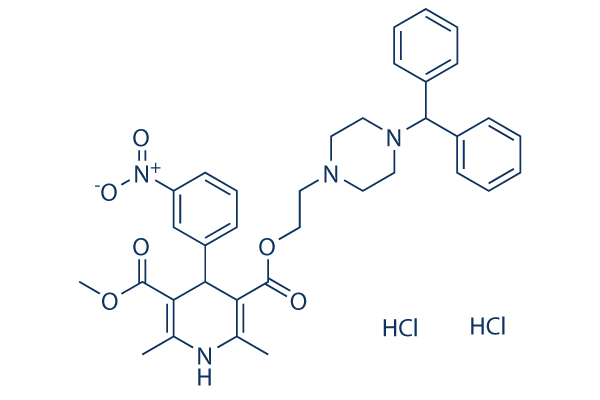
Manidipine 2HCl Calcium Channel inhibitor
Cat.No.S2482
Quality Control
| Related Targets | CFTR CRM1 CD markers AChR Sodium Channel Potassium Channel GABA Receptor TRP Channel ATPase GluR |
|---|---|
| Other Calcium Channel Inhibitors | Bay K 8644 BAPTA-AM Tetrandrine Flunarizine 2HCl Nilvadipine Cilnidipine YM-58483 (BTP2) Ionomycin Imperatorin Astragaloside A |
Solubility
|
In vitro |
DMSO
: 100 mg/mL
(146.28 mM)
Water : Insoluble Ethanol : Insoluble |
Molarity Calculator
|
In vivo |
|||||
In vivo Formulation Calculator (Clear solution)
Step 1: Enter information below (Recommended: An additional animal making an allowance for loss during the experiment)
Step 2: Enter the in vivo formulation (This is only the calculator, not formulation. Please contact us first if there is no in vivo formulation at the solubility Section.)
Calculation results:
Working concentration: mg/ml;
Method for preparing DMSO master liquid: mg drug pre-dissolved in μL DMSO ( Master liquid concentration mg/mL, Please contact us first if the concentration exceeds the DMSO solubility of the batch of drug. )
Method for preparing in vivo formulation: Take μL DMSO master liquid, next addμL PEG300, mix and clarify, next addμL Tween 80, mix and clarify, next add μL ddH2O, mix and clarify.
Method for preparing in vivo formulation: Take μL DMSO master liquid, next add μL Corn oil, mix and clarify.
Note: 1. Please make sure the liquid is clear before adding the next solvent.
2. Be sure to add the solvent(s) in order. You must ensure that the solution obtained, in the previous addition, is a clear solution before proceeding to add the next solvent. Physical methods such
as vortex, ultrasound or hot water bath can be used to aid dissolving.
Chemical Information, Storage & Stability
| Molecular Weight | 683.62 | Formula | C35H38N4O6.2HCl |
Storage (From the date of receipt) | |
|---|---|---|---|---|---|
| CAS No. | 89226-75-5 | Download SDF | Storage of Stock Solutions |
|
|
| Synonyms | CV-4093 | SMILES | CC1=C(C(C(=C(N1)C)C(=O)OCCN2CCN(CC2)C(C3=CC=CC=C3)C4=CC=CC=C4)C5=CC(=CC=C5)[N+](=O)[O-])C(=O)OC.Cl.Cl | ||
Read more about storage stability stock solution CAS number SMILES
Mechanism of Action
| Targets/IC50/Ki |
Calcium channel
(Guinea-pig single ventricular cells ) 2.6 nM
|
|---|---|
| In vitro |
At a holding potential of −37 mV, Manidipine decreases the Ca2+ current at concentrations above 0.1 nM, and abolishes it at 100 nM. Manidipine concentration-dependently inhibits the calcium concentration response curves. Manidipine inhibits coronay artery and renal artery with pIC50 of 9.3 nM and 9.1 nM, respectively. Manidipine partly inhibits sympathetic nerve activity and suppresses the mean arterial pressure response to infused norepinephrine. Manidipine also inhibits aldosterone secretion. Manidipine increases in both urinary calcium and uric acid. In addition, Manidipine, at nanomolar concentrations, is efficacious in modulating gene transcriptions that are involved in proinflammatory changes of mesangial cells.
|
| In vivo |
Manidipine (3 mg/kg and 10 mg/kg, p.o.) dose-dependently decreases systolic blood pressure in the three types of hypertensive rats. At the dose of 10 mg/kg, Manidipine decreases the blood pressure to the normotensive level between 1 hour and 3 hours after Manidipine is administered; the antihypertensive effect lasted for at least 8 hours. When Manidipine is administered at 10 μg/kg, the hypotensive action is markedly augmented. Manidipine potently inhibits the Ca inward current, When the potential is at -60 mV. Manidipine consistently inhibits the Ca current evoked by depolarization to 0 mV. However, a low concentration of Manidipine (1-3 nM) enhances the Ca current evoked by the depolarizing pulse of -20 mV, when the membrane potential is held at -80 mV. Inhibition of the Ca current induced by Manidipine develops slowly and over 10 minutes is required to reach the maximum inhibition.
|
References |
|
Tech Support
Tel: +1-832-582-8158 Ext:3
If you have any other enquiries, please leave a message.
Signaling Pathway Map

Products are for research use only. Not for human use. We do not sell to patients.
©Copyright 2013 Selleck Chemicals. All Rights Reserved.