
-
 Argentina
-
 Australia
-
 Austria
-
 Belgium
-
 Brazil
-
 Canada
-
 China
China
-
 Czech Republic
-
 Denmark
-
 Finland
-
 France
-
 Germany
-
 Greece
-
 Hong Kong
-
 Hungary
-
 Iceland
-
 India
India
-
 Ireland
-
 Israel
-
 Italy
Italy
-
 Japan
Japan
-
 Korea
Korea
-
 Luxembourg
-
 Malaysia
-
 Netherlands
-
 New Zealand
-
 Norway
-
 Poland
-
 Portugal
-
 Qatar
Qatar
-
 Romania
-
 Saudi Arabia
-
 Singapore
-
 Spain
Spain
-
 Sweden
-
 Switzerland
-
 Taiwan
-
 Turkey
-
 United Kingdom
-
 United States
research use only
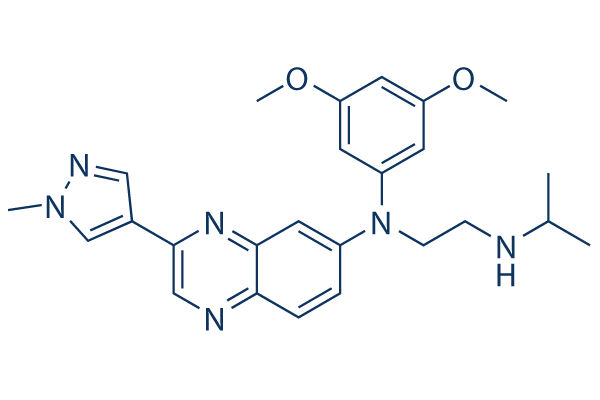
Erdafitinib (JNJ-42756493) FGFR inhibitor
Cat.No.S8401
Quality Control
Products Often Used Together with Erdafitinib (JNJ-42756493)
| Related Targets | EGFR VEGFR JAK PDGFR Src HIF FLT3 HER2 FLT Bcr-Abl |
|---|---|
| Other FGFR Inhibitors | PD173074 BLU9931 Futibatinib (TAS-120) LY2874455 H3B-6527 PD-166866 Fisogatinib (BLU-554) Zoligratinib (Debio-1347) SSR128129E Alofanib (RPT835) |
Cell Culture, Treatment & Working Concentration
| Cell Lines | Assay Type | Concentration | Incubation Time | Formulation | Activity Description | PMID |
|---|---|---|---|---|---|---|
| BA/F3 | Function assay | 24 hrs | Inhibition of FGFR3 (unknown origin) transfected in mouse BA/F3 cells assessed as decrease in cell proliferation in absence of mouse IL3 after 24 hrs by Alamar blue assay, IC50 = 0.01585 μM. | ChEMBL | ||
| BA/F3 | Function assay | 24 hrs | Inhibition of FGFR1 (unknown origin) transfected in mouse BA/F3 cells assessed as decrease in cell proliferation in absence of mouse IL3 after 24 hrs by Alamar blue assay, IC50 = 0.08318 μM. | ChEMBL | ||
| BA/F3 | Function assay | 24 hrs | Inhibition of VEGFR2 (unknown origin) transfected in mouse BA/F3 cells assessed as decrease in cell proliferation in absence of mouse IL3 after 24 hrs by Alamar blue assay, IC50 = 3.31131 μM. | ChEMBL | ||
| Click to View More Cell Line Experimental Data | ||||||
Solubility
|
In vitro |
DMSO
: 89 mg/mL
(199.31 mM)
Ethanol : 89 mg/mL Water : Insoluble |
Molarity Calculator
|
In vivo |
|||||
In vivo Formulation Calculator (Clear solution)
Step 1: Enter information below (Recommended: An additional animal making an allowance for loss during the experiment)
Step 2: Enter the in vivo formulation (This is only the calculator, not formulation. Please contact us first if there is no in vivo formulation at the solubility Section.)
Calculation results:
Working concentration: mg/ml;
Method for preparing DMSO master liquid: mg drug pre-dissolved in μL DMSO ( Master liquid concentration mg/mL, Please contact us first if the concentration exceeds the DMSO solubility of the batch of drug. )
Method for preparing in vivo formulation: Take μL DMSO master liquid, next addμL PEG300, mix and clarify, next addμL Tween 80, mix and clarify, next add μL ddH2O, mix and clarify.
Method for preparing in vivo formulation: Take μL DMSO master liquid, next add μL Corn oil, mix and clarify.
Note: 1. Please make sure the liquid is clear before adding the next solvent.
2. Be sure to add the solvent(s) in order. You must ensure that the solution obtained, in the previous addition, is a clear solution before proceeding to add the next solvent. Physical methods such
as vortex, ultrasound or hot water bath can be used to aid dissolving.
Chemical Information, Storage & Stability
| Molecular Weight | 446.54 | Formula | C25H30N6O2 |
Storage (From the date of receipt) | |
|---|---|---|---|---|---|
| CAS No. | 1346242-81-6 | Download SDF | Storage of Stock Solutions |
|
|
| Synonyms | JNJ-42756493 | SMILES | CC(C)NCCN(C1=CC2=NC(=CN=C2C=C1)C3=CN(N=C3)C)C4=CC(=CC(=C4)OC)OC | ||
Read more about storage stability stock solution CAS number SMILES
Mechanism of Action
| Targets/IC50/Ki |
FGFR
RET
CSF-1R
PDGFR
Kit
VEGFR2
|
|---|---|
| In vitro |
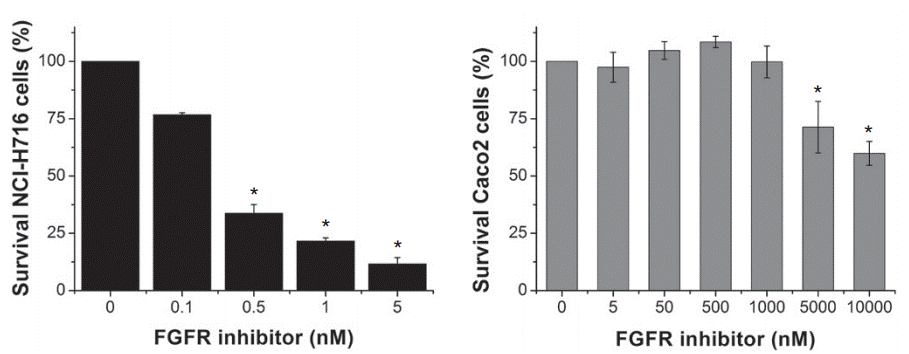
JNJ-42756493 is a potent, oral pan-FGFR tyrosine kinase inhibitor with half-maximal inhibitory concentration values in the low nanomolar range for all members of the FGFR family (FGFR1 to FGFR4), with minimal activity on vascular endothelial growth factor receptor (VEGFR) kinases compared with FGFR kinases (approximately 20-fold potency difference). In vitro, the proliferation of cells treated with this compound is decreased, associated with increased apoptotic death and decreased cell survival. |
| In vivo |
In vivo, growth of NCI-H716 tumors is delayed by 5 days by drug treatment alone, although when drug delivery is stopped the relative tumor volume increased compared to control. This compound shows favorable drug like properties and displays a high distribution to lung, liver and kidney tissue. It is well tolerated at efficacious doses and results in potent dose-dependent antitumor activity accompanied by pharmacodynamic modulation of tumor FGFR and downstream pathway components. |
References |
|
Applications
| Methods | Biomarkers | Images | PMID |
|---|---|---|---|
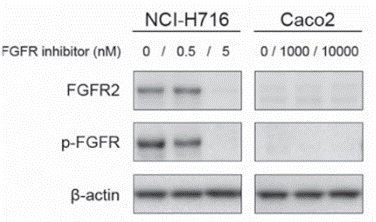
| Western blot | FGFR2 / p-FGFR PARP / Cleaved PARP / AKT / p-AKT / p-ERK / ERK2 |
|
26675289 |
| Growth inhibition assay | Cell viability |
|
26675289 |
Clinical Trial Information
(data from https://clinicaltrials.gov, updated on 2026-05-18)
| NCT Number | Recruitment | Conditions | Sponsor/Collaborators | Start Date | Phases |
|---|---|---|---|---|---|
| NCT06204614 | ENROLLING_BY_INVITATION | Muscle Invasive Bladder Urothelial Carcinoma |
Brigham and Women's Hospital |
2024-06-14 | EARLY_PHASE1 |
| NCT06319820 | RECRUITING | Non-Muscle Invasive Bladder Neoplasms |
Janssen Research & Development, LLC |
2024-04-18 | PHASE3 |
| NCT06919965 | RECRUITING | Non-Muscle Invasive Bladder Neoplasms |
Janssen Research & Development, LLC |
2025-09-10 | PHASE3 |
| NCT05316155 | ACTIVE_NOT_RECRUITING | Non-Muscle Invasive Bladder Neoplasms |
Janssen Research & Development, LLC |
2022-04-11 | PHASE1; PHASE2 |
| NCT02925234 | RECRUITING | Cancer; Tumors; Neoplasm; Neoplasia |
The Netherlands Cancer Institute |
2016-08 | PHASE2 |
| NCT04917809 | ACTIVE_NOT_RECRUITING | Bladder Cancer; Recurrent Bladder Cancer; FGFR3 Gene Mutation |
Memorial Sloan Kettering Cancer Center |
2022-02-17 | PHASE2 |
Read more about Clinical Trials
Tech Support
Tel: +1-832-582-8158 Ext:3
If you have any other enquiries, please leave a message.
Signaling Pathway Map

Products are for research use only. Not for human use. We do not sell to patients.
©Copyright 2013 Selleck Chemicals. All Rights Reserved.