
-
 Argentina
-
 Australia
-
 Austria
-
 Belgium
-
 Brazil
-
 Canada
-
 China
China
-
 Czech Republic
-
 Denmark
-
 Finland
-
 France
-
 Germany
-
 Greece
-
 Hong Kong
-
 Hungary
-
 Iceland
-
 India
India
-
 Ireland
-
 Israel
-
 Italy
Italy
-
 Japan
Japan
-
 Korea
Korea
-
 Luxembourg
-
 Malaysia
-
 Netherlands
-
 New Zealand
-
 Norway
-
 Poland
-
 Qatar
Qatar
-
 Romania
-
 Saudi Arabia
-
 Singapore
-
 Spain
Spain
-
 Sweden
-
 Switzerland
-
 Taiwan
-
 Turkey
-
 United Kingdom
-
 United States
research use only
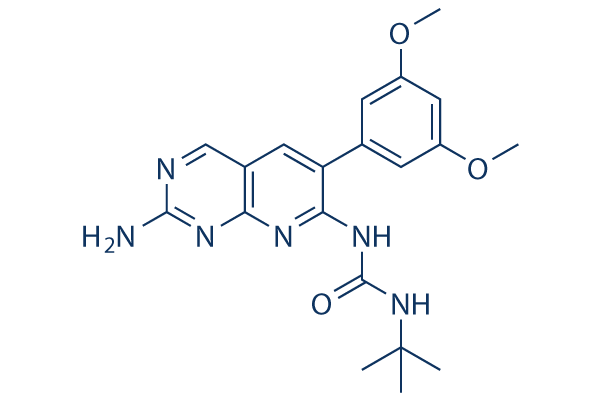
PD-166866 FGFR inhibitor
Cat.No.S8493
Quality Control
| Related Targets | EGFR VEGFR JAK PDGFR Src HIF FLT3 HER2 FLT Bcr-Abl |
|---|---|
| Other FGFR Inhibitors | PD173074 AZD4547 (Fexagratinib) BLU9931 Futibatinib (TAS-120) LY2874455 H3B-6527 Fisogatinib (BLU-554) Zoligratinib (Debio-1347) SSR128129E Alofanib (RPT835) |
Cell Culture, Treatment & Working Concentration
| Cell Lines | Assay Type | Concentration | Incubation Time | Formulation | Activity Description | PMID |
|---|---|---|---|---|---|---|
| HUVEC cells | Function assay | Inhibition of microcapillary growth in HUVEC cells, IC50=0.1 μM | ||||
| Click to View More Cell Line Experimental Data | ||||||
Solubility
|
In vitro |
DMSO
: 40 mg/mL
(100.89 mM)
Ethanol : 4 mg/mL Water : Insoluble |
Molarity Calculator
|
In vivo |
|||||
In vivo Formulation Calculator (Clear solution)
Step 1: Enter information below (Recommended: An additional animal making an allowance for loss during the experiment)
Step 2: Enter the in vivo formulation (This is only the calculator, not formulation. Please contact us first if there is no in vivo formulation at the solubility Section.)
Calculation results:
Working concentration: mg/ml;
Method for preparing DMSO master liquid: mg drug pre-dissolved in μL DMSO ( Master liquid concentration mg/mL, Please contact us first if the concentration exceeds the DMSO solubility of the batch of drug. )
Method for preparing in vivo formulation: Take μL DMSO master liquid, next addμL PEG300, mix and clarify, next addμL Tween 80, mix and clarify, next add μL ddH2O, mix and clarify.
Method for preparing in vivo formulation: Take μL DMSO master liquid, next add μL Corn oil, mix and clarify.
Note: 1. Please make sure the liquid is clear before adding the next solvent.
2. Be sure to add the solvent(s) in order. You must ensure that the solution obtained, in the previous addition, is a clear solution before proceeding to add the next solvent. Physical methods such
as vortex, ultrasound or hot water bath can be used to aid dissolving.
Chemical Information, Storage & Stability
| Molecular Weight | 396.44 | Formula | C20H24N6O3 |
Storage (From the date of receipt) | |
|---|---|---|---|---|---|
| CAS No. | 192705-79-6 | Download SDF | Storage of Stock Solutions |
|
|
| Synonyms | N/A | SMILES | CC(C)(C)NC(=O)NC1=C(C=C2C=NC(=NC2=N1)N)C3=CC(=CC(=C3)OC)OC | ||
Read more about storage stability stock solution CAS number SMILES
Mechanism of Action
| Targets/IC50/Ki |
FGFR1
(Cell-free assay) 52.4 nM
|
|---|---|
| In vitro |
The treatment with PD166866 apparently causes a mitochondrial deficit and an oxidative stress. PD 166866 inhibits human full-length FGFR-1 tyrosine kinase with an IC50 value of 52.4 ± 0.1 nM but has no effect on c-Src, platelet-derived growth factor receptor-β, epidermal growth factor receptor or insulin receptor tyrosine kinases or on mitogen-activated protein kinase, protein kinase C and CDK4 at concentrations as high as 50 μM. PD 166866 is a potent inhibitor of basic fibroblast growth factor (bFGF)-mediated receptor autophosphorylation in NIH 3T3 cells expressing endogenous FGFR-1 and in L6 cells overexpressing the human FGFR-1 tyrosine kinase, confirming a tyrosine kinase-mediated mechanism. PD 166866 does not inhibit platelet-derived growth factor, epidermal growth factor or insulin-stimulated receptor autophosphorylation in vascular smooth muscle, A431 or NIHIR cells, respectively, further supporting its specificity for the FGFR-1. Besides, PD 166866 is found to be a potent inhibitor of microvessel outgrowth (angiogenesis) from cultured artery fragments of human placenta. Phosphorylated 44- and 42-kDa MAPK isoforms are inhibited in L6 cells by PD 166866 with IC50 values of 4.3 and 7.9 nM, respectively. PD166866 induces autophagy through repressing Akt/mTOR signaling pathway.
|
References |
|
Tech Support
Tel: +1-832-582-8158 Ext:3
If you have any other enquiries, please leave a message.
Signaling Pathway Map

Products are for research use only. Not for human use. We do not sell to patients.
©Copyright 2013 Selleck Chemicals. All Rights Reserved.