
-
 Argentina
-
 Australia
-
 Austria
-
 Belgium
-
 Brazil
-
 Canada
-
 China
China
-
 Czech Republic
-
 Denmark
-
 Finland
-
 France
-
 Germany
-
 Greece
-
 Hong Kong
-
 Hungary
-
 Iceland
-
 India
India
-
 Ireland
-
 Israel
-
 Italy
Italy
-
 Japan
Japan
-
 Korea
Korea
-
 Luxembourg
-
 Malaysia
-
 Netherlands
-
 New Zealand
-
 Norway
-
 Poland
-
 Portugal
-
 Qatar
Qatar
-
 Romania
-
 Saudi Arabia
-
 Singapore
-
 Spain
Spain
-
 Sweden
-
 Switzerland
-
 Taiwan
-
 Turkey
-
 United Kingdom
-
 United States
research use only
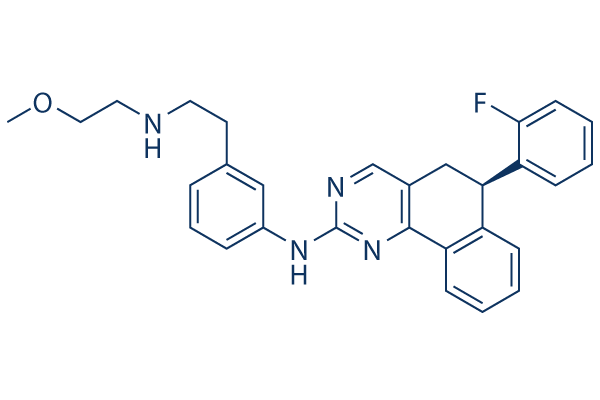
Derazantinib FGFR inhibitor
Cat.No.S8609
Quality Control
| Related Targets | EGFR VEGFR PDGFR c-Met Src MEK CSF-1R FLT3 HER2 c-Kit |
|---|---|
| Other FGFR Inhibitors | PD173074 AZD4547 (Fexagratinib) BLU9931 Futibatinib (TAS-120) LY2874455 H3B-6527 PD-166866 Fisogatinib (BLU-554) Zoligratinib (Debio-1347) SSR128129E |
Solubility
|
In vitro |
DMSO
: 93 mg/mL
(198.47 mM)
Water : Insoluble Ethanol : Insoluble |
Molarity Calculator
|
In vivo |
|||||
In vivo Formulation Calculator (Clear solution)
Step 1: Enter information below (Recommended: An additional animal making an allowance for loss during the experiment)
Step 2: Enter the in vivo formulation (This is only the calculator, not formulation. Please contact us first if there is no in vivo formulation at the solubility Section.)
Calculation results:
Working concentration: mg/ml;
Method for preparing DMSO master liquid: mg drug pre-dissolved in μL DMSO ( Master liquid concentration mg/mL, Please contact us first if the concentration exceeds the DMSO solubility of the batch of drug. )
Method for preparing in vivo formulation: Take μL DMSO master liquid, next addμL PEG300, mix and clarify, next addμL Tween 80, mix and clarify, next add μL ddH2O, mix and clarify.
Method for preparing in vivo formulation: Take μL DMSO master liquid, next add μL Corn oil, mix and clarify.
Note: 1. Please make sure the liquid is clear before adding the next solvent.
2. Be sure to add the solvent(s) in order. You must ensure that the solution obtained, in the previous addition, is a clear solution before proceeding to add the next solvent. Physical methods such
as vortex, ultrasound or hot water bath can be used to aid dissolving.
Chemical Information, Storage & Stability
| Molecular Weight | 468.57 | Formula | C29H29FN4O |
Storage (From the date of receipt) | 3 years -20°C powder |
|---|---|---|---|---|---|
| CAS No. | 1234356-69-4 | -- | Storage of Stock Solutions |
|
|
| Synonyms | ARQ-087 | SMILES | COCCNCCC1=CC(=CC=C1)NC2=NC=C3CC(C4=CC=CC=C4C3=N2)C5=CC=CC=C5F | ||
Read more about storage stability stock solution CAS number SMILES
Mechanism of Action
| Targets/IC50/Ki |
FGFR2
(Cell-free assay) 1.8 nM
RET
(Cell-free assay) 3 nM
DDR2
(Cell-free assay) 3.6 nM
PDGFRβ
(Cell-free assay) 4.1 nM
PDGFRβ
(Cell-free assay) 4.1 nM
FGFR1
(Cell-free assay) 4.5 nM
FGFR3
(Cell-free assay) 4.5 nM
KIT
(Cell-free assay) 8.2 nM
KIT
(Cell-free assay) 8.2 nM
PDGFRα
(Cell-free assay) 9.5 nM
VEGFR1
(Cell-free assay) 11 nM
Src
(Cell-free assay) 11 nM
Abl
(Cell-free assay) 14 nM
VEGFR2
(Cell-free assay) 21 nM
VEGFR3
(Cell-free assay) 31 nM
FGFR4
(Cell-free assay) 34 nM
|
|---|---|
| In vitro |
ARQ-087 has anti-proliferative activity in cell lines driven by FGFR dysregulation, including amplifications, fusions, and mutations. Cell cycle studies in cell lines with high levels of FGFR2 protein show a positive relationship between ARQ 087 induced G1 cell cycle arrest and subsequent induction of apoptosis. ARQ 087 inhibits the auto-phosphorylation of FGFR1 and FGFR2 in a dose-dependent manner. In Cos-1 cells overexpressing full-length FGFR1, FGFR2, FGFR3 and FGFR4, ARQ 087 inhibits their phosphorylation with EC50 values of < 0.123 μM, 0.185 μM, 0.463 μM, >10 μM respectively. ARQ 087 inhibits FGFR kinase by an ATP competitive mechanism, and is capable of inhibiting both the inactive and fully active forms of the FGFR kinase. Hence, ARQ 087 delays FGFR activation by inhibiting its autophosphorylation, as well as inhibition of the phosphorylated active kinase. |
| Kinase Assay |
Determination of Ki and mode of inhibition
|
|
Kinase inhibitory activity of ARQ 087 was determined for the recombinant FGFR1 or FGFR2 proteins utilizing a biotinylated PYK2 peptide substrate and ATP. ARQ 087 was titrated in DMSO utilizing a 3-fold dilution scheme, and then diluted 10-fold further in deionized water for a final DMSO concentration of 10%. A volume (2.5 μL) of these dilutions or vehicle was added to each well of a reaction plate. FGFR1 or FGFR2 was added to assay buffer (50 mM Tris, pH 8.0, 0.02 mg/mL BSA, 10 mM MgCl2, 1 mM EGTA, 10% glycerol, 0.1 mM Na3PO4, 1 mM DTT) to each well in a volume of 17.5 μL for a final concentration of 0.50 or 0.25 nM, respectively. After a 30-minute pre-incubation period, ATP and substrate were added in assay buffer (5 μL) for final concentrations of 0–1,000 μM ATP and 80 nM biotinylated-PYK2, for a final reaction volume of 25 μL. The plates were incubated for 60 minutes at room temperature, and then stopped in the dark by the addition of 10 μL stop/detection mixture prepared in assay buffer containing EDTA, AlphaScreen™ Streptavidin Donor and P-TYR-100 Acceptor beads for final concentrations of 10 mM EDTA and 500 ng/well of both AlphaScreen™ Donor and Acceptor beads. Assay plates were incubated for 60 minutes at room temperature in the dark, and the plates were read on a Perkin Elmer, Envision Multilabel plate reader. (excitation wavelength: 640 nm, emission wavelength: 570 nm). The effect of enzyme concentration was applied for tight-binding inhibitors, and if necessary, the IC50 values were converted into Ki values if the enzyme concentration was above the IC50 values under the assay conditions utilized.
|
|
| In vivo |
ARQ 087 attenuates FGFR signaling in SNU-16 human xenograft tumors, leading to a reduction in phospho-FGFR, phospho-FRS2-α, and phospho-ERK, while the total FGFR2 protein is unaffecte. ARQ 087 is effective at inhibiting tumor growth in vivo in FGFR2 altered, SNU-16 and NCI-H716, xenograft tumor models with gene amplifications and fusions. ARQ 087 demonstrated efficacy in multiple in vivo xenograft models, and was well tolerated at doses up to 75 mg/kg. |
References |
Clinical Trial Information
(data from https://clinicaltrials.gov, updated on 2025-12-05)
| NCT Number | Recruitment | Conditions | Sponsor/Collaborators | Start Date | Phases |
|---|---|---|---|---|---|
| NCT05174650 | ACTIVE_NOT_RECRUITING | Intrahepatic Cholangiocarcinoma |
Institut für Klinische Krebsforschung IKF GmbH at Krankenhaus Nordwest |
2022-04-20 | PHASE2 |
| NCT04604132 | TERMINATED | Gastric Adenocarcinoma |
Basilea Pharmaceutica |
2020-10-06 | PHASE1; PHASE2 |
| NCT03230318 | COMPLETED | Intrahepatic Cholangiocarcinoma; Combined Hepatocellular and Cholangiocarcinoma |
Basilea Pharmaceutica |
2017-09-28 | PHASE2 |
| NCT04045613 | COMPLETED | Urothelial Carcinoma |
Basilea Pharmaceutica |
2019-08-02 | PHASE1; PHASE2 |
| NCT04098692 | COMPLETED | Healthy Volunteers |
Basilea Pharmaceutica |
2019-08-08 | PHASE1 |
| NCT01752920 | COMPLETED | Solid Tumor |
Basilea Pharmaceutica |
2012-12-10 | PHASE1; PHASE2 |
Read more about Clinical Trials
Tech Support
Tel: +1-832-582-8158 Ext:3
If you have any other enquiries, please leave a message.
Signaling Pathway Map

Products are for research use only. Not for human use. We do not sell to patients.
©Copyright 2013 Selleck Chemicals. All Rights Reserved.