
-
 Argentina
-
 Australia
-
 Austria
-
 Belgium
-
 Brazil
-
 Canada
-
 China
China
-
 Czech Republic
-
 Denmark
-
 Finland
-
 France
-
 Germany
-
 Greece
-
 Hong Kong
-
 Hungary
-
 Iceland
-
 India
India
-
 Ireland
-
 Israel
-
 Italy
Italy
-
 Japan
Japan
-
 Korea
Korea
-
 Luxembourg
-
 Malaysia
-
 Netherlands
-
 New Zealand
-
 Norway
-
 Poland
-
 Portugal
-
 Qatar
Qatar
-
 Romania
-
 Saudi Arabia
-
 Singapore
-
 Spain
Spain
-
 Sweden
-
 Switzerland
-
 Taiwan
-
 Turkey
-
 United Kingdom
-
 United States
research use only
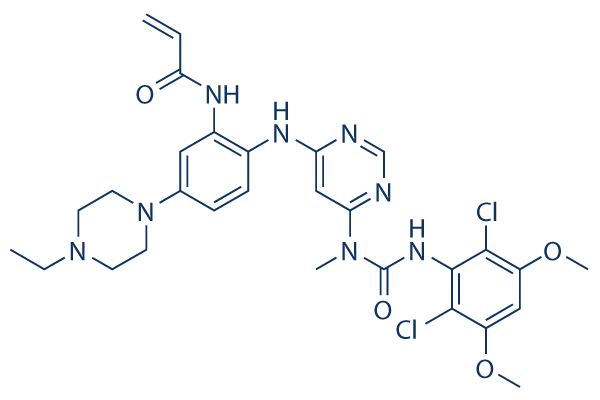
H3B-6527 FGFR inhibitor
Cat.No.S8675
Quality Control
| Related Targets | EGFR VEGFR PDGFR c-Met Src MEK CSF-1R FLT3 HER2 c-Kit |
|---|---|
| Other FGFR Inhibitors | PD173074 AZD4547 (Fexagratinib) BLU9931 Futibatinib (TAS-120) LY2874455 PD-166866 Fisogatinib (BLU-554) Zoligratinib (Debio-1347) SSR128129E Alofanib (RPT835) |
Solubility
|
In vitro |
DMSO
: 50 mg/mL
(79.42 mM)
Water : Insoluble Ethanol : Insoluble |
Molarity Calculator
|
In vivo |
|||||
In vivo Formulation Calculator (Clear solution)
Step 1: Enter information below (Recommended: An additional animal making an allowance for loss during the experiment)
Step 2: Enter the in vivo formulation (This is only the calculator, not formulation. Please contact us first if there is no in vivo formulation at the solubility Section.)
Calculation results:
Working concentration: mg/ml;
Method for preparing DMSO master liquid: mg drug pre-dissolved in μL DMSO ( Master liquid concentration mg/mL, Please contact us first if the concentration exceeds the DMSO solubility of the batch of drug. )
Method for preparing in vivo formulation: Take μL DMSO master liquid, next addμL PEG300, mix and clarify, next addμL Tween 80, mix and clarify, next add μL ddH2O, mix and clarify.
Method for preparing in vivo formulation: Take μL DMSO master liquid, next add μL Corn oil, mix and clarify.
Note: 1. Please make sure the liquid is clear before adding the next solvent.
2. Be sure to add the solvent(s) in order. You must ensure that the solution obtained, in the previous addition, is a clear solution before proceeding to add the next solvent. Physical methods such
as vortex, ultrasound or hot water bath can be used to aid dissolving.
Chemical Information, Storage & Stability
| Molecular Weight | 629.54 | Formula | C29H34Cl2N8O4 |
Storage (From the date of receipt) | |
|---|---|---|---|---|---|
| CAS No. | 1702259-66-2 | Download SDF | Storage of Stock Solutions |
|
|
| Synonyms | N/A | SMILES | CCN1CCN(CC1)C2=CC(=C(C=C2)NC3=CC(=NC=N3)N(C)C(=O)NC4=C(C(=CC(=C4Cl)OC)OC)Cl)NC(=O)C=C | ||
Read more about storage stability stock solution CAS number SMILES
Mechanism of Action
| Targets/IC50/Ki |
FGFR4
(Cell-free assay) <1.2 nM
|
|---|---|
| In vitro |
H3B-6527 shows robust inhibition of the target kinase FGFR4 with an IC50 value of <1.2 nmol/L and at least 250-fold selectivity over FGFR1-3 (IC50 values of 320, 1,290 and 1,060 nmol/L respectively). TAOK2, JNK2, and CSF1R are also less sensitive to this compound treatment with IC50 values of 690, >10,000, and >10,000 nmol/L, respectively. This chemical inhibits FGFR4 signaling, proliferation, and leads to apoptosis in a HCC cell line (Hepatocellular carcinoma). Treatment on Hep3B cells leads to robust activation of caspase-3/7, an apoptotic marker, in a concentration-dependent manner, indicating FGFR4 inhibition by this compound leads to cell death in HCC cell lines. It has the selectivity and the selective dependence on FGFR4 across cancer types. |
| In vivo |
In the Hep3B human HCC xenograft mouse model, H3B-6527 shows dose-proportional plasma exposures and greater than dose-proportional tumor exposures within the dose range evaluated (30, 100, and 300 mg/kg). The pharmacodynamic response of this compound as measured by CYP7A1 mRNA and pERK1/2 protein levels is dose dependent, with higher doses leading to sustained responses. Oral treatment of this chemical, twice daily, inhibits xenograft growth in a dose-dependent manner in nude mice, with the 300 or 100 mg/kg twice daily, significantly inhibiting tumor growth in both Hep3B subcutaneous and orthotopic xenograft model and causing tumor regressions in the subcutaneous xenograft model. |
References |
Clinical Trial Information
(data from https://clinicaltrials.gov, updated on 2023-11-13)
| NCT Number | Recruitment | Conditions | Sponsor/Collaborators | Start Date | Phases |
|---|---|---|---|---|---|
| NCT02834780 | COMPLETED | Advanced Hepatocellular Carcinoma; Hepatocellular Carcinoma; Liver Cancer; Liver Neoplasms; Hepatic Cancer; Hepatic Carcinoma |
H3 Biomedicine Inc. |
2016-12-28 | PHASE1 |
| NCT03424577 | COMPLETED | Healthy Participants |
Eisai Inc. |
2017-12-27 | PHASE1 |
| NCT03424577 | Completed | Healthy Participants |
Eisai Inc.|H3 Biomedicine Inc. |
2017-12-27 | Phase 1 |
| NCT02834780 | Completed | Advanced Hepatocellular Carcinoma|Hepatocellular Carcinoma|Liver Cancer|Liver Neoplasms|Hepatic Cancer|Hepatic Carcinoma |
H3 Biomedicine Inc.|Eisai Inc. |
2016-12-28 | Phase 1 |
Read more about Clinical Trials
Tech Support
Tel: +1-832-582-8158 Ext:3
If you have any other enquiries, please leave a message.
Signaling Pathway Map

Products are for research use only. Not for human use. We do not sell to patients.
©Copyright 2013 Selleck Chemicals. All Rights Reserved.